
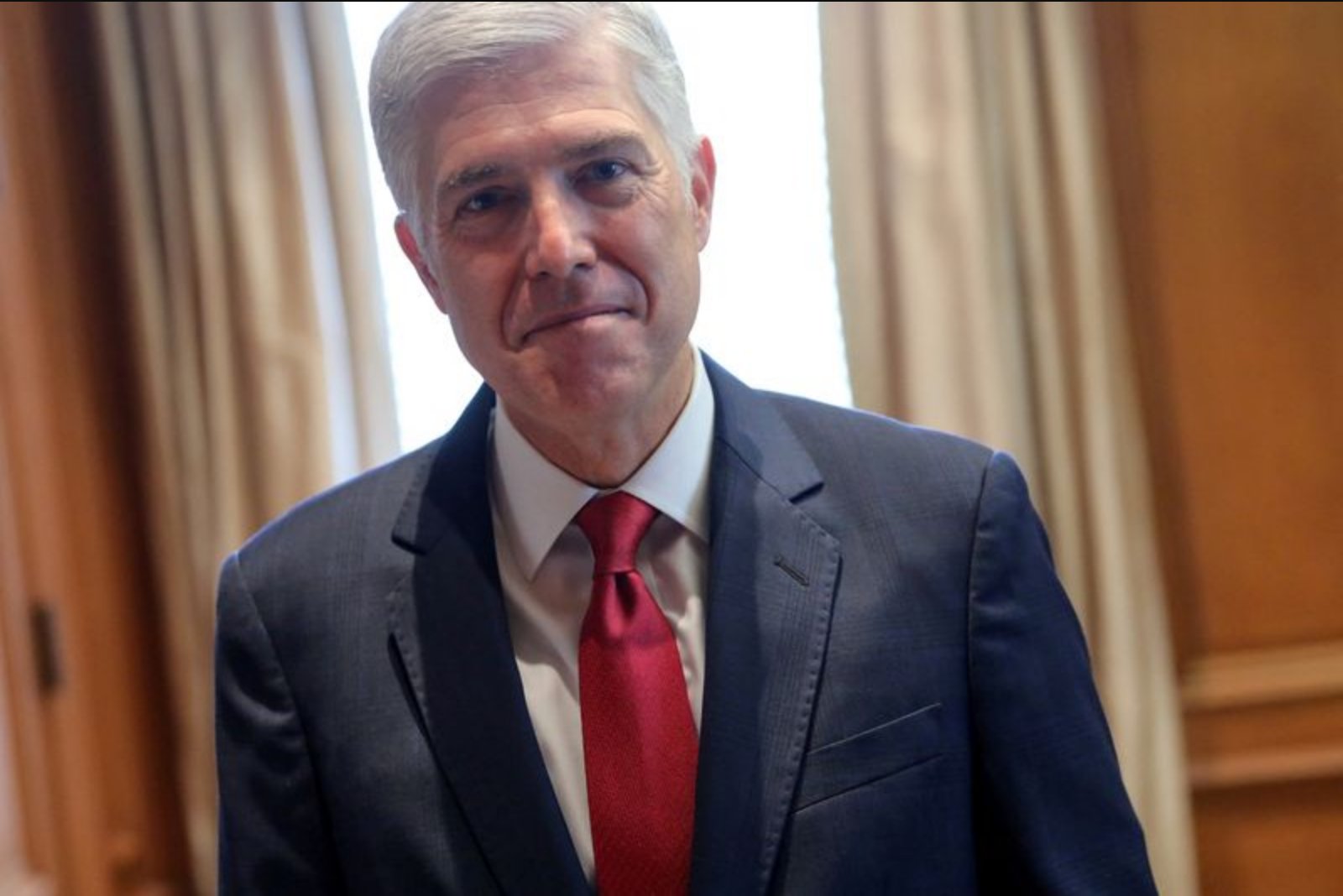
U.S. Supreme Court Justice Neil Gorsuch on Sunday raised concerns about the steady stream of disclosures of the court's internal deliberations, stressing that the nine justices must retain private space for frank discussion and negotiation.
Gorsuch, who sits with the court's 6-3 conservative majority, made the comments on the "Fox News Sunday" program after reporting last month that the New York Times had published leaked memos linked to a 2016 Supreme Court action that blocked Democratic President Barack Obama’s Clean Power Plan. The memos were among several recent unauthorized disclosures involving the court.
"We want some transparency, but we also have to leave room for candid conversations and deliberations with one another," Gorsuch said on the program. He pointed to the live audio feed of the court's oral arguments as an example of public access to proceedings, while arguing that justices nonetheless require private time to confer and to locate potential common ground.
"But do we need time to actually talk quietly with one another, to find those places where we can reach agreement? Yeah, we do," he added.
The issue of leaks has intersected with broader debate over the court's increased use of its emergency docket - often referred to as the shadow docket. The court has used that procedure more frequently in recent years, issuing rulings that have at times granted significant short-term relief to the Trump administration. Those emergency decisions have enabled the administration to pursue assertive and, in some cases, novel exercises of executive authority while related legal challenges played out in lower courts.
The New York Times' recently published memos concerned the court's exercise of emergency docket authority in 2016 related to the Clean Power Plan. Separately, the most prominent prior leak cited by observers occurred in 2022, when Politico published a draft of the court's decision overturning the 1973 Roe v. Wade ruling that had legalized abortion nationwide, weeks before the formal opinion was released.
Asked whether leaks affect the court's role or the public's confidence in it, Gorsuch stressed that the public has access to the court's arguments and opinions. "Everything that I think about a case is there, on the printed page for anybody to read if they so choose," he said.
That public access, however, exists alongside a pattern in which emergency decisions are often issued quickly and sometimes with little or no detailed explanation of the court's reasoning, a practice that critics say can leave parties and observers without guidance while disputes continue in lower courts.
Gorsuch made his remarks while promoting a new children's book he authored, "Heroes of 1776: The Story of the Declaration of Independence," which the article noted goes on sale on Tuesday and coincides with U.S. celebrations of the 250th anniversary of independence in July.
The piece also noted recent jurisprudential shifts: Gorsuch joined his fellow conservative justices last week in a decision that significantly limited a key provision of the Voting Rights Act, altering the ability of minority groups to challenge electoral maps as racially discriminatory under that statute.
Key points
- Justice Neil Gorsuch publicly cautioned that unauthorized leaks threaten the private deliberations justices need to reach agreement; sectors affected include the legal community and institutions that rely on the court's stability.
- The New York Times' publication of leaked memos tied to a 2016 Clean Power Plan action is the latest in a series of disclosures, following the 2022 Politico leak of a draft opinion overturning Roe v. Wade; this has implications for energy policy litigation and election law challenges.
- The court's increased reliance on its emergency - or shadow - docket, which issues rapid decisions often with limited reasoning, remains a flashpoint for those tracking judicial process and regulatory certainty.
Risks and uncertainties
- Continued leaks could further complicate candid internal deliberations among justices, potentially affecting the court's ability to craft consensus - a concern for legal practitioners and institutions that depend on predictable judicial decision-making.
- The shadow docket's frequent use and its sometimes sparse explanations introduce uncertainty for regulated industries and parties awaiting fuller rulings in lower courts, notably in areas like energy regulation and election law.
- Public confidence in the court may be affected by both leaks and opaque emergency rulings, though the court maintains that written opinions and oral argument recordings are available for public review.