
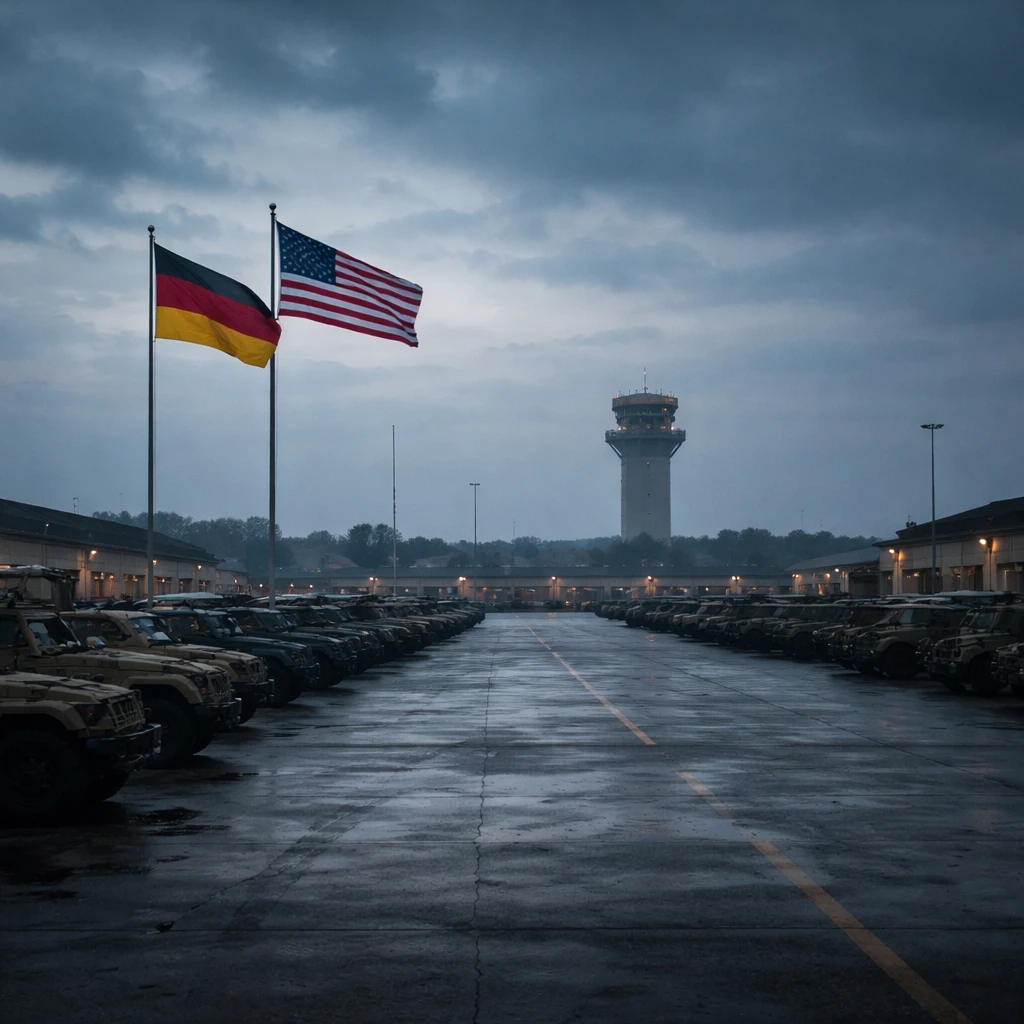
President Donald Trump told reporters on Saturday, as he boarded Air Force One, that he plans to reduce the U.S. military presence in Germany by significantly more than the initially planned removal of 5,000 troops. He added, "We're going to cut way down," but did not provide a specific timeline or a final figure for the drawdown.
The comment follows growing friction between the White House and European partners linked to disagreements over allied support for U.S. military operations aimed at Iran and efforts to reopen the Strait of Hormuz. The broader pattern of disagreement has widened into a set of policy tensions that now include both security and trade instruments.
The announcement drew swift criticism from NATO officials and senior Republican lawmakers. Senate Armed Services Committee Chair Roger Wicker and House Armed Services Committee Chair Mike Rogers issued a rare joint rebuke, saying the United States benefits from maintaining a "strong deterrent in Europe" and suggesting U.S. forces should be moved eastward within the alliance footprint instead of being withdrawn entirely.
Concurrently, the administration announced an increase in tariffs on European Union cars and trucks to 25%, a step likely to have a concentrated effect on Germany's export-focused industrial regions. German Chancellor Friedrich Merz, who has publicly criticized the administration's approach to the Iran situation, now confronts simultaneous pressures on security cooperation and the country's key automotive sector.
The Pentagon expects the initial 5,000-troop withdrawal to be completed within six to 12 months, but officials face legal and legislative obstacles. A prior effort to cut the roughly 35,000-strong U.S. contingent stationed in Germany was blocked by Congress in 2020, and the current order is anticipated to encounter a comparable contest on Capitol Hill.
Polish Prime Minister Donald Tusk warned that the NATO framework "risks disintegrating" amid the current uncertainty, highlighting concern among allies that the alliance's cohesion could be undermined by both force posture changes and trade disputes.
Clear summary
- President Trump signaled a much deeper U.S. troop reduction in Germany than the earlier 5,000-troop plan, without specifying timing or final numbers.
- The announcement compounds growing tensions with European allies over perceived shortcomings in support for U.S. operations related to Iran and coincides with a 25% tariff on EU cars and trucks.
- Senior U.S. lawmakers and NATO officials urged preserving a strong deterrent in Europe and suggested repositioning forces eastward rather than a broad withdrawal.
Key points
- Security posture: The president's statement increases uncertainty about the scale and pace of U.S. force reductions in Germany and raises questions about NATO's deterrence posture.
- Trade impact: A 25% tariff on EU autos and trucks is expected to particularly affect Germany's industrial and export sectors.
- Political resistance: The Pentagon's projected six- to 12-month window for the initial 5,000-troop move faces likely legal and legislative challenges, referencing a prior 2020 congressional block of a similar reduction.
Risks and uncertainties
- Alliance cohesion - NATO and European partners may see the combined security and trade measures as creating instability within the trans-Atlantic framework, a concern explicitly voiced by Poland's prime minister.
- Legislative pushback - The proposed drawdown faces probable obstacles in Congress, given that a comparable move in 2020 was blocked and this order is expected to encounter similar challenges.
- Economic exposure - Germany's industrial heartland, reliant on auto exports, could face meaningful pressure from the 25% tariff on cars and trucks, heightening domestic economic and political stress.
At present, specific details about the final scope, timing and legal pathway for a deeper troop reduction remain undefined. The combination of announced force posture changes and trade measures has already prompted public rebukes from influential lawmakers and alarm from allies, leaving the trans-Atlantic relationship at an uncertain juncture.