
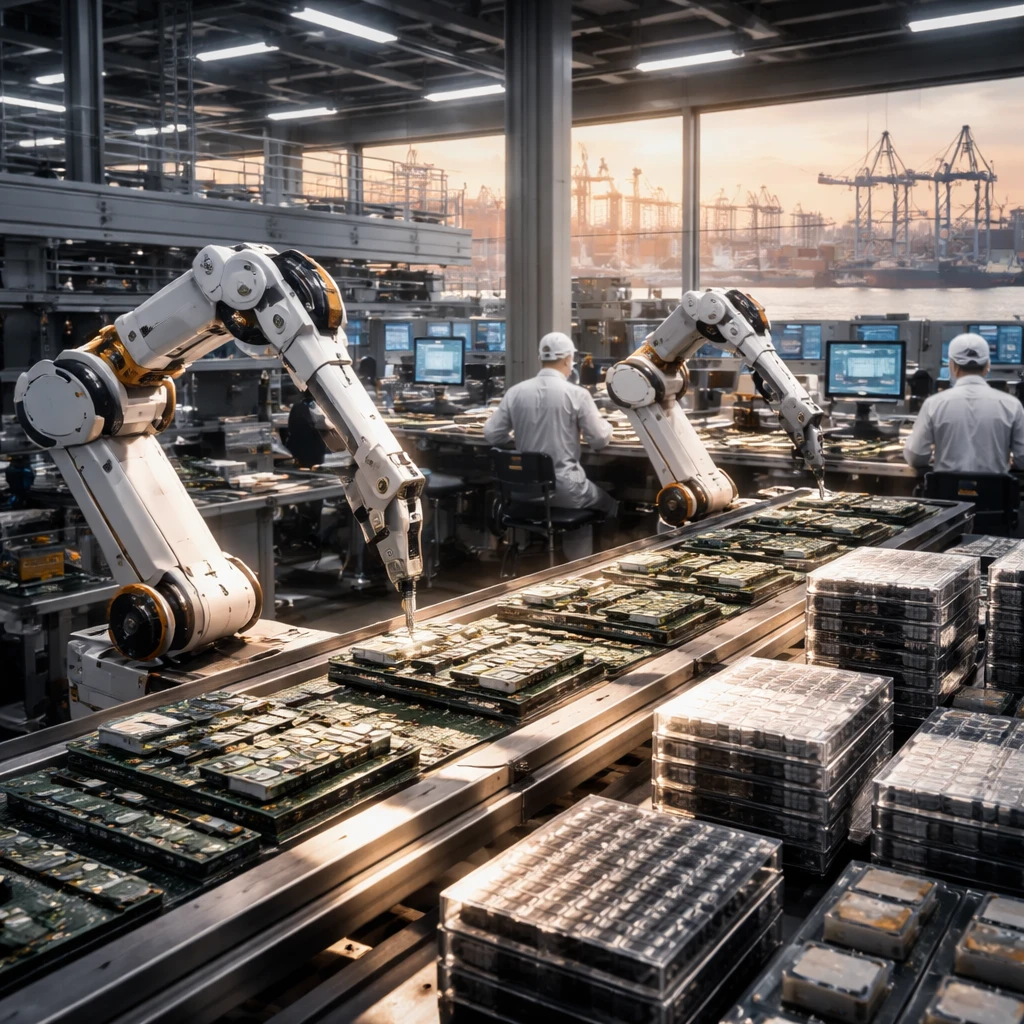
Nvidia Corp.'s deliberate broadening from core semiconductors into what CEO Jensen Huang has described as the next major wave of artificial intelligence - labelled "physical AI" - has spurred a notable rally among its Asian partners as the region becomes more central to the chipmaker's production chain.
According to reporting, Asian suppliers now absorb about 90% of Nvidia's production costs, a substantial rise from roughly 65% in the prior year. That shift reflects a movement beyond pure chip fabrication toward robotics, autonomous platforms and AI-enabled manufacturing systems that integrate hardware and software in real-world applications.
The market's response has been immediate. Several regional companies posted double-digit share gains after announcements of collaboration with Nvidia. South Korea's LG Electronics recorded intraday gains up to 15% on coverage that it would integrate home robots with Nvidia's platform. Taiwan's Nanya Technology saw its stock climb about 10% following news of partnership. In China, Huizhou Desay SV Automotive and Pateo Connect Technology Shanghai experienced sharp share increases after revealing intelligent driving solutions and tie-ups with the U.S. chip designer.
Underlying the equity moves is heightened capital expenditure by U.S. hyperscalers. Amazon, Microsoft and Alphabet are each committing nearly $200 billion in AI-related spending this year, and Bloomberg data cited in reporting shows Nvidia accounts for nearly half of Microsoft's capex and roughly a quarter of Amazon's. Those proportions create a pronounced pass-through for equipment makers and component vendors in North Asia, including contract manufacturers such as Hon Hai and memory producers like SK Hynix.
Analysts tracking the trend say that the widening base of demand allows more hardware suppliers to participate in the ecosystem, a dynamic that supports continued outperformance among tech-heavy North Asian markets. The expansion in demand is already visible in corporate results: Samsung's semiconductor division reported a 48-fold jump in profit, while SK Hynix posted quarterly earnings that were approximately five times higher than previously.
Industry observers note that as the AI buildout progresses from concentrated digital compute toward deployments in physical environments, Asia's entrenched capabilities in advanced hardware and robotics constitute an operational advantage for rolling out the physical AI wave. That existing industrial infrastructure is cited as a structural factor in the region's increasing role in Nvidia's supply chain.
Summary
Nvidia's expansion into physical AI is accelerating demand for a broader set of hardware and systems, pushing Asian suppliers to the forefront of its production costs and prompting sizable stock rallies among partners.
Key points
- Asian suppliers now represent about 90% of Nvidia's production costs, up from roughly 65% last year - impacting semiconductor, robotics and contract manufacturing sectors.
- Several regional partners experienced double-digit share gains after collaboration announcements, including LG Electronics (up as much as 15%) and Nanya Technology (up about 10%).
- Heavy AI capex from U.S. hyperscalers - nearly $200 billion each from Amazon, Microsoft and Alphabet - channels demand to North Asian hardware and memory suppliers.
Risks and uncertainties
- Concentration risk - a large share of production costs tied to Asian suppliers could expose global customers and markets to regional supply-chain disruptions; this affects manufacturers and logistics providers.
- Market sensitivity - share prices of partner firms have shown pronounced moves on collaboration news, indicating potential volatility in technology and semiconductor equities.
- Dependency on hyperscaler capex - a significant portion of Nvidia-related demand is linked to major cloud providers' spending levels, which could influence contract manufacturers and memory suppliers if those commitments change.