
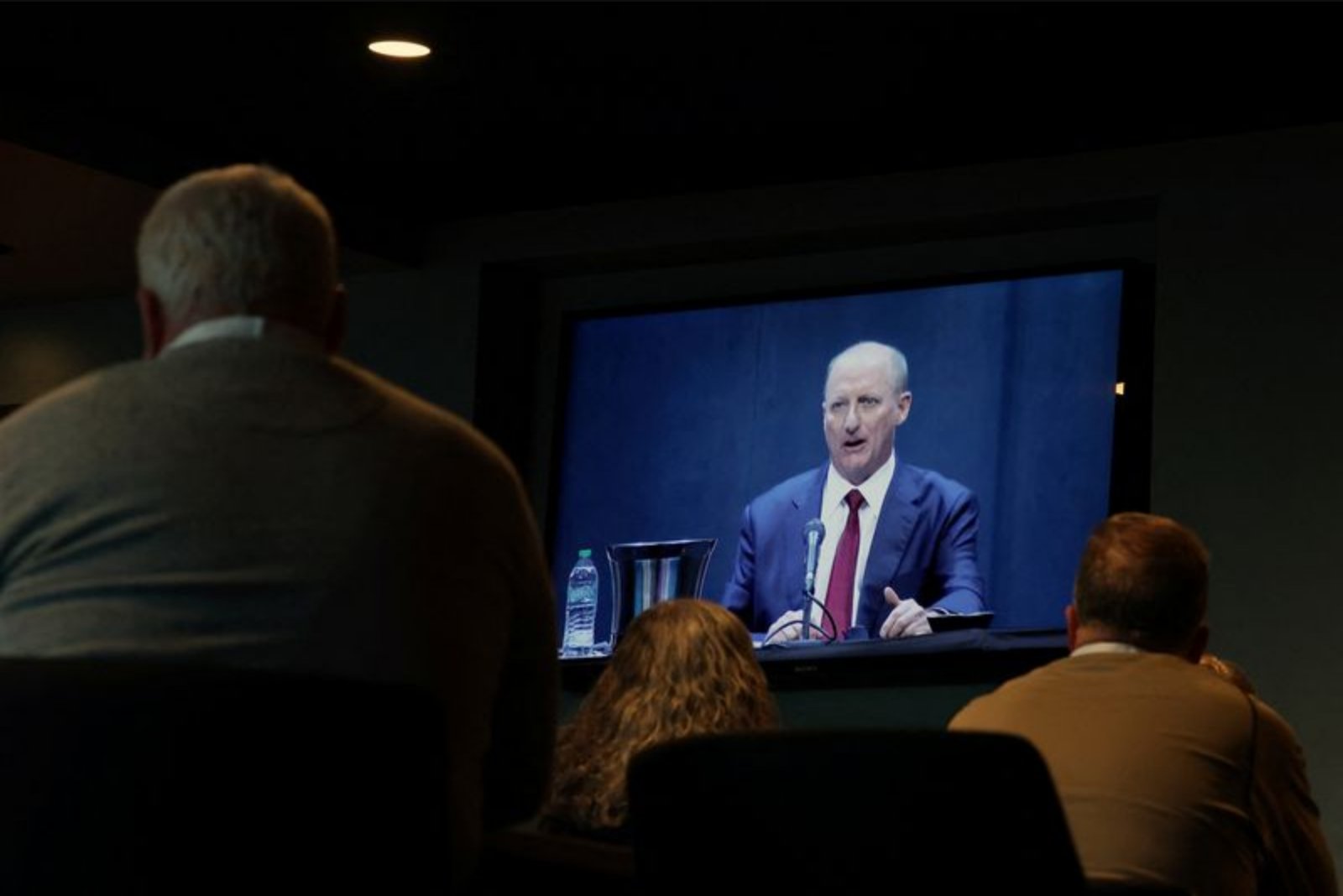
Greg Abel has won visible approval from many Berkshire Hathaway shareholders for his knowledge of the company’s businesses and his stewardship as chief executive. But at the firm’s annual shareholder weekend in Omaha - the first since Abel replaced Warren Buffett in January - organizers and some attendees noted a different tone and thinner attendance compared with the gatherings that defined Buffett and his late longtime partner Charlie Munger.
The meeting took place in a downtown arena where Abel presided without Buffett on stage. The 95-year-old billionaire observed from the audience and addressed shareholders briefly. While shareholders told reporters they left with respect for Abel’s grasp of Berkshire’s sprawling operations - which include insurance, railroads, energy, manufacturing and retail - many also said the event lacked the unique draw generated by Buffett and Munger in prior decades, when the two men often spoke at length and framed their presentations as lessons.
"I was a little bit disappointed," said Xiao Zhang, a private investor from Boston. "In previous years, Warren Buffett and Charlie Munger sat on the stage, sharing their investing experiences and also life experiences and philosophies. This year, I didn't hear something like that."
Other shareholders emphasized that Buffett and Munger set a cultural foundation that Abel respects and appears prepared to maintain. "They built something to outlast them," said John Wichita, a utility systems analyst from Omaha. "And I think it will. And the ideas they presented are much more powerful than their physical presence, in a way."
Attendance and retail signals
On the retail and attendance side, the atmosphere was noticeably different. At the annual shareholder shopping event in an exhibit hall adjacent to the arena - where Berkshire-owned businesses display products and merchandise - customer lines were shorter and some items remained unsold.
A staffer, calling out near a Geico display, shouted: "Picture with the Gecko! There's no line!" By late Saturday, Reuters reporters observed hundreds of unsold boxes of Berkshire commemorative See's chocolates, leftover Dairy Queen ice cream bars, and an ample stock of Fechheimer Brothers T-shirts featuring images of Buffett and Abel that resembled Andy Warhol prints. In prior years, similar items either sold better or sold out.
The main event hall also appeared less full than when Buffett was the primary draw. A Reuters reporter and photographer estimated the arena has approximately 18,000 seats and that about 12,000 were occupied when Abel began this year’s meeting. Lines to enter before the arena’s 7 a.m. opening were generally shorter, though some attendees still arrived early to secure seating.
Shareholder impressions
Those who attended the meeting expressed mixed reactions about the shift in emphasis and tone under Abel. Some felt reassured by his operational focus and keen familiarity with Berkshire’s diverse businesses.
"I've watched it online, but flying here and communicating with people face to face is a better way to learn the meaning of value investing," said Chandler Thien, a freelance writer from Beijing. "It was worth it to pay money for this trip." Alexandra Cook, an accounting and finance professor at Palm Beach Atlantic University in Florida who attended with four students, said: "Greg did a good job. He had a job to do to reassure shareholders, and he did that. It was clear he knew the operations intimately, and it wasn't just Warren's opinion that that was the case."
Other attendees said the weekend felt different in substance. "Most people are here for investing knowledge and life philosophies. It was one of the reasons I was drawn to Berkshire," said Sophia Deng, who runs an artificial intelligence startup in San Francisco. "With Greg Abel, the emphasis was very, very different. It (became) more of an operational excellence conference, and it's not what I'm interested in as much." Deng added she plans to keep her Berkshire shares but will not buy more.
Context and longer-term views
Some shareholders suggested practical reasons for lighter attendance, including travel costs and hesitancy to travel to the United States from abroad. Others saw continuity and stability as reasons to value Berkshire as a haven amid wider market uncertainty, and welcomed Abel’s focus on the company’s future.
"In light of everything that's going on in the world, there doesn't seem to be a lot of hope and positivity," said Julie Vargas, a healthcare logistics manager from Omaha. "Having someone tell us what's going to possibly happen and where we can look forward is a positive step in the right direction." Cindy Chin, CEO and chief space officer of Planetary Systems AI, framed Berkshire's continuity as central to its appeal: "We have a lot of volatility in geopolitics, but Berkshire's investing philosophy has always been staying true to value investors and shareholders, and I don't think that's going to change," she said. "This is Warren and Charlie's legacy, and being here is still someplace special."
Abel, 63, has indicated an intention to lead Berkshire for an extended period, perhaps decades. He enjoys shareholders' respect for his knowledge and leadership, but some attendees questioned whether that will be enough for the company to preserve the singular character of the annual meeting and its appeal to long-time followers.
"The throngs of shareholders may abandon the meeting with the lack of the unique homespun feel of Warren's wit," said Richard Callahan, a retail banker at BMO in Omaha. "Abel may grow into it. But he's no Warren Buffett."
Takeaway
Greg Abel's first annual meeting at the helm of Berkshire Hathaway underscored both continuity and change. Shareholders praised his operational command and reassurances about the company's future, while lower attendance and softer merchandise sales suggested that the charismatic stage presence of Warren Buffett - and the educational tone set by Buffett and Charlie Munger in prior decades - remains a distinct part of Berkshire's public identity. Abel appears to have the respect of many owners, but the early signs from this shareholder weekend indicate that translating that respect into the same broad public draw will take time.