
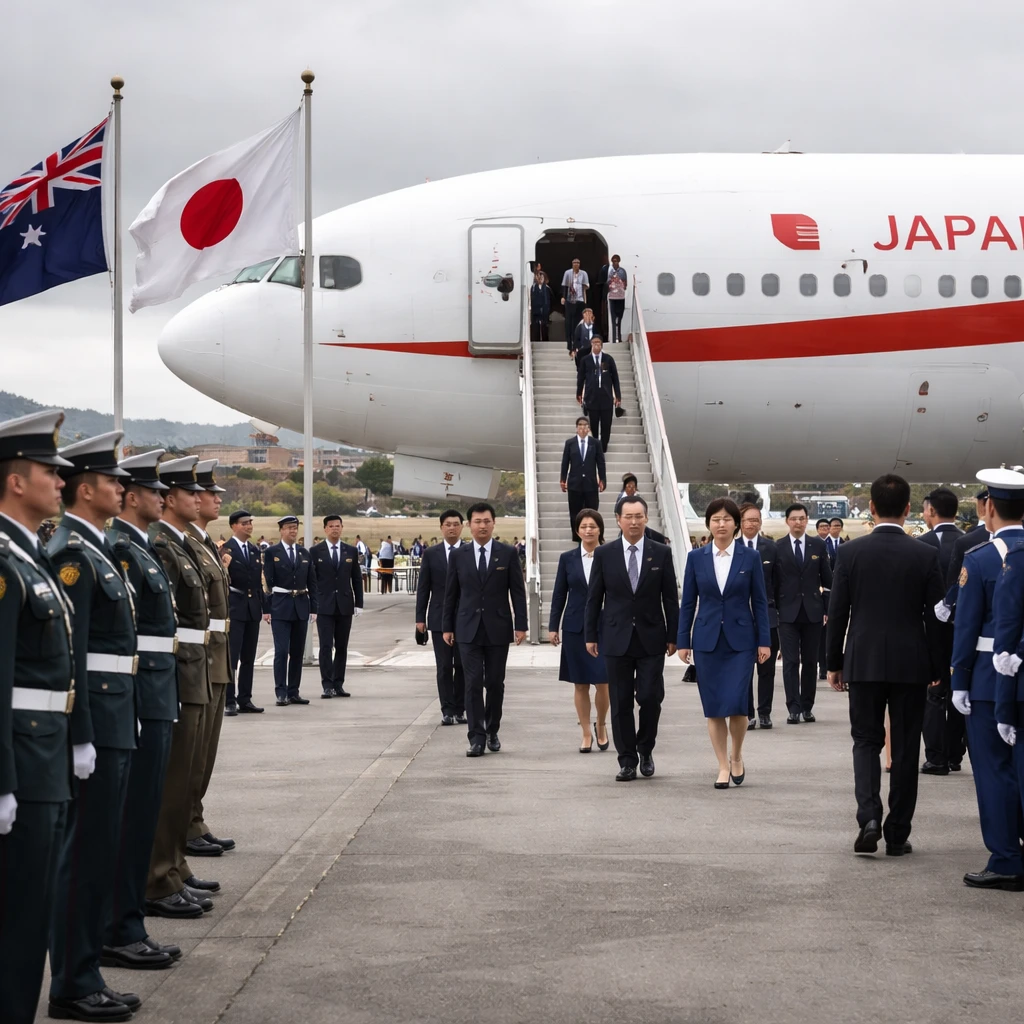
Japanese Prime Minister Sanae Takaichi is due in Canberra late Sunday for a three-day state visit focusing on bolstering ties with Australia. The itinerary follows an updated regional strategy the prime minister set out during a stop in Vietnam, with particular emphasis on defense collaboration, access to critical minerals, and wider questions of economic security.
Leaders in both capitals have signaled rising concern about changes in the strategic and economic landscape across the Asia-Pacific. With the United States allocating attention to other global priorities and China increasing its regional influence, Tokyo and Canberra have moved toward closer military cooperation and deeper technology sharing.
Defense cooperation and military integration
A focal point of the relationship is Australia's agreement to purchase Japanese naval vessels, a deal worth multiple billions of dollars that Japanese officials view as a potential springboard for future defense exports to partners such as India and New Zealand. The transaction is being framed as a cornerstone for expanded defense industrial ties.
Japanese Defense Minister Shinjiro Koizumi has described the regional security environment as "increasingly severe," and he has indicated that collaboration will extend beyond frigates to include unmanned systems, cyber capabilities, space-related cooperation, and joint production of defense equipment.
Further underlining the shift in military posture, Koizumi is scheduled to observe exercises in the Philippines this week. In those drills, 1,400 Japanese troops will take part in combat training for the first time since World War II. The exercises, conducted alongside Australian and U.S. forces in the South China Sea, will feature the Japanese navy firing missiles in a ship-sinking exercise. Observers note that conducting such maneuvers near disputed waters sends a clear signal to Beijing about the prioritization of regional stability.
Economic security and supply chain resilience
Beyond defense, the visit highlights an expanding economic relationship in which Japanese companies now rank as the second-largest source of foreign investment in Australia. Traditional energy projects, including Inpex Corp.'s liquefied natural gas hub, remain important components of bilateral investment flows, but the current strategic focus has shifted markedly toward minerals deemed critical for advanced technologies.
Japan is seeking to secure reliable supplies of rare earths and gallium to reduce a long-standing dependence on China for those inputs. The urgency of diversifying supply chains has been amplified by recent steps from Beijing, which has curtailed shipments of rare earths to Japanese firms amid a deterioration in diplomatic ties. That action follows a pattern in which punitive trade measures have been used in recent years, including tariffs previously imposed on Australian exports during the pandemic period.
To address these vulnerabilities, Tokyo and Canberra are expected to formalize agreements that prioritize six specific commodity projects. Those projects, which include nickel and rare earths, are intended to strengthen mutual economic security and provide more resilient supply chains for critical industrial inputs.
The visit is being framed by officials as a dual-track effort: deepen defense interoperability while simultaneously reducing economic exposure to single-source suppliers of commodities vital to advanced manufacturing and security-related technologies. Details on the specific projects and the timeline for implementation are to be confirmed as the meetings proceed.