
Hezbollah’s foray into open hostilities on March 2 has produced steep consequences for the group and for parts of Lebanon. Portions of southern Lebanon are now under Israeli occupation, hundreds of thousands of Shi’ite residents have been displaced, and internal estimates from within Hezbollah point to substantial losses among its fighters. At the same time, the political fallout inside Lebanon has deepened divisions over the group’s role as an armed actor and prompted the government to pursue direct engagement with Israel - a move Hezbollah firmly opposed.
The current escalation began after U.S. and Israeli strikes on Iran on February 28. Hezbollah opened fire two days later, on March 2, entering the conflict in a manner its leaders argued was necessary to respond to repeated Israeli attacks on its members. More than a dozen Hezbollah officials told interlocutors they view participation in the wider confrontation as a chance to reverse what they see as a deteriorating strategic position by aligning with Tehran in its contest with Israel and the United States.
Those within the group contend that active engagement will compel negotiators in any U.S.-Iran dialogue to put Lebanon on the table, and that Iranian leverage could secure a more substantial ceasefire than the truce that came into effect in November 2024. That earlier ceasefire followed a conflict set off by the Gaza war and, by Hezbollah’s account, left the group weakened.
Casualties, graves and displacement
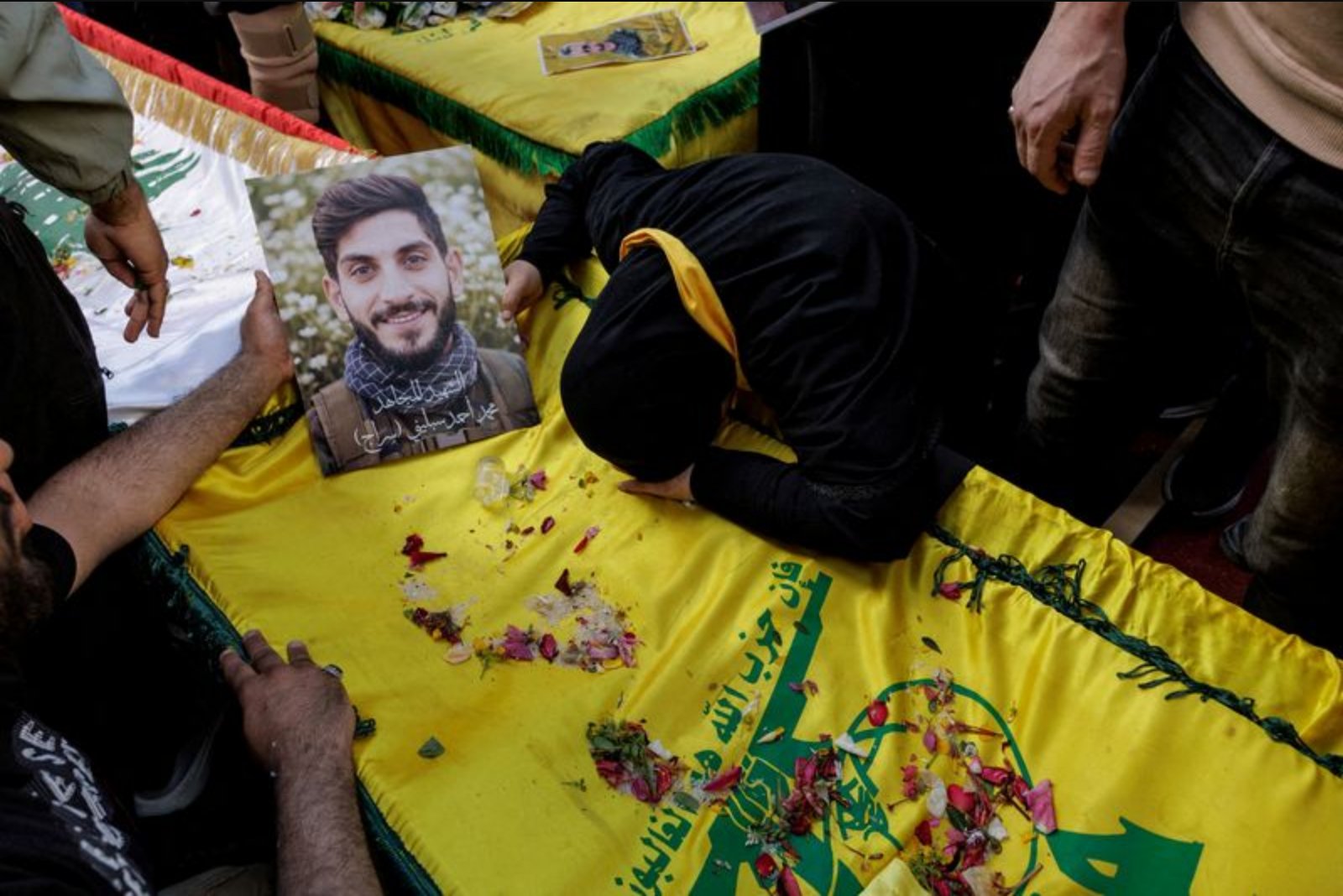
Lebanon’s health ministry reports that more than 2,600 people have been killed since March 2; it says roughly one-fifth of those killed were women, children and medics. The ministry’s tally does not distinguish between civilians and combatants. Several sources, including two Hezbollah officials, told contacts that the ministry figures omit many of the group’s own combatant casualties; those sources estimated that several thousand Hezbollah fighters have been killed, although they also acknowledged the group lacks a complete accounting.
Hezbollah’s media office said the figure of several thousand was inaccurate, while also stating that the organization does not yet possess a full tally and referring inquiries to the health ministry figures. One Hezbollah commander said that scores of fighters who traveled to frontline towns such as Bint Jbeil and Khiyam had intended to fight to the death and that some of their bodies have not been recovered.
In Hezbollah-controlled southern suburbs of Beirut, residents and local officials described a wave of burials in the days after a U.S.-mediated ceasefire took effect on April 16. More than two dozen freshly dug graves were filled quickly, with simple marble tombstones identifying some as commanders and others as fighters. In the village of Yater, the local council recorded the deaths of 34 fighters associated with the group.
The human cost extends beyond fighters. Lebanon’s Shi’ite Muslim population has borne the brunt of Israel’s strikes, with many families fleeing into Christian, Druze and other communities. Numerous displaced residents blame Hezbollah’s decision to enter the fighting for drawing Israeli retaliation onto their neighborhoods.
Battlefield dynamics and Israeli posture
On the ground, Israel has expanded a self-declared security zone that now reaches up to about 10 km (6 miles) into Lebanese territory, a move accompanied by village demolitions. Israeli officials say the operations aim to protect northern Israel from attacks by militants they allege operate from within civilian areas in Lebanon.
An Israeli government official asserted that Hezbollah abandoned the November 2024 ceasefire by firing on Israeli citizens on March 2. The same official maintained that the threat to northern Israel would be eradicated, that thousands of Hezbollah militants had been killed, and that Israel was methodically degrading the group’s military infrastructure.
From its side, the Israeli military reports that Hezbollah has launched hundreds of rockets and drones into Israeli territory since March 2. Israel has also reported its own losses: 17 soldiers killed in southern Lebanon and two civilians killed in northern Israel.
Although a U.S.-brokered pause in major combat took effect on April 16 and produced a marked reduction in large-scale exchanges, both sides have continued to trade strikes in southern Lebanon. Israel maintains forces inside what it describes as a buffer zone there, and Hezbollah has described continuing strikes by Israel as rendering the ceasefire effectively meaningless, prompting it to persist with attacks in some sectors.
Political repercussions inside Lebanon
Hezbollah’s military engagement has intensified domestic opposition to the group’s armed status. Rivals at the national level argue that maintaining an independent military capability exposes Lebanon to recurrent wars with Israel and constrains the state’s sovereignty. In April, Lebanon’s government conducted face-to-face talks with Israel - the first such direct engagement in decades - a step that Hezbollah opposed vocally.
President Joseph Aoun and Prime Minister Nawaf Salam, officials said, have sought the group’s peaceful disarmament since last year. On March 2, the Lebanese government took the step of banning Hezbollah’s military activities. The group has demanded that the government rescind that decision and halt the direct negotiations with Israel, arguing that disarmament is a matter for national dialogue rather than unilateral measures.
Lebanese officials told interlocutors they believe direct talks with Israel under U.S. auspices represent the most realistic path to a lasting ceasefire and the eventual withdrawal of Israeli troops, since Washington is seen as having leverage with Israel that other parties lack.
Tehran’s role and diplomatic calculations
Hezbollah was founded in 1982 by Iran’s Islamic Revolutionary Guard Corps, and several officials within the organization now see closer alignment with Tehran as a route to reversing recent setbacks. The group has been rearmed and has adopted new tactics, including the increased use of drones, which surprised observers after a fragile 15-month truce during which Hezbollah refrained from firing even as Israel continued to target members.
More than a dozen Hezbollah officials indicated they view participation alongside Iran as a way to ensure Lebanon is factored into broader U.S.-Iran negotiations, on the theory that Iranian pressure could yield stronger terms to halt Israeli operations in Lebanon than previous arrangements provided.
A diplomat familiar with Hezbollah described the decision to enter the war as "a big gamble and a survival strategy," saying the group felt it needed to be "part of the problem so it could be part of an eventual regional solution." It remains uncertain whether that gamble will secure the gains Hezbollah expects.
Tehran has demanded that any settlement on the wider conflict include attention to Israel’s campaign against Hezbollah. Yet, officials quoted said that the United States may seek a deal with Iran that does not make Lebanon a condition of settlement. A Western official noted the possibility that the U.S. and Iran might reach an agreement that leaves the situation in Lebanon unaddressed. Pakistan’s Foreign Ministry spokesperson Tahir Andrabi, referring to a statement on April 16, emphasized that peace in Lebanon is essential to the talks Pakistan is mediating between the United States and Iran.
Asked about Washington’s position, U.S. and other international offices did not immediately comment to inquiries. Hezbollah’s own lawmaker, Ibrahim al-Moussawi, said the group did not act as Iran’s proxy in resuming hostilities and framed its intervention as an opportunity to "break this vicious cycle ... where the Israelis can target, assassinate, bombard, kill, without any revenge." He acknowledged the losses and damage in southern Lebanon but insisted that "you don’t go into making calculations of how many are going to be killed" when "pride and sovereignty and independence" are at stake.
Moussawi also asserted that a ceasefire in Lebanon remains a top priority for Iran and said Tehran "shares Lebanon’s objectives, including that Israel halt attacks and withdraw from Lebanon." He added that Hezbollah had "full trust in Iran - that the Iranians will not sell their own friends."
International responses and statements
U.S. officials have publicly urged proportionality. In an interview cited by U.S. officials from April 27, Secretary of State Marco Rubio said Israel had a right to defend itself against Hezbollah’s attacks and that he did not think Israel wanted to maintain its buffer zone in Lebanon indefinitely. He added that the United States had urged Israel "to make sure their responses are proportional and targeted."
Israel’s prime minister, announcing the ceasefire on April 16, made disarmament of Hezbollah a central demand for any future peace dialogue with Lebanon. Hezbollah has rejected outright the premise of disarmament by force, arguing such a move could ignite conflict in a country still scarred by the civil war of 1975 to 1990.
Outlook and unresolved questions
The balance of gains and losses for Hezbollah remains contested and fluid. The group’s own commanders and officials report heavy fighter deaths and widespread displacement of its community base. Those developments have weakened, at least politically, Hezbollah’s dominant position inside Lebanon. Yet officials within the organization maintain that aligning with Tehran and pressing to make Lebanon a live issue in U.S.-Iran diplomacy could yield improved terms on a ceasefire and alleviate the immediate military pressure.
Analysts and diplomats interviewed cautioned that absent a comprehensive U.S.-Iran deal that explicitly addresses the campaign in Lebanon, the fighting is likely to inflict continuing pain on both sides and on Lebanese civilians. As one observer put it, "The only thing that will contain Israel is a comprehensive U.S.-Iran deal. Without a deal, there’s going to be a lot of pain for everyone. At best, a hurting stalemate."
For now, the ceasefire has reduced large-scale exchanges but not ended targeted strikes and counterstrikes. The situation on the ground - occupation of parts of southern Lebanon, the newly entrenched buffer zone, and ongoing demolitions - leaves many core questions unresolved about the future of Hezbollah’s weapons, the trajectory of internal Lebanese politics, and whether international negotiations will bind the parties to a durable settlement that secures both withdrawal of Israeli forces and limits further militant action.
Summary
Hezbollah’s decision to engage Israeli forces on March 2 has resulted in significant military and political costs: disputed but substantial fighter casualties, large-scale displacement of Lebanon’s Shi’ite community, and a hardening of domestic opposition to the group’s armed status. Some in Hezbollah hope that closer alignment with Iran and elevating Lebanon in U.S.-Iran negotiations will produce a stronger ceasefire, but the outcome depends on whether international diplomacy ultimately incorporates the Lebanon theater. In the absence of a comprehensive U.S.-Iran settlement that addresses Israel’s campaign against Hezbollah, analysts warn the conflict risks a protracted, painful stalemate.