
Overview
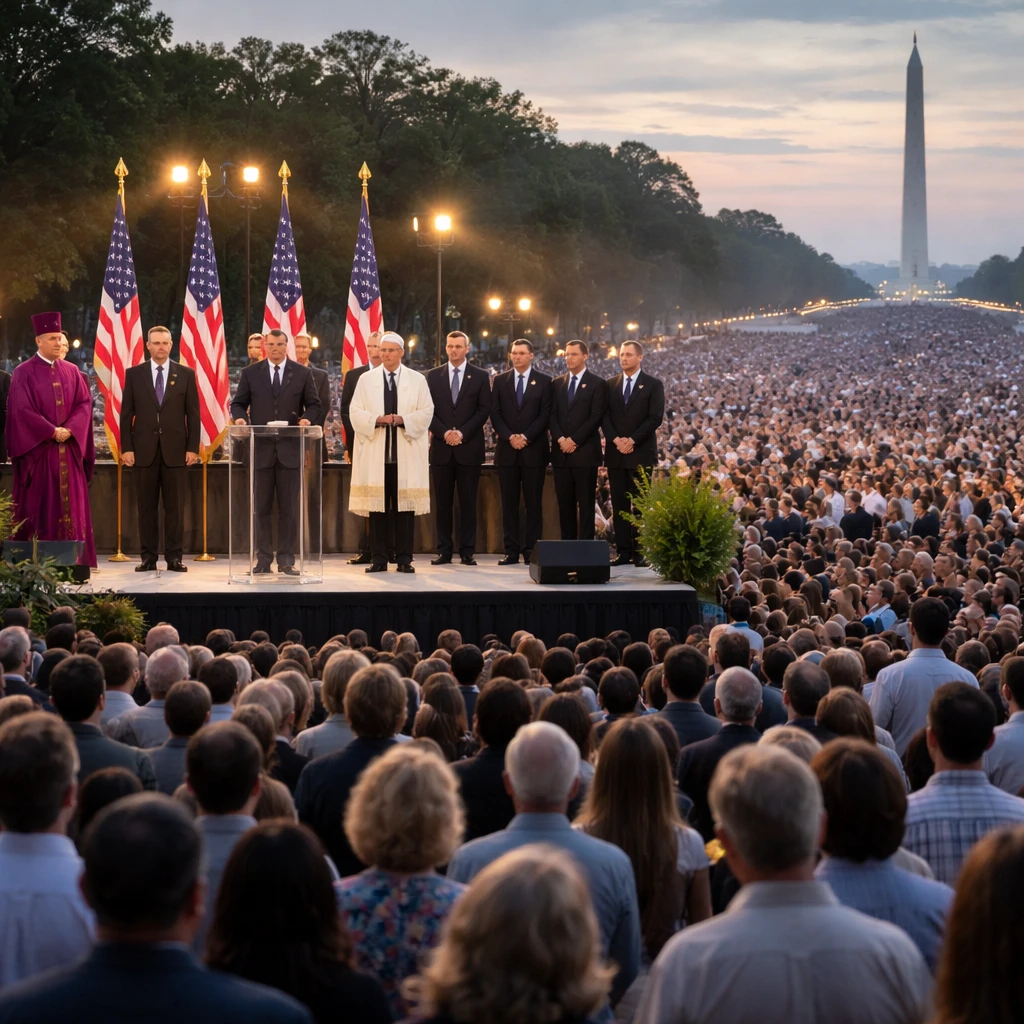
On Sunday a White House-affiliated program billed as "Rededicate 250: National Jubilee of Prayer, Praise & Thanksgiving" staged a nine-hour event on the National Mall in Washington, D.C., featuring a roster dominated by evangelical Christian and conservative Catholic speakers. The organizers describe the gathering as a spiritual exercise to prepare the country for its 250th birthday; critics say it instead spotlights close ties between President Donald Trump and conservative religious leaders while failing to represent the nation’s broader faith landscape.
Organization and stated purpose
The program is organized by Freedom 250, a public-private partnership established by the White House to coordinate events marking the United States’ 250th anniversary in collaboration with federal agencies. According to the event’s public materials, participants are to use Scripture, testimony and prayer to "prepare for the nation’s 250th birthday" and to "rededicate our country as One Nation to God." The event’s website states its aim as offering praise for 250 years of what organizers call "His Providence for the United States," praying for protection for the next 250 years, and solemnly rededicating the country under God.
Speakers and political presence
President Trump is scheduled to appear via a prerecorded video message. Senior Republican officials - including Defense Secretary Pete Hegseth - are listed among those speaking on the Mall. Political participants also include Republican House Speaker Mike Johnson and Republican Senator Tim Scott. No prominent Democrats were slated to appear, according to the event program.
Religious figures on the roster include Bishop Robert Barron of the Catholic Diocese of Winona-Rochester; Jonathan Falwell, chancellor of Liberty University; Rabbi Meir Soloveichik, senior rabbi of Congregation Shearith Israel in New York City; and Samuel Rodriguez, leader of the National Hispanic Christian Leadership Conference. Rodriguez, speaking in an interview, said the primarily Christian lineup was intended to reflect the religious composition of the American colonies following the 18th century Great Awakening, calling it "a depiction, a screenshot of our foundation."
Criticism: church-state lines and representation
Advocates for separation of church and state criticized the event for what they described as government-sponsored promotion of a single religious viewpoint. Annie Laurie Gaylor, co-president of the Freedom From Religion Foundation, said the program "is the epitome of exactly what our secular Constitution forbids our government from doing" and called it a fusion of government with Christian nationalism.
Other critics noted that several major religious traditions are absent from the speaker list, including mainline Protestant denominations such as Lutherans, Methodists and Episcopalians; the Church of Jesus Christ of Latter-day Saints; Orthodox Christianity; Islam; Hinduism; and Buddhism. The Council on American-Islamic Relations urged event organizers to include speakers from other faith communities. Corey Saylor, research and advocacy director at the organization, told Reuters that Muslims were present in North America prior to U.S. independence and said the contemporary religious landscape warrants recognition and respect.
Religious demographics cited
Organizers and critics alike point to the current distribution of religious identification in the United States as context for debates over representation. Data from the Pew Research Center cited by observers note that more than a quarter of U.S. adults identify as religiously unaffiliated. Approximately 23% identify as evangelical Protestant, 19% as Catholic, and about 11% as mainline Protestant. Critics point to those figures when arguing that the event’s lineup does not mirror today’s religious diversity.
Historical and reputational concerns
Some opponents of the Freedom 250 events have argued the programs risk downplaying or ignoring darker chapters of American history, including slavery and violent treatment of Indigenous peoples. That criticism frames part of a broader debate over how national milestones should address founding-era injustices.
Related tensions between administration and faith leaders
The broader relationship between the administration and religious figures has been strained at times, according to public exchanges. The article notes that President Trump and Vice President JD Vance, who is Catholic, have publicly criticized Pope Leo and other faith leaders who disagree with some administration policies. After a public feud with the pope, Trump briefly posted an AI-generated image of himself depicted in a Christ-like pose, then deleted the image following criticism from some supporters within the administration.
Event context in the 250th anniversary program slate
The Rededicate 250 event is the first of 16 planned activities the administration intends to hold in advance of the nation’s 250th anniversary in 2026. Organizers describe the event as one piece of a larger commemoration effort intended to mark the federal milestone.
Additional promotional material included with coverage
The original coverage included promotional copy pitching an investment research product that emphasizes data-driven decision-making for choosing investments in 2026. That material framed investment success as linked to institutional-grade data and AI-powered insights, and encouraged readers to explore investment opportunities with such tools.
Conclusion
The National Mall gathering spotlighted a close alignment between the current administration and conservative Christian leaders while reigniting disputes over the proper boundary between government and organized religion and questions about inclusive representation in national commemorations. Organizers present the program as a spiritual rededication in advance of the 250th anniversary; critics contend the event privileges a narrow set of religious voices and sidelines many others.