
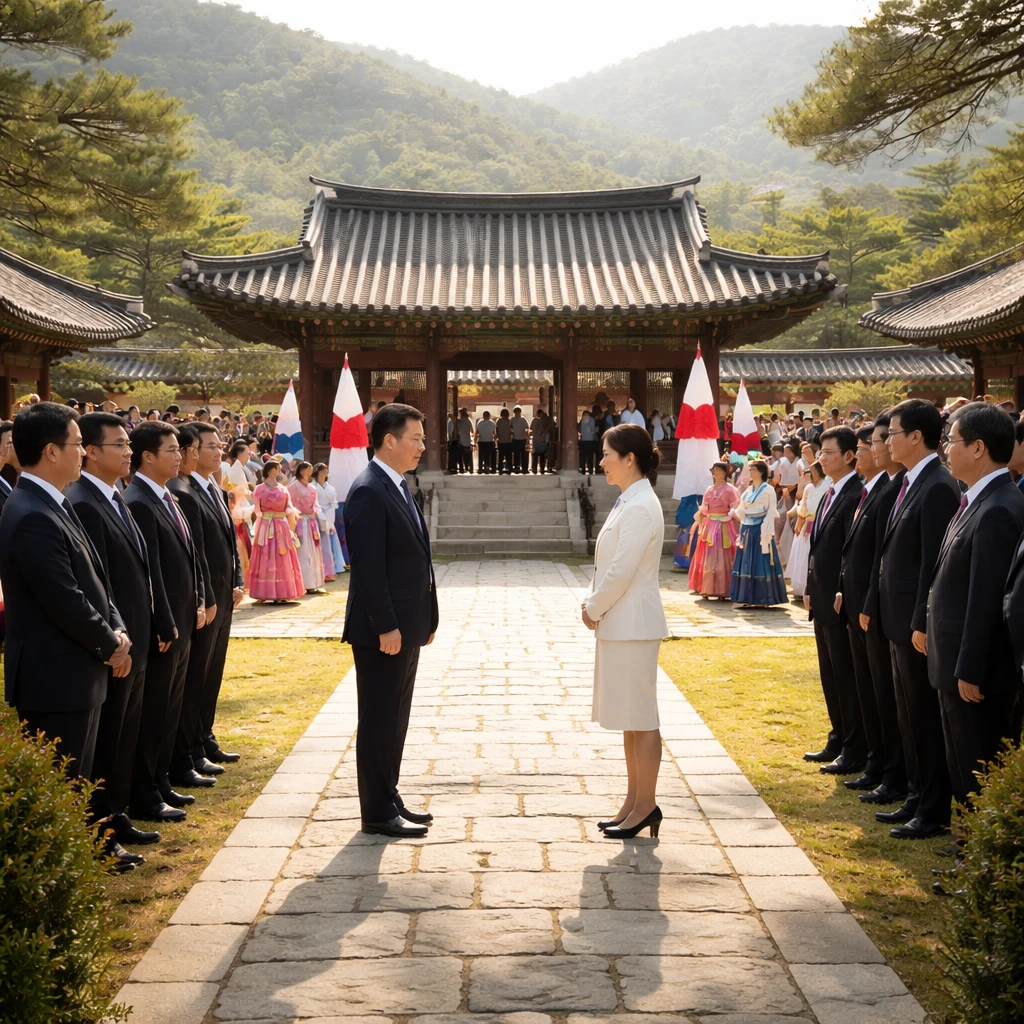
South Korea and Japan will hold a high-level bilateral summit on Tuesday, the South Korean presidential Blue House said on Sunday. The meeting will bring together President Lee Jae Myung and Prime Minister Sanae Takaichi in what officials describe as a pivotal encounter amid ongoing regional and global economic uncertainty.
This session is the second major installment of resumed "shuttle diplomacy" between the two leaders this year and is being framed by both governments as a vital opportunity to actively deepen mutual trust. The summit will take place in President Lee's hometown of Andong, North Gyeongsang Province, a reciprocal gesture following a January meeting that Prime Minister Takaichi hosted in her hometown of Nara.
South Korean authorities plan to accord the visit the highest level of diplomatic hospitality, treating it as equivalent to a formal state visit. The agenda includes a joint press conference, an official bilateral dinner featuring historical regional cuisine, and traditional cultural performances intended to highlight local heritage.
Officials characterise the talks as occurring at a critical juncture for East Asian trade dynamics, pointing to a strategic reset that began when President Lee's administration took office. Despite persistent historical grievances that have long complicated relations, both leaders have pursued a "two-track" diplomatic approach that keeps matters of historical justice distinct from pressing economic and national defense issues.
Since their initial meeting in January, Tokyo and Seoul have concentrated on practical cooperation in advanced technological areas. Priorities identified by both sides include protecting cross-border manufacturing supply chains, creating frameworks for artificial intelligence governance, and sustaining real-time military radar data-sharing networks.
According to Japanese government officials, the upcoming discussions will focus heavily on efforts to steady bilateral economic relations, to advance regional denuclearization initiatives, and to improve transparency across supply chains - considerations that officials say have been amplified by ongoing macroeconomic turmoil in the Middle East.
The summit's ceremonial and substantive elements together reflect an intent by both capitals to institutionalize closer ties while keeping sensitive historical topics on a parallel track. How the two governments navigate this balance - combining cultural diplomacy with concrete policy cooperation on high-tech and security matters - will help shape commercial and strategic calculations across the region.
Summary
The summit in Andong, reciprocal to the January Nara meeting, represents the second major exchange in a resumed "shuttle diplomacy" this year. Leaders plan a state-visit-level reception, a public press event, cultural programming, and discussions centered on economic stability, denuclearization and supply chain transparency amid regional volatility.
Key points
- The meeting is the second major bilateral engagement between the two leaders this year and is seen as an opportunity to bolster mutual trust.
- Core agenda items include preserving cross-border manufacturing supply chains, setting rules for AI, and maintaining real-time military radar data-sharing.
- Japanese officials say talks will emphasize stabilizing economic relations, advancing denuclearization efforts, and improving supply chain transparency in light of macroeconomic turmoil in the Middle East.
Sectors impacted
- High-tech manufacturing and semiconductor supply chains
- Defense and military information-sharing systems
- International trade and regional economic relations
Risks and uncertainties
- Historical grievances between the two countries could complicate deeper integration - this affects political relations and sectoral cooperation.
- Ongoing macroeconomic turmoil in the Middle East may increase pressure on supply chain transparency and trade flows tied to the region.
- Efforts to separate historical justice from economic and defense cooperation - the so-called "two-track" framework - carry uncertainty about how long the separation can hold under political or public pressure.