
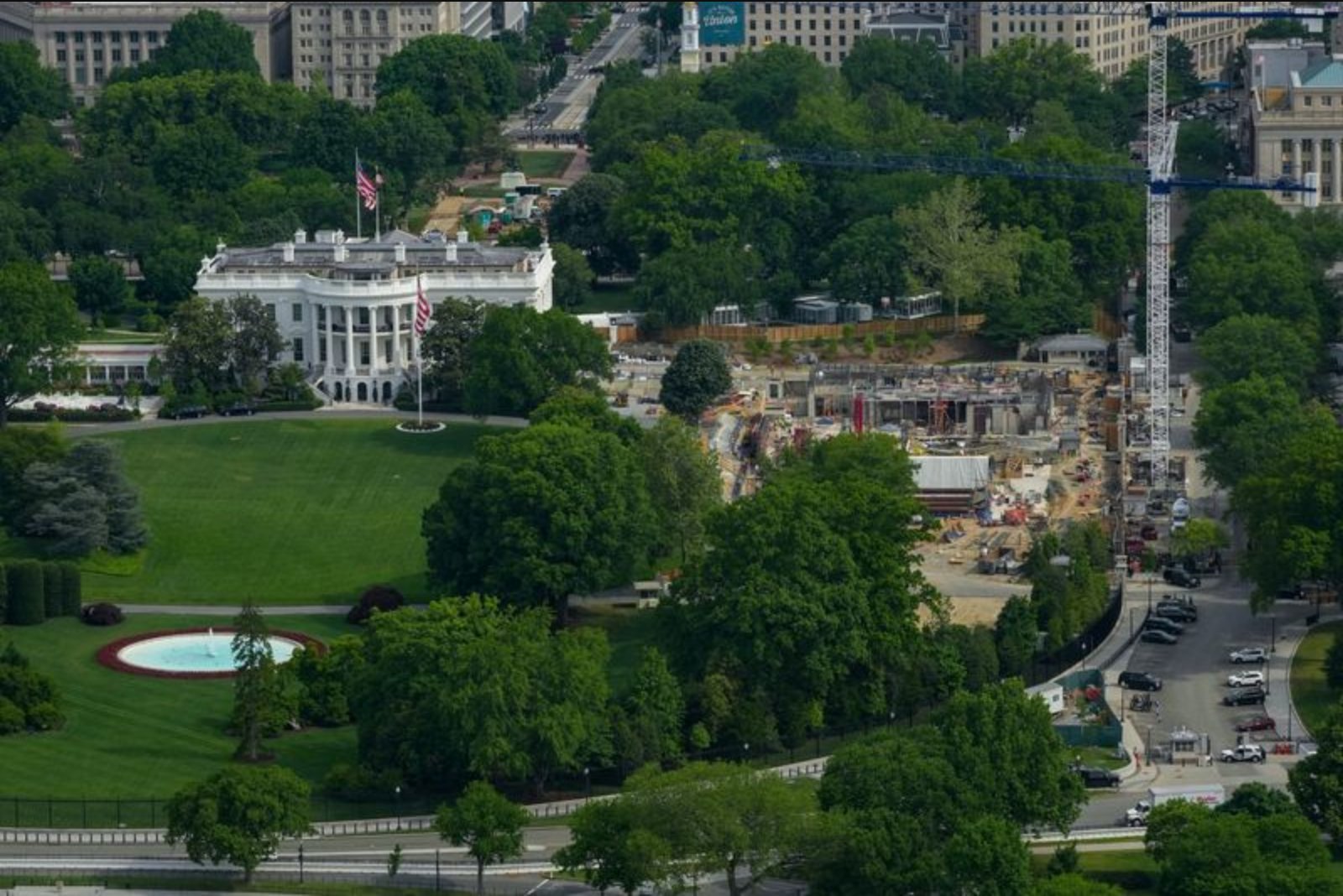
President Donald Trump is pursuing an extensive program of construction and renovation in and around the nation’s capital that touches some of Washington’s most recognizable sites and institutions. The initiatives range from a massive new ballroom attached to the White House to a proposed monumental arch, the repurposing of the Kennedy Center, and alterations across the White House grounds and interiors.
Overview
Collectively, these undertakings represent one of the most sweeping reworkings of the capital’s built environment by a U.S. president in modern times. Supporters say the projects will refresh and fortify important federal properties; critics raise alarms about historic preservation, cost, legality and potential interference with existing federal systems.
White House ballroom
At the center of the administration’s domestic construction ambitions is a proposed 90,000-square-foot White House ballroom that the president has described as "the Greatest of its kind ever built." The new space is intended to match the existing mansion in height and scale, and Trump has said it would seat 1,000 guests. The administration has placed an estimated price tag of $400 million on the project and indicated the funds would come from wealthy individuals and corporations.
Construction of the ballroom has already generated considerable controversy. The East Wing of the White House - which historically housed the first lady's offices and the White House movie theater - was demolished to make room for the ballroom after earlier assurances that such a demolition would not take place. Preservationists and opponents argue the replacement could overwhelm the main mansion visually and that Trump exceeded his authority by razing the historic East Wing.
A Washington judge issued an order to halt the project, but an appeals court allowed construction to continue and scheduled a June hearing to review the judge's injunction. The sequence of rulings leaves the project under legal scrutiny even as work proceeds.
In the wake of a shooting at the White House Correspondents’ Association dinner in April, the president cited security as an additional rationale for the ballroom project. He has described security features he intends for the structure, including missile-resistant columns, drone-resistant roofing and a military-style bunker.
National Garden of American Heroes
The administration is also advancing a National Garden of American Heroes, a concept the president has discussed since his first term. The president announced on social media on May 15 that the garden will be placed at West Potomac Park along the Potomac River in time for the nation’s 250th anniversary of independence this summer.
The planned garden would feature statues representing a wide range of figures the president said are important to the country’s story, including founding fathers, military leaders, religious figures, civil rights advocates, athletes, artists and entertainers.
Kennedy Center renovation and renaming
The John F. Kennedy Center for the Performing Arts, established by Congress to honor the late Democratic president, has been subject to a sharp alteration in identity and operations under the current administration. A Trump-appointed board voted last year to change the institution’s name to the Trump-Kennedy Center. Following that decision, the performing arts venue experienced a wave of show cancellations and softer ticket sales.
On February 1, the president announced that the Kennedy Center would close beginning July 4 for a two-year period to undergo a major renovation. The president has framed the closure and overhaul as necessary to address functional problems at the site, citing plumbing issues and deteriorating masonry. He has said the center will be renovated rather than demolished and has estimated the cost at $200 million, to be paid with tax dollars.
Critics of the Kennedy Center plan note the president used similar language when defending the demolition of the East Wing, claiming at the time that he intended to renovate rather than destroy the structure.
Reflecting Pool resurfacing
The Reflecting Pool near the Lincoln Memorial, the location of Martin Luther King Jr.'s 1963 "I Have a Dream" speech, is another focus of the administration’s work on Washington landmarks. On May 4 the president said he had become more directly involved in the pool’s restoration after determining it was in poor condition.
Trump described a restoration that included resurfacing the pool with what he called "American flag blue" materials and said the repair work was completed at a fraction of an earlier high-cost estimate. The president posted a social media image - generated using artificial intelligence according to his post - showing himself and other cabinet officials floating shirtless in the restored pool.
Independence Arch proposal
Across the Potomac River from the Lincoln Memorial, the administration has proposed the construction of an Independence Arch on a traffic roundabout. The president has pictured an arch in the tradition of triumphal monuments, with decorative eagles and a Lady Liberty-style figure topping the structure. The administration has described an arch that would rise to roughly 250 feet.
At that height the arch would exceed the Lincoln Memorial and approach the mass of the U.S. Capitol, which stands at 288 feet. By contrast, the Arc de Triomphe in Paris measures 164 feet. When asked about the rationale for a large monument, the president told reporters on January 31 that a grand arch was appropriate because "we're the biggest, most powerful nation."
Questions remain about whether the arch could be built to the proposed height without interfering with aviation. Planners have noted the possibility that a structure of that scale could intrude on the flight path for southbound aircraft on final approach to Ronald Reagan Washington National Airport, located a few miles from the proposed site.
Oval Office redecoration and interior changes
When he returned to the White House in January 2025, the president began a sizable redecoration of the Oval Office and other high-profile interiors. The Oval Office now features gold accents, statuettes, and portraits of famous Americans pulled from storage, including some that are not readily identifiable. A copy of the Declaration of Independence hangs on a wall behind a black sheet, and busts of Abraham Lincoln and Benjamin Franklin sit on tables near the presidential desk.
The president and his aides have described the changes as personal preferences; visitors have observed that the accumulation of objects creates a cluttered, old-library atmosphere that differs from the decor of recent predecessors. The president has made the reworked Oval Office a space he enjoys showing to visitors.
Rose Garden, White House grounds and portraits
Beyond indoor renovations, the president has made visible alterations to the White House grounds. The Rose Garden’s traditional grass lawn was removed and replaced with a white stone patio furnished with tables and umbrellas, evoking the patio style the president maintains at his Mar-a-Lago Club in Palm Beach, Florida. The administration defended the change by noting that high-heeled shoes can sink in the grass.
Along a colonnade walkway, portraits of America’s 47 presidents now line the wall, each accompanied by a plaque bearing the president's personal assessment of that leader. In a notable change reflecting political acrimony, the portrait of President Joe Biden was replaced with an image of an autopen - a signing device the president and other Republicans have criticized, even though it has been used by recent presidents.
Large flagpoles have been installed on both the North and South Lawns as additional elements of the grounds reconfiguration.
Lincoln Bedroom bathroom replacement
Inside the White House, the administration replaced the green-tiled, retro-styled bathroom adjoining the Lincoln Bedroom with a modern room featuring white and black marble. The green tiles dated to the Truman-era renovation of the 1950s. Earlier work on the Lincoln Bedroom during the George W. Bush administration had left the bathroom intact at the time, described in a past news report as well-preserved.
Legal and public response
Several of the president’s projects have prompted legal challenges and public criticism. Preservation groups and other opponents have argued that the demolition of historic structures and the proposed scale of new monuments exceed presidential authority and jeopardize established landmarks. A court order briefly halted construction on the White House ballroom before an appeals court allowed work to continue pending further review.
In the case of the Kennedy Center, a renaming and the announcement of a two-year closure have coincided with canceled performances and a noted drop in ticket sales. These cultural repercussions underscore how decisions about the management and branding of federal cultural institutions can have immediate economic and operational effects.
Security, aviation and preservation concerns
Security has been invoked as a justification for some projects, including the ballroom’s defensive design elements. At the same time, the proposed Independence Arch raises aviation safety questions due to its proximity to approaches for Ronald Reagan Washington National Airport. Preservationists have also emphasized the historical importance of structures such as the East Wing and features like the Reflecting Pool, arguing for caution in altering sites with deep symbolic significance.
Conclusion
The administration's array of construction and renovation projects represents a concentrated effort to reshape key symbols and working spaces in Washington. As these undertakings proceed, they are likely to remain the subject of legal proceedings, public debate and scrutiny over cost, authority and the preservation of national landmarks.