
TAIPEI, May 14 - Chinese President Xi Jinping told President Donald Trump that disagreement over Taiwan could send relations down a dangerous path, saying that "Taiwan independence" and cross-Taiwan Strait peace are as "irreconcilable as fire and water". The exchange highlights longstanding tensions over how to describe Taiwan's status. Below is a structured explanation of what the phrase "Taiwan independence" signifies in international and domestic political terms, and how various governments frame the island's status.
Historical background and Taiwan's formal name
The island now most commonly referred to as Taiwan was previously known as Formosa. Indigenous peoples lived there for millennia before European powers briefly controlled parts of the territory in the 1600s. The Qing dynasty incorporated Taiwan into Fujian province in 1684 and later elevated it to a separate province in 1885. Following Qing defeat in a war with Japan, Taiwan became a Japanese colony in 1895.
After World War Two, in 1945, control of Taiwan was transferred to the government of the Republic of China. In 1949, after the Communist forces led by Mao Zedong defeated the Nationalist government, the Republic of China government relocated its capital to Taiwan. The Republic of China remains the island's formal name. Mao established the People’s Republic of China and claimed to be the sole legitimate government of all China, including Taiwan, positioning the PRC as the successor state.
International status and Beijing's position
For many decades after 1949, the government in Taipei also asserted it was the legitimate government of China. That changed in 1971 when Beijing took the China seat at the United Nations from Taipei. At present, only 12 countries maintain formal diplomatic relations with Taipei, largely small developing states. The majority of major Western countries and U.S. allies, while not maintaining formal diplomatic ties, keep close unofficial relations with Taiwan. These ties typically include recognition of Taiwanese passports and the operation of de facto embassies.
Taiwanese citizens can generally travel freely to most countries with their Taiwanese passports. Beijing, however, has stated it will not renounce the use of force to bring Taiwan under its control. It has offered Taiwan a "one country, two systems" arrangement, akin to what was promised to Hong Kong, which would allow for a high degree of autonomy. No major political party in Taiwan supports such a model. Opinion polls in Taiwan have repeatedly shown that most Taiwanese prefer to maintain the current status quo in relations with China.
Beijing cites United Nations Resolution 2758, adopted in 1971, to argue that the world legally recognises Taiwan as part of China. That resolution affirms that the People’s Republic of China is the only legitimate government of China. Taipei disputes Beijing's interpretation, noting that the resolution does not address the status of Taiwan itself. Last year, the U.S. State Department said China was intentionally mischaracterising the resolution as part of a broader effort to isolate Taiwan diplomatically.
The United States' stance
The United States severed official diplomatic ties with Taipei in favor of Beijing in 1979, but remains bound by the Taiwan Relations Act to provide Taiwan with the means to defend itself. Under Washington's "One China" policy, the U.S. does not take an official position on Taiwan's sovereignty.
In 2022, the U.S. State Department added language concerning the Six Assurances, a set of Reagan-era security promises to Taiwan that were declassified in 2020. Those assurances include statements that the U.S. has not set a date to end arms sales to Taiwan, has not agreed to consult with Beijing before conducting such sales, and has not agreed to revise the Taiwan Relations Act. China has repeatedly demanded that the United States cease arms transfers to Taiwan.
Is Taiwan already independent in practice?
Although most countries do not formally recognise Taiwan as a sovereign state, Taiwan functions with many hallmarks of an independent country. Its people elect their own leaders; its government exercises control over a defined territory; it maintains its own military, issues passports and circulates its own currency. These characteristics amount to de facto independence even if not universally acknowledged in diplomatic terms.
The government in Taipei argues that the Republic of China is a sovereign state and that Beijing has no authority to represent or speak for Taiwan. The People's Republic of China has never governed Taiwan and thus, Taipei maintains, it has no legitimacy to determine how Taiwan selects its leaders.
Could Taipei formally declare a "Republic of Taiwan"?
A formal change to the island's name or legal status would not be straightforward. Under Taiwan's constitutional framework, such a move would require a constitutional amendment, which needs approval by at least 75% of lawmakers and then confirmation via a public referendum. That process would be beyond the authority of a single executive action by the president.
Parliamentary arithmetic presents a practical barrier. The ruling Democratic Progressive Party (DPP) and the main opposition Kuomintang (KMT) currently hold an equal number of seats. The DPP, in power since 2016, has not sought to amend the constitution to alter the country's formal name. The KMT strongly opposes any attempt to change the designation of the Republic of China.
Taiwan's president and the independence debate
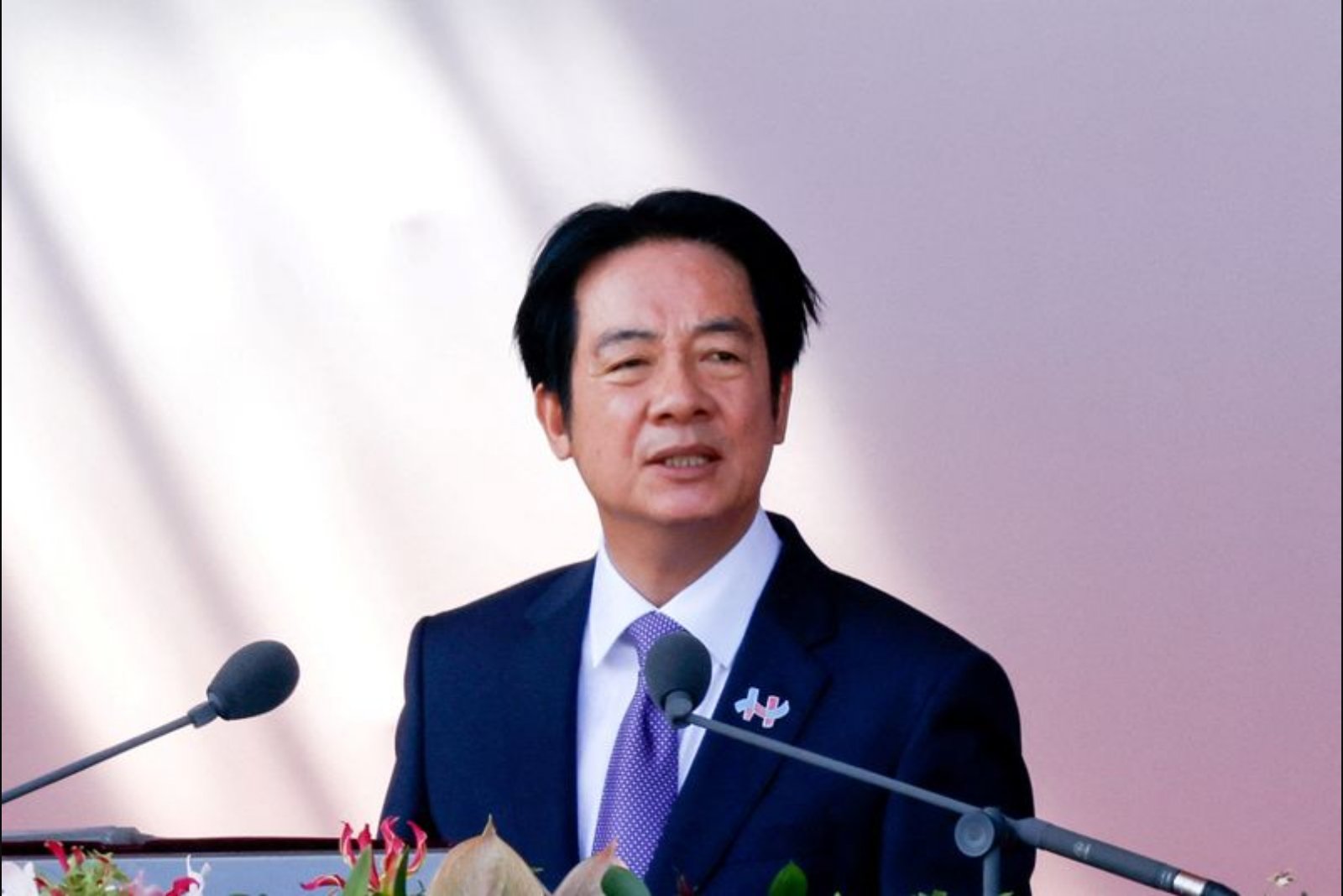
Beijing has been openly critical of President Lai, labeling him a "separatist". Prior to his election, Lai made remarks identifying himself as a "practical worker for Taiwan independence." He has since said he meant to convey that Taiwan is already an independent country in practice. Since assuming office in 2024, Lai has repeatedly stated that the Republic of China and the People’s Republic of China are "not subordinate to each other." Beijing interprets such statements as evidence that he regards the two entities as separate countries and thus as advancing an independence narrative.
China's legal framework to prevent formal independence
In 2005, China's National People's Congress enacted the Anti-Secession Law. The legislation provides Beijing with a legal basis to use military force if Taiwan were to declare formal secession or if, in Beijing's view, the possibilities for peaceful reunification had been entirely exhausted. The law is broadly worded and does not specify detailed triggers or procedures for military action.
Conclusion
The phrase "Taiwan independence" carries different meanings depending on who uses it. For Beijing it denotes a red line tied to the prospect of forceful reunification. For Taipei, many leaders and a majority of the population prefer maintaining the current practical arrangements rather than seeking a formal redefinition of status. The United States maintains a deliberately ambiguous policy balance between recognising Beijing diplomatically and providing Taiwan with defensive capabilities. Any change to Taiwan's formal status would be legally and politically complex and remains constrained by parliamentary rules, public opinion and the risk of escalation under frameworks such as the Anti-Secession Law.