
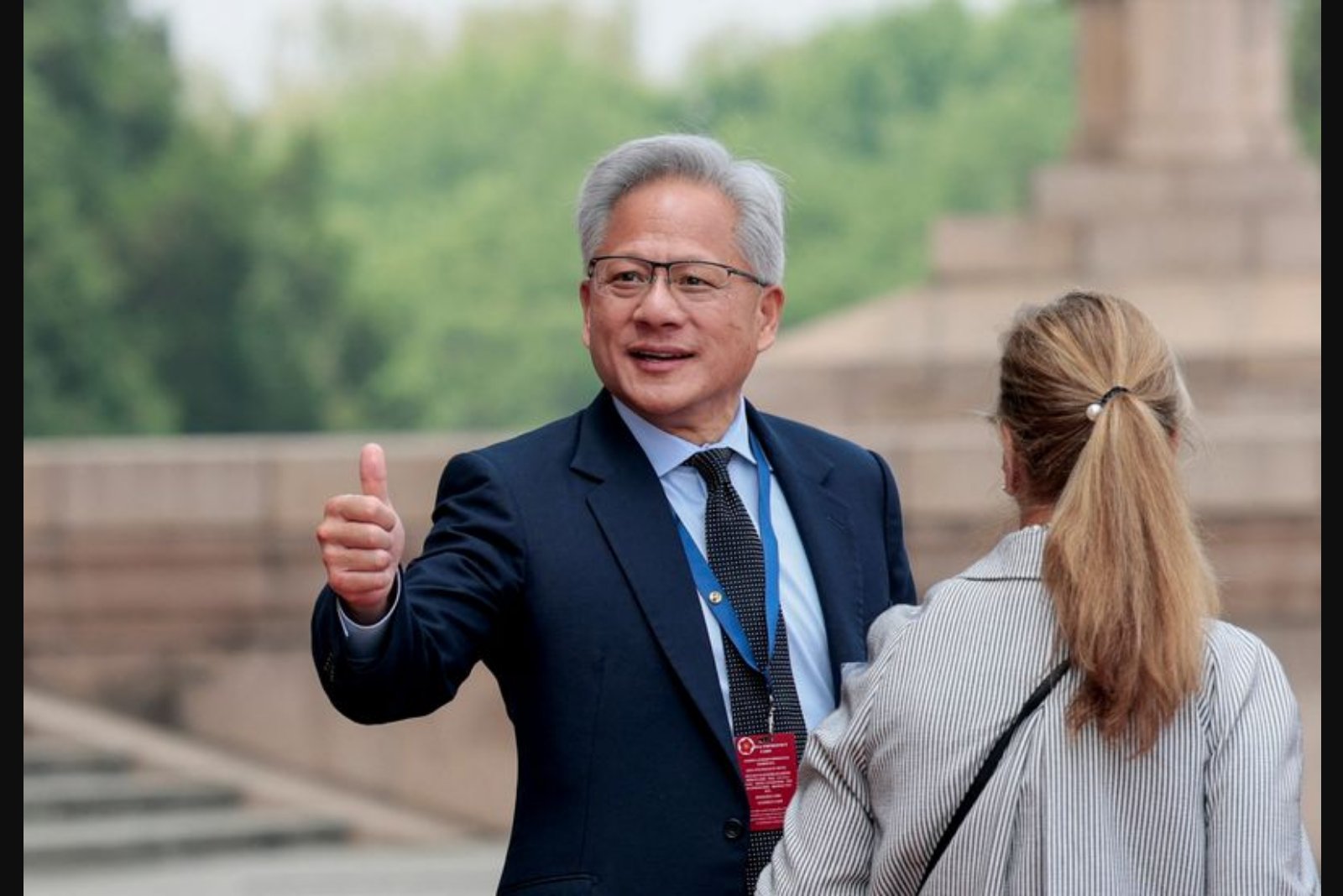
May 14 - U.S. officials have cleared approximately 10 Chinese companies to purchase Nvidia's H200 AI chip, but despite the formal approvals no deliveries have occurred, according to three people familiar with the matter. The situation leaves an anticipated commercial move in limbo even as Nvidia's chief executive, Jensen Huang, seeks progress in China this week.
Huang joined a White House delegation to Beijing after an invitation from President Donald Trump, a source said, with Trump reportedly picking him up in Alaska en route to a summit with Chinese President Xi Jinping. The optics of the trip have raised expectations that the long-stalled effort to ship H200 units into China could be revived, but the approvals have not translated into completed transactions.
Approvals and the parties named
Sources said the U.S. Commerce Department has authorized around 10 Chinese buyers, among them large internet platforms such as Alibaba, Tencent, ByteDance and JD.com, to purchase the H200 chips. The approvals also include several distributors, with Lenovo and Foxconn singled out by the sources as authorized intermediaries. Under the licensing terms described by two of the sources, each approved customer may acquire up to 75,000 H200 chips, and buyers can obtain units either directly from Nvidia or through the authorized distributors.
Lenovo confirmed to Reuters in a statement that it "is one of several companies approved to sell H200 in China as part of Nvidia’s export license." A spokeswoman for the U.S. Commerce Department declined to comment. Nvidia, Alibaba, Tencent, ByteDance, JD.com and Foxconn did not respond to requests for comment in relation to the approvals cited by sources. China’s Ministry of Industry and Information Technology and the National Development and Reform Commission did not reply to requests for comment.
No sales completed - reasons cited
Despite the licenses, no deliveries have been made. One source said Chinese buyers retreated after guidance from Beijing, and that the shift in approach inside China was also prompted in part by changes on the U.S. side, though that source did not specify what had changed. A separate fourth source said pressure in Beijing is increasing to either block orders or subject them to tighter vetting.
Commerce Secretary Howard Lutnick, speaking at a Senate hearing last month, expressed a similar point of view: "the Chinese central government has not let them, as of yet, buy the chips, because they’re trying to keep their investment focused on their own domestic industry." That statement, as provided in the sources' account, frames part of Beijing's hesitation as a deliberate policy choice to preserve investment for domestic semiconductor development.
Strategic considerations and market impact
The approvals and the hold-up underscore the strategic complexity of U.S.-China technology competition. Before U.S. export controls were tightened, Nvidia held roughly 95% of China's advanced chip market, according to the article's account. China was at one time responsible for about 13% of Nvidia's revenue, and Huang has estimated the Chinese AI market alone would be worth $50 billion this year. Those figures illustrate the commercial stakes for Nvidia, which remains a dominant supplier of AI accelerators.
At the same time, Beijing's push to cultivate domestic AI chip producers is highlighted by the article's reporting that Chinese firms such as DeepSeek increasingly describe themselves as using locally developed processors, including those from Huawei. That shift is cited as evidence of China’s effort to build an indigenous semiconductor ecosystem and of Nvidia's increasingly precarious position in the market; Huang has warned that U.S. export controls have effectively reduced Nvidia's share of AI accelerators in China to zero.
U.S. licensing conditions and the 25% revenue arrangement
The path to completed sales has been complicated by a range of requirements on both sides. U.S. rules issued in January require Chinese buyers to demonstrate they have installed "sufficient security procedures" and that they will not use the chips for military purposes. Nvidia is also required to certify it holds adequate inventory in the United States.
Separately, the reporting notes an arrangement negotiated by President Trump under which the U.S. would receive 25% of the revenue from chip sales to China. That structure requires H200 units to transit U.S. territory before shipment to China because U.S. law does not allow the direct imposition of export fees. Sources describe the revenue-sharing mechanism primarily as a legal workaround to allow the U.S. to capture a share of proceeds, but the arrangement has prompted unease in Beijing over potential tampering or hidden vulnerabilities during the required transit.
Adding to the complexity, the State Council in China issued two recent supply chain security regulations that sources said have catalyzed a government-wide effort to identify and eliminate potential foreign dependencies in critical technology infrastructure. That campaign has intensified scrutiny of foreign-sourced chips and related transactions, according to one of the people familiar with the matter.
Domestic political responses and external commentary
The continued delay has been welcomed by China hardliners in Washington, who are skeptical that expanded sales would slow Beijing's progress toward domestic chip development. Chris McGuire, identified in the article as a senior fellow for China and emerging technologies at the Council on Foreign Relations, was quoted as saying that any deal that allows Nvidia to sell more chips to China "means fewer Nvidia chips for U.S. firms, and a smaller U.S. lead in AI over China," and called it "remarkable that President Trump keeps getting convinced to put Nvidia’s interest ahead of America’s."
Huang, speaking to state broadcaster CCTV, said he hoped Trump and Xi would build on their good relationship during talks in Beijing to improve two-way ties, reflecting the CEO's public appeal for smoother bilateral commerce.
What remains unresolved
While export licenses have been granted to a set of Chinese buyers and distributors, the transaction pipeline remains inactive. The combination of Chinese reticence, tighter vetting driven by new domestic rules, and U.S. licensing conditions that include security certifications and the unusual revenue-sharing mechanism has so far prevented shipments from moving forward. Given those constraints, the fate of H200 deliveries to China is unresolved at present, leaving Nvidia and buyers in a holding pattern despite formal approvals.
The outcome will depend on how Chinese authorities respond to the approvals and the U.S.-imposed conditions, and whether the commercial parties and regulators can bridge concerns about security, supply chain integrity and the legal mechanics of revenue sharing. Until those issues are resolved, the approved licenses exist largely on paper, and no H200 units have crossed into Chinese hands.