
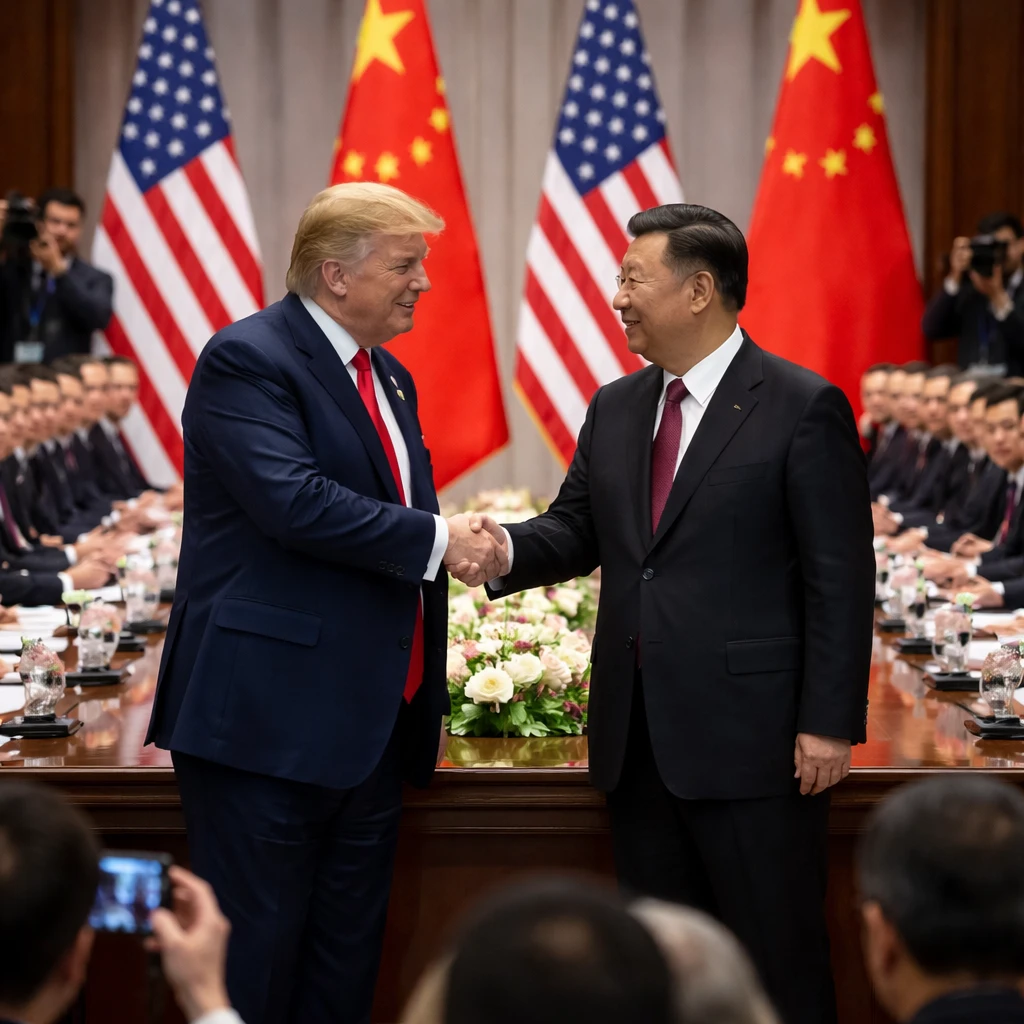
U.S. President Donald Trump and Chinese President Xi Jinping set a conciliatory tone as they opened a closely watched summit in Beijing, each urging warmer relations between the world’s two largest economies.
Speaking before a series of ministerial and policy-level meetings, Xi framed the relationship as one of potential cooperation rather than confrontation, saying China and the U.S. should be "partners, not rivals," and arguing that shared interests "far outweighed their differences." He also urged that 2026 be made "a historic year of renewal" in ties between the two countries.
Trump, who arrived in Beijing accompanied by a group of prominent U.S. business leaders, praised Xi as "a great leader" and said he expected U.S.-China relations to become "better than ever before." The U.S. president additionally said he would press Xi to "open up" China to U.S. business during their discussions.
Senior-level talks in Beijing begin against a backdrop of strained relations. The two countries endured a bitter trade war through most of 2025 and continue to disagree over controls on artificial intelligence chips and related technology. Those differences are expected to feature prominently in the summit agenda.
"Partners, not rivals" - Xi Jinping
One notable element of the U.S. delegation was the inclusion of Nvidia CEO Jensen Huang, a move that raised hopes among some observers for a potential loosening of U.S. restrictions on chip sales to China. Trump’s decision to bring senior business figures underscores the economic dimensions of the visit and the desire on the U.S. side to press for expanded market access.
The leaders are also scheduled to confront more sensitive security questions. Trump has said he will raise Taiwan in discussions with Xi, specifically noting the topic of U.S. arms sales to Taiwan. In addition, the pair are expected to address the impact of the U.S. and Israeli war on Iran, which the article says has disrupted oil flows to parts of Asia, including China.
Preparatory diplomacy took place ahead of the summit: U.S. Treasury Secretary Scott Bessent and Chinese Vice Premier He Lifeng met in South Korea to set the stage for the talks and struck an upbeat tone in their discussions.
As the summit proceeds, focus will fall on whether the initial conciliatory language from both presidents translates into concrete policy shifts on trade, technology exports, security ties related to Taiwan, and efforts to stabilize energy supplies disrupted by regional conflict.
Summary
Presidents Trump and Xi publicly advocated for improved U.S.-China relations as high-level talks commenced in Beijing. Their opening remarks emphasized partnership and economic engagement, while the summit agenda is set to tackle contentious topics such as semiconductor export controls, Taiwan-related arms sales, and disruptions to oil flows tied to conflict in the Middle East. Senior officials from both sides held preparatory meetings in South Korea ahead of the talks.