
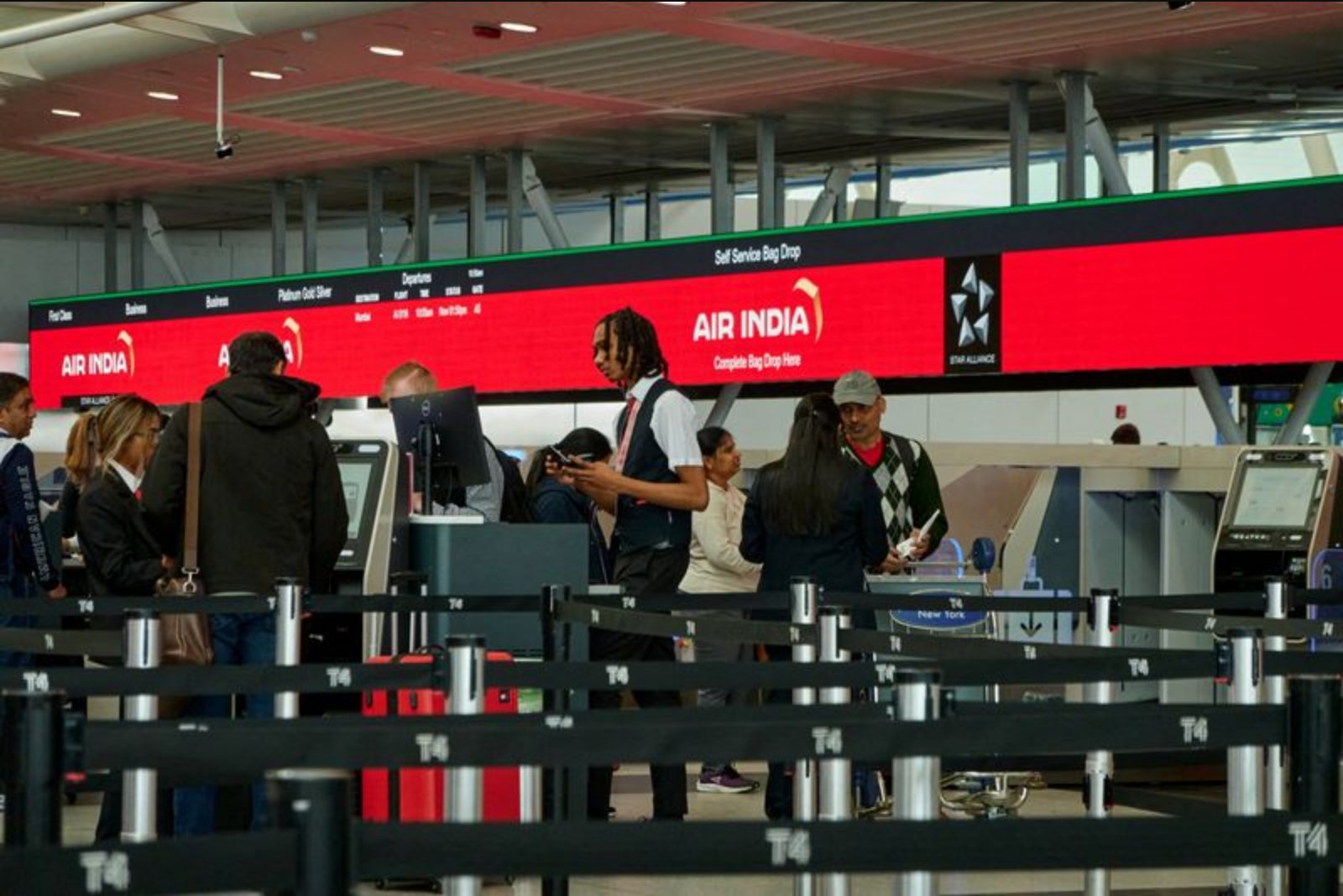
International carriers are stepping into capacity vacuums created by airspace restrictions and route reroutings that have curtailed Air India’s long-haul operations. With passengers increasingly avoiding Gulf connections and some Middle Eastern routes limited, airlines including members of the Lufthansa Group and Cathay Pacific have added seats on India-origin services to tap strong demand between South Asia, Europe and North America.
Data from OAG show foreign airlines accounted for 58.4% of scheduled international flights originating in India during March-May, up from 51.2% a year earlier. Over the same March-May period, Air India scheduled 6,404 international flights from India, a 17.5% decline from a year earlier, and on Wednesday announced broad reductions to its June-August schedule that affect services to Europe and North America.
Those cuts and the encroachment of rivals undercut Air India’s stated goal of becoming a stronger global carrier through new widebody aircraft, cabin upgrades and more nonstop services to Europe and the United States. "The war has attacked every leg of Air India’s transformation plan," said Linus Benjamin Bauer, global managing partner at aviation consultancy BAA & Partners.
Two people familiar with Air India’s finances, speaking on condition of anonymity because the details were not public, said the airline has never reported a profit since it was sold by the government in 2022. One source said the carrier is on track to record losses of over $2.12 billion for fiscal 2025-26. A second source noted that more than 60% of the group’s revenue derives from international operations.
In a May 1 staff memo, outgoing Air India CEO Campbell Wilson attributed losses to a combination of factors, writing that the "massive rise" in jet fuel prices "together with airspace closures and longer flying routes, has caused many of our international flights to become unprofitable." Pakistan has barred Indian carriers from using its airspace since April 2025 amid diplomatic tensions, forcing airlines into longer, more costly routings.
Foreign carriers have been able to expand in this environment even as some Gulf airlines hold their schedules steady. Emirates maintained an India-origin schedule of 2,196 flights in March-May. European carriers showed notable increases: Swiss, part of Lufthansa Group, scheduled 247 flights from India during March-May, a 39% rise versus a year earlier, while KLM scheduled 294 flights, up 19.5%.
Swiss attributed much of its growth to the Delhi-Zurich route, where scheduled frequencies increased 76% to 155 flights in March-May. The airline said it added a second daily Delhi-Zurich frequency and is seeing "very strong demand from India to Europe, and especially to the U.S." KLM said it had observed rising numbers of Indian passengers amid the Middle East disruptions.
Cathay Pacific also expanded India services, scheduling 588 flights between India and Hong Kong in March-May, a 19% increase from the prior year. Cathay’s CEO Ronald Lam told Reuters in late March that many travelers who previously connected through the Middle East were rerouting to the U.S. via Hong Kong.
Still, capacity growth by foreign carriers may be constrained by bilateral seat and frequency caps that have already limited expansion by Gulf carriers in India.
The changes have been especially acute on India-U.S. travel corridors. Air India’s Europe-origin schedule fell 5.1% year-on-year in March-May, but U.S. services were hit far harder: route-level data from Cirium show Air India’s scheduled flights to the United States plunged 77.4% over the same period.
Air India’s challenges on U.S. routes were compounded when Dubai capped daily flights by foreign carriers in March, and when Pakistan closed its airspace to Indian airlines. Some India-U.S. journeys have lengthened by nearly five hours because of the required reroutes. The carrier has already suspended its Delhi-Chicago service as of the Wednesday announcement and reduced several other U.S. services for the June-August period. Earlier, it had stopped flights from Delhi to Washington and from Bengaluru and Mumbai to San Francisco.
Those suspensions and reductions have created openings for U.S. carriers. American Airlines and United Airlines have been able to bolster their presence on India-U.S. routes following Air India’s pullbacks.
From a consumer perspective, fare and routing economics are influencing booking decisions. Ravi Gosain, president of the Indian Association of Tour Operators, said that "Air India can still attract bookings when it offers lower fares. But when its fares are similar to foreign airlines and routings are longer, passengers tend to prefer foreign carriers."
For Air India, the combined pressures of higher fuel prices, longer routings due to airspace closures and competitive responses from international airlines mark a material challenge to its turnaround efforts. Foreign carriers appear to be capitalizing on the situation by adding services on profitable city pairs and marketing aggressively for Indian demand, while bilateral limits and airport caps will set boundaries on how far they can expand.
The market response to these route shifts is ongoing. Airlines and regulators will continue to adjust schedules and capacity through the summer months, with implications for airline revenues, international travel connectivity and competition across the aviation sector.