
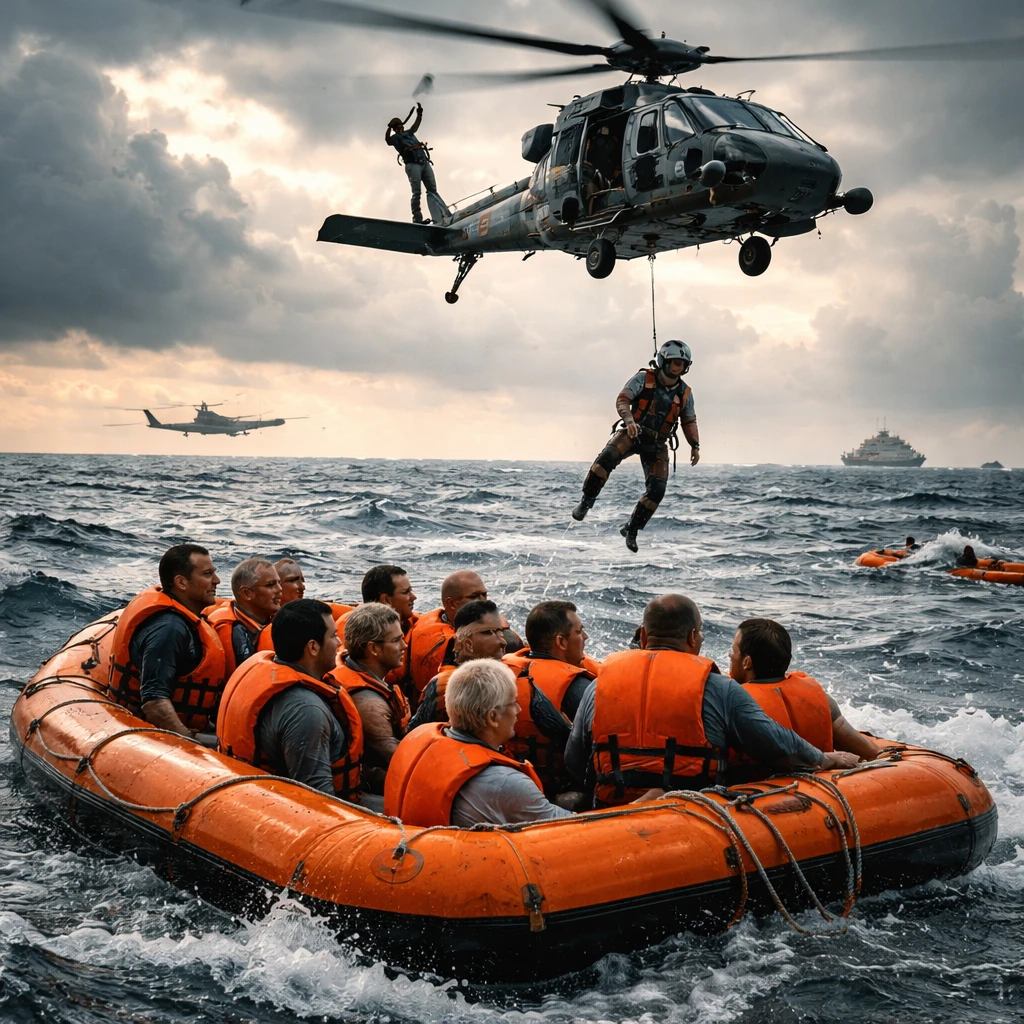
A private twin-engine turboprop carrying 11 adults went down in the Atlantic Ocean roughly 80 miles (129 km) off Melbourne, Florida, and all passengers survived the crash, U.S. Air Force Reserve and Coast Guard officials said on Wednesday. The aircraft, which had departed Marsh Harbour in the Bahamas and was bound for Freeport on Grand Bahama Island, activated an emergency locator beacon that was detected by the Coast Guard.
One of the first military assets to join the search was an Air Force HC-130J Combat King II that happened to be airborne on a training mission when the distress signal was received. The HC-130J crew located the life raft carrying the survivors as a thunderstorm approached and dropped supplies to sustain them until a rescue helicopter could arrive.
"For all those people to survive is pretty miraculous," said Air Force Major Elizabeth Piowaty, commander of one of the aircraft involved in the rescue, at a briefing the day after the incident.
Major Piowaty described how her team sighted the life raft and airdropped food, water and additional flotation while coordinating with Coast Guard units. The survivors had been in the raft for approximately five hours by the time they were located, according to rescue personnel.
Air Force Captain Rory Whipple, one of the pararescuers involved in the recovery, said the group in the raft displayed clear signs of distress - physical, mental and emotional - when they were found. He recounted that the rescue helicopter, deployed from the Air Force Reserve's 920th Rescue Wing based near Melbourne, executed hoist operations to lift the survivors out of the water.
The helicopter crew completed nine hoists to bring all 11 people aboard. Captain Whipple noted the operation concluded with only five minutes of fuel remaining before the helicopter would have faced the need to refuel in flight or land immediately. After extraction, the survivors were flown to Melbourne Orlando International Airport to receive medical attention.
Officials from the Air Force and Coast Guard said they had no immediate updates on the severity of injuries or the medical conditions of those rescued. Bahamian authorities have opened an investigation into the cause of the crash, with the Coast Guard reporting that the aircraft was said to have experienced engine failure.
The Coast Guard reported the flight leg involved - from Marsh Harbour to Freeport on Grand Bahama Island - is a route of about 100 miles. Beyond the initial accounts that an engine problem was reported, investigators have not released further findings.
This incident highlights the rapid coordination between military aircrews and coast guard responders in maritime search and rescue operations, and underscores the challenges of executing hoist rescues at sea under time and fuel constraints. Authorities continue to gather information as the investigation proceeds.