
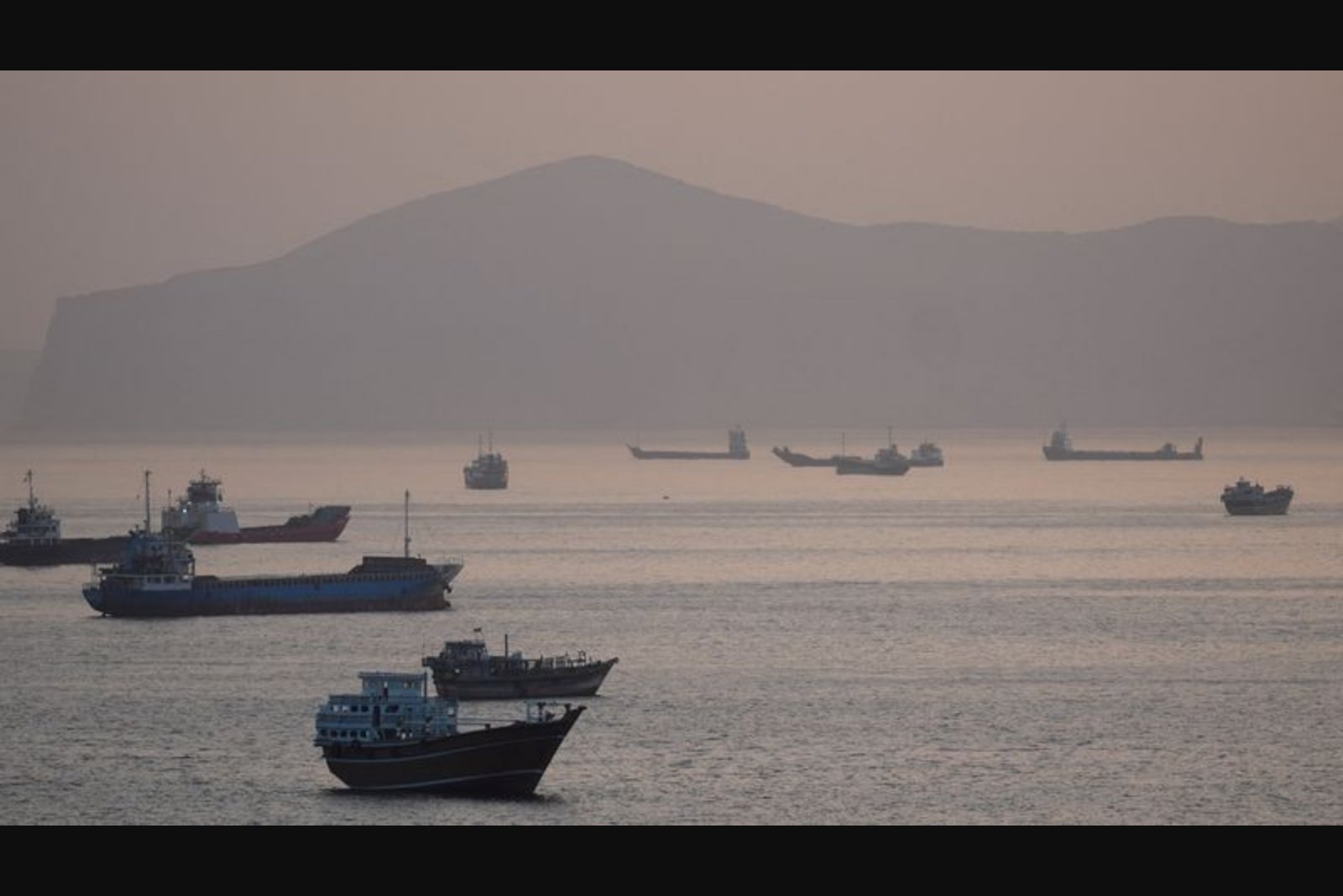
President Donald Trump announced that the United States would begin assisting in the release of commercial vessels stranded in the Strait of Hormuz, and a maritime security body subsequently said a tanker had reported being hit by unidentified projectiles in the same waterway.
Trump provided limited detail about the effort, saying it would commence on Monday to help ships and their crews who have been "locked up" in the vital passage and were facing shortages of food and other supplies. In a post on his Truth Social site, he said: "We have told these Countries that we will guide their Ships safely out of these restricted Waterways, so that they can freely and ably get on with their business."
International shipping groups have warned that the conflict has left a large number of vessels unable to transit the strait. The International Maritime Organization estimates that hundreds of ships and as many as 20,000 seafarers have been unable to move through the passage during the fighting.
U.S. Central Command said it would back the operation with substantial resources, including 15,000 U.S. military personnel and more than 100 land and sea-based aircraft, together with warships and drones. CENTCOM stated the operation was designed to "restore freedom of navigation for commercial shipping."
Admiral Brad Cooper, the CENTCOM commander, described the mission as a defensive measure he said was necessary for regional stability and the global economy, saying the support was "essential to regional security and the global economy as we also maintain the naval blockade." The statement framed the effort as combining military capacity with diplomatic engagement.
Shortly after the U.S. announcement, the United Kingdom Maritime Trade Operations agency reported that a tanker had been hit by unknown projectiles in the Strait of Hormuz. UKMTO said the incident took place 78 nautical miles north of Fujairah in the United Arab Emirates and that all crew were reported safe.
Iran has been blocking nearly all shipping from the Gulf except for its own for more than two months, a posture that officials say has contributed to sharp rises in energy prices. Some vessels attempting to transit the strait have reported being fired upon, and Tehran has seized several ships. The United States imposed its own blockade of ships from Iranian ports last month.
The Trump administration has been seeking assistance from other countries to assemble an international coalition to secure commercial traffic through the strait. CENTCOM said the latest plan would combine "diplomatic action with military coordination," but it was not immediately clear which countries would be assisted by the U.S. operation or exactly how the effort would be carried out. The White House did not immediately respond to requests for comment.
Trump warned that any interference with the U.S. operation would "have to be dealt with forcefully."
Diplomatic exchanges between Washington and Tehran continued to show limited progress. Iranian authorities said they had received a U.S. response to their most recent 14-point offer for peace talks, a day after Trump indicated he would probably reject the proposal because, in his words, "they have not paid a big enough price." Trump, speaking to reporters, added that talks were going "very well" without providing further details.
State media in Iran reported that Washington had transmitted its response to Tehran through Pakistan, and that Iranian officials were reviewing the U.S. reply. There was no immediate confirmation of that transmission from either U.S. or Pakistani officials.
Iran’s Foreign Ministry spokesperson Esmaeil Baghaei was quoted by state media as saying, "At this stage, we do not have nuclear negotiations," a remark apparently referring to Tehran’s proposal to defer discussions on nuclear issues until after the war concludes and opposing blockades of Gulf shipping have been lifted.
Trump said on Saturday that he had not yet reviewed the exact wording of Iran’s proposal and was likely to reject it. U.S. and Israeli bombing of Iran was suspended four weeks ago, and U.S. and Iranian officials have conducted one round of talks. However, efforts to arrange additional meetings have so far not succeeded.
The Iranian proposal to postpone talks on nuclear matters until a later phase appears at odds with Washington’s insistence that Tehran accept strict limitations on its nuclear program before the conflict ends. The United States has demanded Iran relinquish its stockpile of more than 400 kg (900 pounds) of highly enriched uranium, which U.S. officials say could be used to build a bomb. Iran maintains that its nuclear program is peaceful while indicating it is willing to discuss some curbs in exchange for the lifting of sanctions. Tehran previously accepted such curbs under a 2015 agreement that the Trump administration later abandoned.
Domestically, the U.S. president faces pressure to break Iran’s effective control over the Strait of Hormuz. The disruption has choked off roughly 20% of global oil and gas supplies and contributed to higher gasoline prices in the United States. With midterm congressional elections in November, Trump’s Republican Party risks voter backlash tied to rising consumer prices.
Iranian media have outlined elements of Tehran’s 14-point plan, saying it includes the withdrawal of U.S. forces from nearby areas, lifting the blockade, release of frozen assets, payment of compensation, removal of sanctions, ending the war on all fronts including Lebanon, and the establishment of a new control mechanism for the strait.
Summary
The United States announced a plan to assist commercial vessels and crews trapped in the Strait of Hormuz, deploying substantial military resources to restore navigation, while a tanker reported being struck by unknown projectiles. Diplomatic channels remain uncertain as Iran reviews a U.S. response to its 14-point peace proposal, and both sides maintain differing positions on nuclear negotiations and conditions for ending hostilities.
- Key points
- The U.S. will support an operation to free stranded ships with 15,000 personnel, over 100 aircraft and naval assets to restore commercial navigation through the strait - sectors affected include shipping, energy, and insurance.
- A tanker reported being hit by unknown projectiles 78 nautical miles north of Fujairah; all crew were reported safe - this underscores ongoing maritime security risks that affect supply chains and fuel markets.
- Diplomatic efforts continue with Iran reviewing a U.S. response to its 14-point proposal; outstanding differences remain on timing of nuclear talks and demands over enriched uranium holdings, which bear directly on geopolitical risk and energy market stability.
- Risks and uncertainties
- Maritime security risk: Continued attacks and seizures in the Strait of Hormuz may further disrupt global oil and gas flows, affecting energy prices and transportation-dependent sectors.
- Operational uncertainty: It is unclear which countries will be aided and how the U.S.-led effort will be executed, creating ambiguity for shipping operators and insurers assessing exposure.
- Diplomatic impasse: Divergent positions on nuclear negotiations and the sequencing of sanctions relief versus curbs on Iran's program leave the prospects for a negotiated end to the conflict uncertain, maintaining elevated geopolitical risk premiums in markets.
Note: This report reflects statements and events as presented by official sources and media outlets referenced in public statements. Where details remain unclear in those accounts, this article reports the limits of available information rather than drawing additional conclusions.