
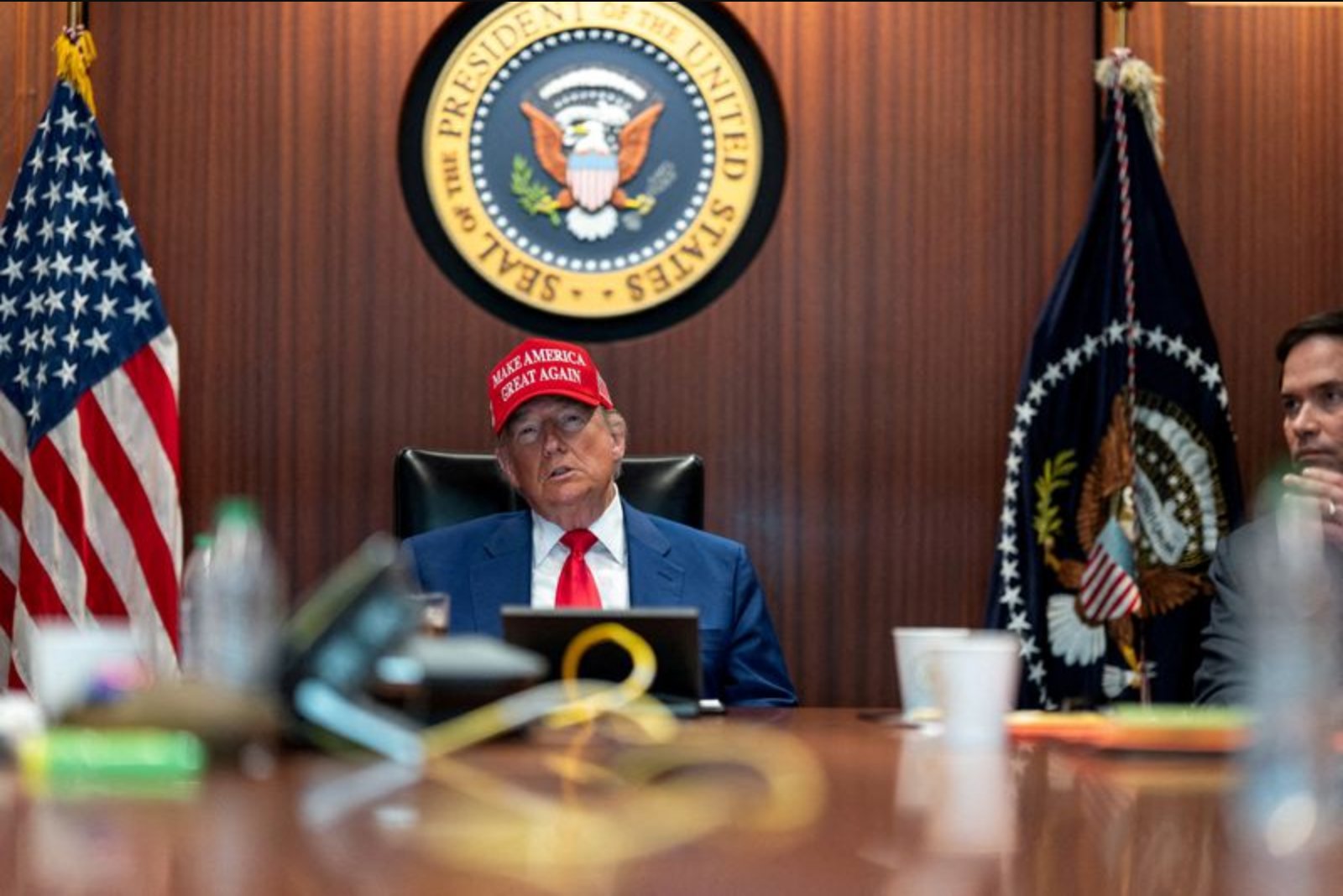
More than two months after opening a major military campaign against Iran, President Donald Trump faces the possibility that a protracted standoff will leave the United States - and his presidency - in a worse position than before hostilities began. Despite intensive U.S. and allied strikes that have significantly weakened Iran’s military capabilities, the conflict has not produced a clear military or diplomatic resolution, and no obvious route to a settlement has emerged.
The two parties continue to present confident public postures, yet their positions remain fundamentally opposed. Iran has submitted fresh proposals aimed at reviving negotiations, but the U.S. president moved quickly to reject one such offer. That rejection underscores the deep gaps between the sides and points to a potential long period of stalemate.
For Trump and the Republican Party, the prospect of a continuing impasse carries serious consequences. An unresolved war would likely prolong global economic disruption, including elevated U.S. gasoline prices, exerting additional pressure on a president whose approval ratings are already weakening. Persistent energy market disruption and the political fallout of a drawn-out conflict could complicate Republican campaigns ahead of November’s midterm congressional elections.
Shortfalls on stated objectives
The costs of the conflict highlight a broader shortcoming: many of the goals President Trump publicly declared at the outset of military action remain unrealized. While U.S. and Israeli operations have inflicted material damage on Iran’s military infrastructure, several of the administration’s shifting demands - ranging from regime alteration to denying Iran any pathway toward acquiring a nuclear weapon - have not been accomplished.
Concerns that the situation could become protracted intensified after Mr. Trump cancelled a planned trip by his negotiators to Islamabad and rejected an Iranian proposal to pause hostilities. The ceasefire, which has been in place since April 8, was central to the offer Iran put forward. Tehran suggested postponing discussions over its nuclear activities until the conflict itself was formally ended and a deal was struck to reopen the Strait of Hormuz. That sequencing was unacceptable to the president, who demanded that the nuclear issue be addressed from the outset.
On one recent day, state-run Iranian media reported a revised proposal had been routed through Pakistani intermediaries, a development that briefly eased global oil prices after a sharp rise following Iran’s effective blockage of the strait. Mr. Trump told reporters he was "not satisfied" with the offer, though he acknowledged that phone contacts were continuing.
Failing to restore guaranteed access to the Strait of Hormuz at the end of the conflict would constitute a significant blemish on Mr. Trump’s record. Laura Blumenfeld, a Middle East expert at Johns Hopkins University in Washington, said, "He’d be remembered as the U.S. president who made the world less safe."
White House spokeswoman Olivia Wales argued that Iran is growing "desperation" under military and economic pressure and insisted Mr. Trump "holds all the cards and has all the time he needs to make the best deal."
Options on the table and the risk of renewed force
With no clear endgame visible, Mr. Trump has discussed the possibility of a prolonged naval blockade of Iran in private meetings, according to a U.S. official who spoke on condition of anonymity. Such a blockade could be sustained for months with the aim of further curtailing Iran’s oil exports and compelling Tehran to agree to denuclearization terms.
At the same time, Mr. Trump has not ruled out returning to kinetic strikes. Military planners have prepared options for a "short and powerful" campaign of strikes as well as for operations to seize control of portions of the strait to reopen it to commercial shipping. Those contingency plans reflect the uncertainty about whether the standoff can be resolved without additional force.
European diplomats, whose relations with Washington have been strained by the outbreak of conflict, generally expect the impasse to endure. "It’s hard to see how this will end soon," one diplomat said on condition of anonymity.
Iran’s leverage and the energy shock
Iran has demonstrated a capacity to exert considerable leverage over the global energy system. By restricting traffic through the Strait of Hormuz - a route that previously carried about one-fifth of the world’s oil - Tehran has contributed to an unprecedented energy supply shock. Analysts warn that Iran will be emboldened by the realization that it can employ the strait as a strategic weapon even after hostilities subside.
Jon Alterman of the Center for Strategic and International Studies in Washington said, "Iran has realized that, even in a weakened state, it can shut off the Strait at will. That knowledge leaves Iran stronger than it was before the war." The implication is that, regardless of the immediate military balance, Iran’s ability to disrupt oil flows has lasting strategic value.
Nuclear stockpile questions
One of the central aims Mr. Trump cited when he ordered strikes on February 28 was to close Iran’s route to nuclear weapons. Yet, according to assessments referenced during the conflict, a stockpile of highly enriched uranium is believed to remain intact in hiding following U.S. and Israeli airstrikes last June and could potentially be recovered and further processed toward weapons-grade material.
Iran has repeatedly insisted it seeks recognition of a right to enrich uranium for what it calls peaceful purposes. The White House spokeswoman maintained Mr. Trump had "met or surpassed" all military objectives, including steps "to ensure that Iran can never have a nuclear weapon." That assertion, however, stands in contrast with concerns that a recoverable uranium stockpile persists.
Proxy networks and other strategic aims
Another declared objective of the U.S. campaign was to force Iran to cease supporting proxy groups across the region - including Hezbollah in Lebanon, the Houthis in Yemen, and Hamas in Palestinian territories. That aim also remains unfulfilled. Defense Secretary Pete Hegseth, testifying before Congress, rejected the characterization of the conflict as a "quagmire," even though the president initially predicted that military action would last four to six weeks.
Prospects for swift peace talks are slim as long as the fundamental positions of Washington and Tehran remain far apart. Although Mr. Trump says he will accept nothing less than a long-term solution to the Iranian threat, he has, at times, appeared open to finding an exit from an increasingly unpopular war.
At the request of senior aides, U.S. intelligence agencies are reportedly studying how Tehran might react if Mr. Trump declared victory unilaterally and withdrew American forces. Independent analysts warn that Iran would likely interpret such a withdrawal as a strategic success for having survived intense military pressure.
Meanwhile, European and Gulf Arab diplomats have cautioned that the president could end up accepting a compromised settlement that leaves a weakened but still threatening Iran in place.
Frozen conflict and wider strategic costs
With talks stalled and major gaps remaining in any possible agreement, some analysts foresee the conflict settling into a frozen state - a condition that resists definitive resolution and could sustain higher force levels in the Middle East. A frozen conflict would limit Mr. Trump’s ability to significantly reduce U.S. military presence in the region and could impose long-term strategic costs.
The United States is already confronting new diplomatic strains. Several European allies said they were not consulted before the campaign began, and transatlantic frictions have widened as Mr. Trump has criticized NATO partners for not committing naval forces to reopen the strait. The president has also publicly discussed the possibility of reducing troop levels in countries such as Germany, Spain and Italy.
The conflict has altered Iran’s internal leadership dynamic, favoring a more hardline posture dominated by the Islamic Revolutionary Guard Corps, which consolidated influence after U.S. and Israeli strikes killed senior figures, including Supreme Leader Ayatollah Ali Khamenei. The president’s early plea for the Iranian population to rise up and topple their leaders went unanswered.
Domestic political pressure and public costs
At home, Mr. Trump faces mounting pressure to wrap up a war that has depressed his approval rating to the low point of his term - 34%, according to a Reuters/Ipsos poll - and driven up gasoline prices past $4 a gallon. Those developments complicate his political objectives as he seeks to preserve Republican control of Congress in the midterm elections.
White House spokeswoman Taylor Rogers said Mr. Trump remained committed to protecting his party’s congressional majority and described gasoline price spikes as "short-term disruptions" that would ease as the conflict ended.
Iranian leaders, aware of Mr. Trump’s domestic political vulnerabilities, may be prepared to outlast the president, betting that American political pressures will eventually prompt concessions. Yet Tehran also faces its own economic hardships and must weigh how long it can sustain such costs without risking deeper internal turmoil. "Iran isn’t fractured or folding, it’s playing for time," Sina Toossi, a senior fellow at the Center for International Policy in Washington, wrote on X.
Outlook
With neither side poised to achieve an immediate, comprehensive victory, the most likely near-term outcome is continued tense deadlock. That scenario brings persistent economic pain, strained alliances and the possibility that Tehran will retain a coercive tool over global oil flows. For President Trump, the central question is whether continued pressure, a negotiated settlement that meets his nuclear preconditions, or renewed force will ultimately define the conflict’s end - and whether that conclusion will leave the United States and his presidency in a stronger or weaker position than at the war’s outset.