
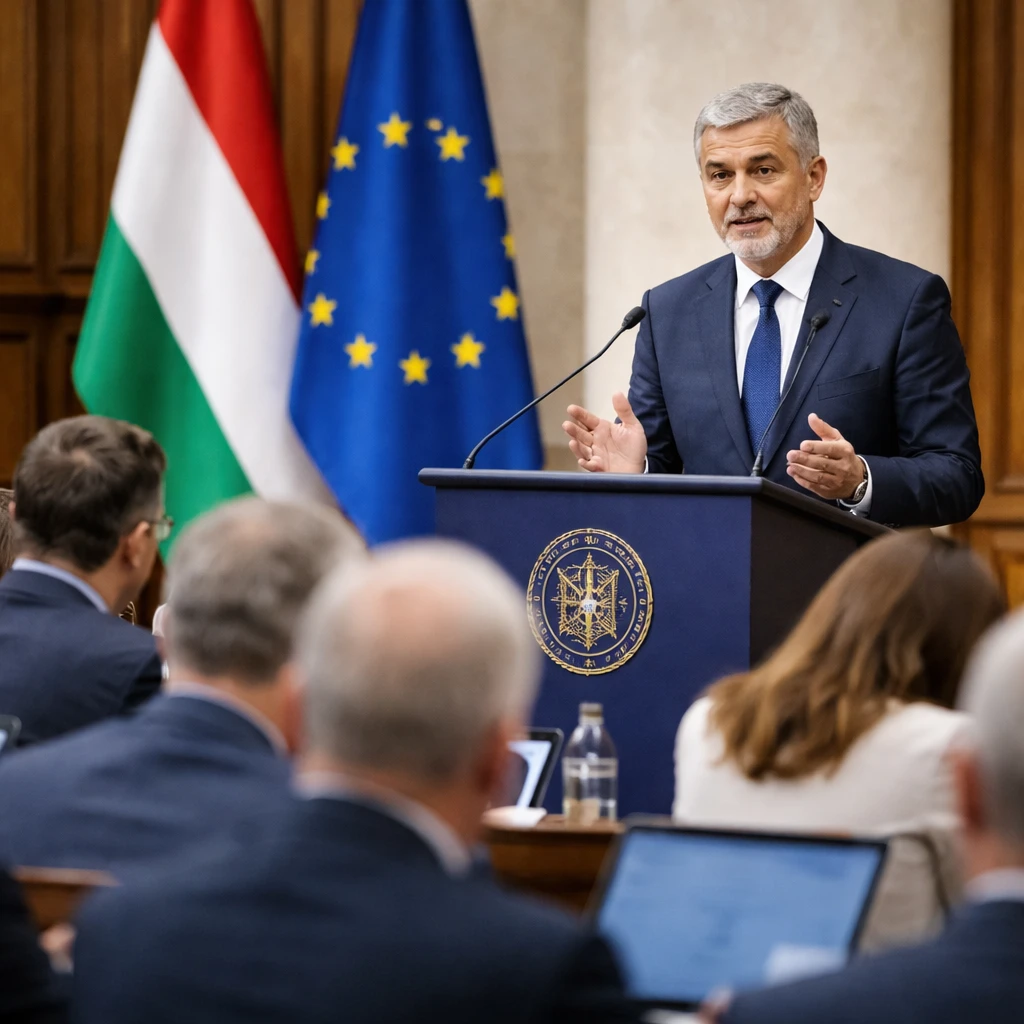
Hungary’s central bank governor, Mihaly Varga, declared on Monday that the bank will back the government’s plan to join the euro, signaling institutional support for a process that the new administration has made a priority.
Speaking at a conference in Budapest, Varga said the central bank intends to be a constructive partner in the transition and will help keep inflation in check. He emphasized that the ultimate move to adopt the euro would be a political decision for Prime Minister Peter Magyar’s new government.
Varga framed compliance with the Maastricht criteria as an important objective. Those criteria, he said, include maintaining inflation and public debt below specified thresholds, and he argued that meeting them would yield benefits for Hungary. The new government has set a goal of joining the euro by 2030, but faces headwinds from high public debt and what Prime Minister Magyar has recently described as a disgraceful budget.
Varga’s position carries particular weight in domestic politics. He is widely seen as a long-standing ally of former premier Viktor Orban, who was defeated in April’s election. Notably, Varga is the only senior appointee from the Orban administration whom Prime Minister Magyar has not publicly pledged to replace, a fact that underscores the governor’s standing within Hungary’s monetary and political establishment.
Voices from other central banks attending the same conference offered contrasting assessments of euro adoption. Polish central bank governor Adam Glapinski warned that retaining a national currency can act as a buffer against external shocks. Glapinski cautioned that "Euro adoption could result in a boom-bust cycle," a concern that underscores potential volatility stemming from surrendering independent monetary policy.
Martin Kocher, who represents the Austrian central bank on the European Central Bank’s Governing Council, highlighted potential economic gains from joining the single currency. Kocher said euro entry would reduce transaction costs and remove foreign currency risks for most corporate loans in Hungary. He added that these advantages would materialize over time as the country moves through the convergence process.
The exchange at the conference illustrated the balance of considerations that Hungary faces as it pursues euro membership: potential long-term cost savings and lower currency risk for businesses, set against short-term fiscal and inflationary constraints and concerns about macroeconomic stability during transition.
Key points
- The Hungarian central bank will support the government’s euro adoption plan and commit to helping keep inflation under control - impacting monetary policy and inflation-sensitive sectors.
- Meeting Maastricht criteria is presented as a necessary step, with implications for public finances and fiscal policy - affecting government finance and sovereign borrowing costs.
- Central bankers at the conference highlighted trade-offs: reduced transaction costs and lower foreign currency risk for corporate loans versus risks to monetary flexibility - relevant to banks and corporate lending markets.
Risks and uncertainties
- Failure to meet Maastricht thresholds for inflation and public debt would delay or complicate euro entry - a risk to fiscal policy and sovereign debt markets.
- High public debt and a budget described as disgraceful by the prime minister create fiscal vulnerability during the convergence process - impacting government financing and investor confidence.
- Adoption of the euro could reduce monetary policy flexibility and, as warned by Adam Glapinski, potentially trigger a boom-bust cycle - a risk for macroeconomic stability and financial markets.