
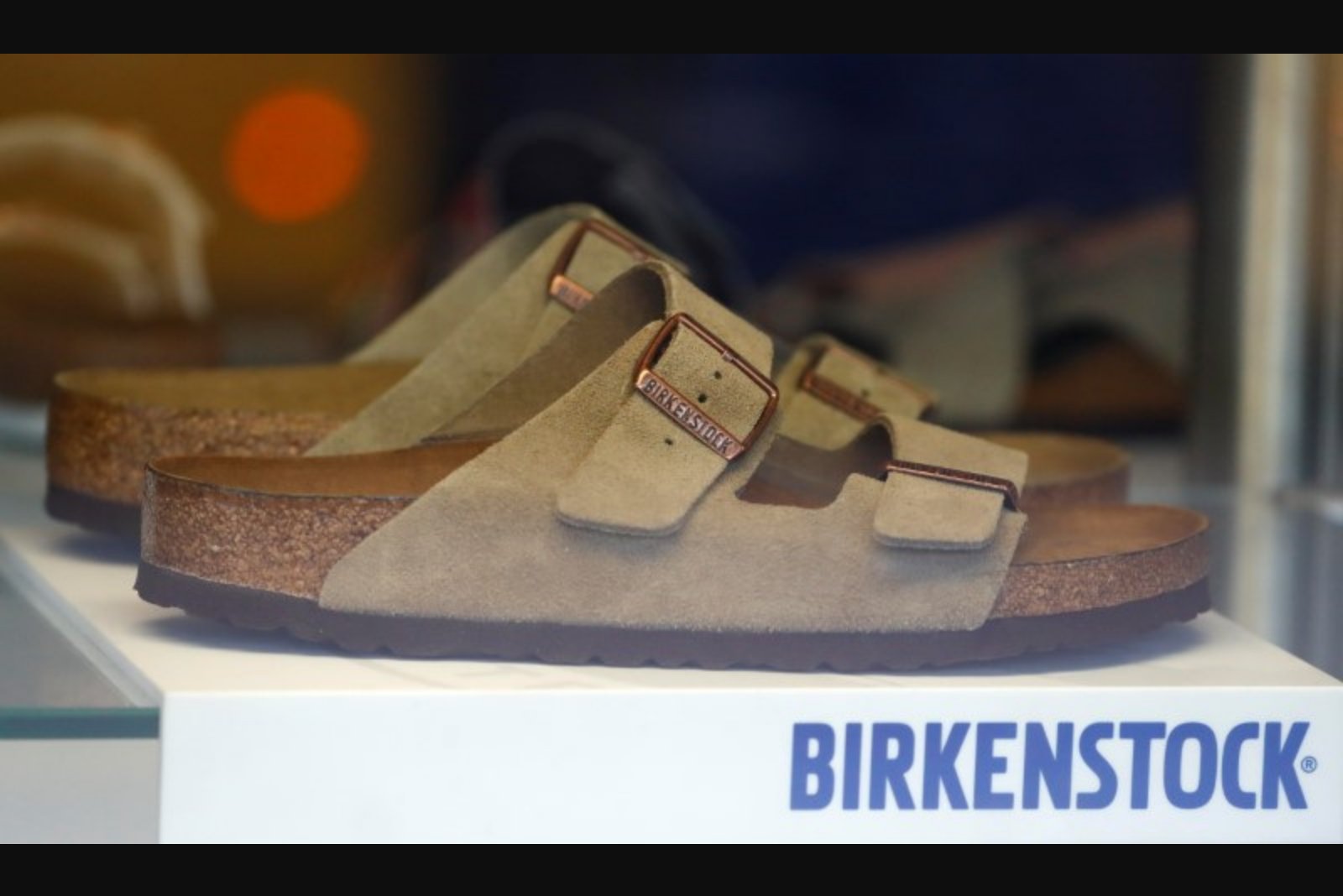
Birkenstock, which entered public markets in 2023 with a narrative that framed the company as a reinvented 250-year-old luxury footwear maker, is confronting a sharp reassessment from investors. The stock slid to a record low after the company disclosed weaker quarterly growth and maintained rather than raised its annual sales forecast, citing the combined impact of higher U.S. tariffs and geopolitical tensions in the Middle East.
The reaction was immediate and severe: shares plunged more than 14% to $32.44, leaving Birkenstock with a market capitalization roughly 38% below the $9.3 billion valuation it held at its initial public offering. The selloff highlights a widening gap between the premium positioning the company promoted and the narrower commercial reality market participants now appear to be pricing in.
Analysts and brand specialists describe Birkenstock as occupying a space between luxury and mainstream footwear. The company enforces tighter distribution controls and limits discounting in ways that resemble luxury labels, but it lacks the broad product scope and scale of global luxury conglomerates such as LVMH, which is a partial owner of the ergonomic shoe maker. As a result, expectations that previously treated Birkenstock like a high-growth luxury fashion player have been dialed back.
"Investor expectations likely became inflated once the brand was valued more like a luxury fashion company than a footwear company," said Keith Fraley, an assistant professor at the Fashion Institute of Technology in New York. He added that the core issue is how to preserve exclusivity while expanding internationally.
That tension between exclusivity and expansion is embedded in the company’s operating choices. Birkenstock manufactures the majority of its shoes in Germany, a strategy that bolsters its premium image but also exposes it to higher production costs relative to rivals that primarily manufacture in Asia. At the same time, consumer demand shows signs of strain: while price hikes have held up among wealthier customers, more price-sensitive shoppers are retreating amid rising living costs that dent discretionary spending.
The company said margins were squeezed in the most recent quarter by a weaker dollar versus the euro and by an increased tariff burden in the United States, where tariffs doubled to 20%. Birkenstock reported a 270 basis point decline in adjusted EBITDA margin in the quarter and warned that these pressures will persist through the year, weighing on profitability.
Birkenstock’s signature contoured cork footbed sandals are central to the brand identity but are, according to industry observers, chiefly a seasonal summer item. Efforts to broaden the product set into clogs, boots and sneakers have not yet produced the kind of widespread growth that some investors had expected.
"Fashion markets eventually ask the same question: is this timeless or did everyone who wanted in buy enough?" said Michael Ashley Schulman, a partner at Cerity Partners, illustrating the investor re-evaluation at play.
The market has already reflected that reassessment in Birkenstock’s valuation metrics. The stock now trades at about 13 times forward earnings, which places it near industry averages and far below the premium multiples it commanded when the share price previously peaked at 123.17. That contraction contrasts with the trajectory of Crocs, identified in the market as Birkenstock’s closest rival, which has avoided an analogous selloff in part because Crocs trades at mass-market footwear multiples of roughly 7 times next 12-month earnings and reports margins above 20%.
"If [Birkenstock] chases volume by opening too many wholesale doors or relying on promotions, they will lose the luxury premium they’ve spent decades building," said Eric Tsytsylin, a brand strategy partner at Lippincott, a global brand consultancy.
Investors are now recalibrating the company’s prospects. Where once the narrative suggested the brand could scale into a luxury powerhouse with broad international appeal and the high margins typical of established luxury houses, the more conservative view grading the company as a solid but constrained consumer footwear brand has gained traction.
Management and market watchers face a clear balancing act: preserve the distribution discipline and pricing power that sustain the brand’s premium image, while pursuing measured growth that does not dilute exclusivity. For now, the market appears inclined to value Birkenstock more like a mid-market footwear name than a pure luxury fashion house.
Key figures and developments:
- Share price fell more than 14% to a record low of $32.44.
- Market capitalization is about 38% below the $9.3 billion IPO valuation.
- Adjusted EBITDA margin declined by 270 basis points in the latest quarter.
- Tariff burden in the United States doubled to 20% and contributed to the margin squeeze.
- Shares trade near 13 times forward earnings; Crocs trades at about 7 times next 12-month earnings with margins above 20%.