
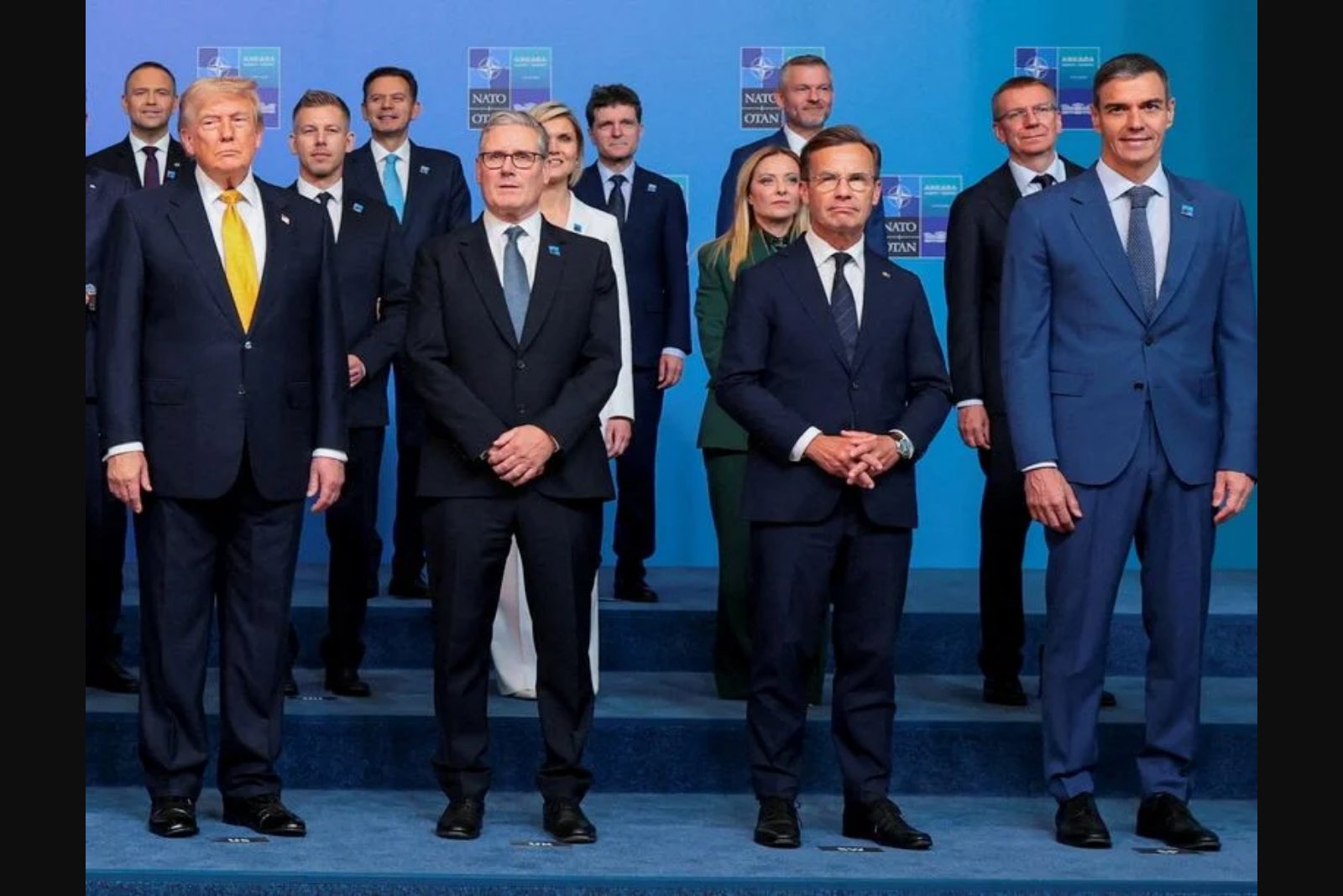
As leaders of NATO’s member states gathered in Ankara for this week’s summit, they faced uncertainty about which version of the U.S. president would attend - the combative leader who has threatened the alliance’s stability, or the accommodating president who has publicly commended NATO members’ defense efforts. Attendees ultimately encountered both.
On Tuesday, upon his arrival, President Donald Trump publicly criticized the United Kingdom, Germany, France and Italy, accusing them of insufficient backing for the U.S. war with Iran. The confrontation expanded on Wednesday morning when he denounced Spain as a "terrible partner" and instructed a cutoff of all trade - including visits - with that country, an order he directed to his Treasury Secretary Scott Bessent during a meeting with NATO Secretary-General Mark Rutte.
He also reiterated his long-running demand that the United States take control of Greenland - a semi-autonomous Danish territory - reviving an issue that has strained ties within the alliance.
Yet by the end of Wednesday, the tenor had shifted. In closed-door sessions, diplomats reported a markedly different tone. Trump did not repeat his public threats against Spain or again press for Greenland in the private discussions, and he emerged to describe the leaders’ meeting as one filled with "love." He praised allied leaders for increasing their military spending and spoke warmly about their intentions.
Trump’s public remarks captured the roller-coaster atmosphere. Speaking to reporters outside a packed auditorium, he reflected on the summit as "sort of pretty wild." He recounted allies telling him, "Sir, we love you," and added, "These are grown people saying that. Isn't that nice?" He also acknowledged that some expressions of affection might have been tactical, saying, "Maybe they're doing it to get to me. And in a way they did."
NATO Secretary-General Mark Rutte, during a private meeting with Trump, sought to reinforce positive developments while addressing the president’s grievances. Rutte praised the U.S. strikes on Iran and encouraged Trump to accept the gains he had extracted on European defense spending, urging him to "Grab the win. It's there. You did it," according to those present.
Diplomats said that flattering approaches and private reassurances have become a routine strategy among NATO leaders for managing their relationship with Trump - a technique employed at last year’s summit as well - aimed at preserving transatlantic cohesion even when public tensions arise.
Spanish Prime Minister Pedro Sanchez sought to minimize the fallout from the president’s morning denunciation, characterizing his own interaction with Trump as "very cordial," and diplomats reported that the climate inside closed sessions was not belligerent. That afternoon, the president offered praise for Ukrainian President Volodymyr Zelenskiy during a bilateral meeting, an unexpectedly positive note for Kyiv given the sometimes uneasy interactions with Washington.
When Trump stepped out for the summit’s concluding news conference, allied officials and diplomats drew a collective sigh of relief; there were no additional dramatic confrontations unveiled at the public end-of-summit remarks. Trump told reporters, "They have a lot of good in their heart, not evil, good, and they're doing a great job for their country."
Still, the underlying strains remained visible. Many diplomats expressed skepticism about the durability of the calmer posture. They noted that during last year’s NATO summit in The Hague, Trump offered effusive praise to alliance leaders and then hosted Russian President Vladimir Putin in the United States a few weeks later, an action that allies privately criticized.
On the flight home, the president again shifted his language. He described Spain as "very generous" and lauded what he called NATO’s "tremendous unity," but shortly thereafter renewed a threat to withdraw more U.S. troops from Europe. The oscillation between conciliatory and confrontational positions underscored the fragile equilibrium allies must navigate.
For NATO leaders, the summit highlighted the continuing challenge of balancing private diplomacy and public messaging to avoid fracturing the 77-year-old alliance. Diplomatic efforts to soothe tensions - including direct appeals from figures such as Rutte and expressions of praise from leaders in private settings - appeared to be effective in averting fresh public ruptures at this summit. Yet the pattern of abrupt swings in tone and policy pronouncements suggested that any agreement reached or goodwill expressed might be short-lived.
Summit participants departed having avoided immediate escalation and with renewed pledges of increased defense spending from several European capitals. But officials remain alert to the possibility of renewed friction, leaving the alliance’s longer-term trajectory uncertain.
Summary
At the NATO summit in Ankara, President Trump alternated between sharp public criticisms - targeting several European governments over support for a U.S. war with Iran and calling for a cutoff of trade with Spain - and later praise for the same leaders' increased defense spending and expressions of unity. Closed-door diplomacy and flattering appeals, including from NATO Secretary-General Mark Rutte, helped shift the tone by the summit’s end, though diplomats cautioned that the calm may not last.
Key points
- President Trump publicly criticized the UK, Germany, France and Italy for not adequately supporting the U.S. war with Iran, and he ordered a trade cutoff with Spain during summit meetings. (Sectors impacted: international trade, diplomatic relations)
- Private diplomacy, including a direct appeal from Mark Rutte to "Grab the win. It's there. You did it," contributed to a softer tone in closed sessions and a public closing in which Trump praised allies for higher defense spending. (Sectors impacted: defense, government procurement)
- Despite the outward show of unity at the summit’s close, diplomats expressed skepticism about the durability of the detente, pointing to past patterns of abrupt policy reversals. (Sectors impacted: defense planning, markets sensitive to geopolitical risk)
Risks and uncertainties
- Potential for renewed public confrontations among NATO members - which could destabilize diplomatic coordination and defense planning. (Impacts: defense sector, allied military cooperation)
- Risk of trade disruptions if threats such as a U.S. cutoff of trade with Spain are enacted or further publicized, affecting commercial ties and markets. (Impacts: international trade, exporters/importers)
- Uncertainty over U.S. troop posture in Europe - repeated threats to withdraw forces could affect regional security calculations and defense spending decisions. (Impacts: defense industrial base, regional security)