
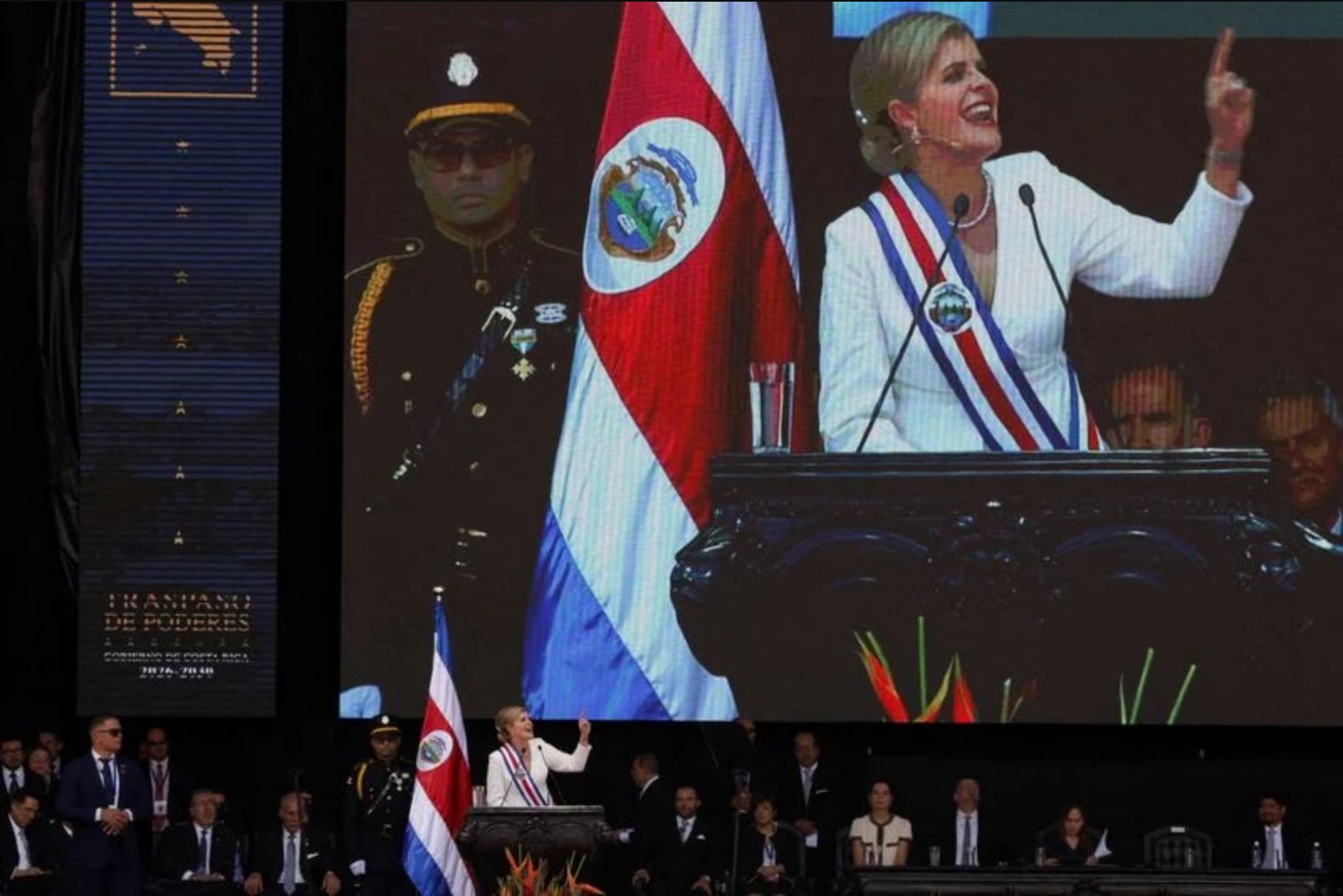
Two months into her presidency, Laura Fernandez is locked in a public dispute with Costa Rica's judiciary that is complicating attempts to coordinate a state response to escalating drug-related violence in the Central American country.
The standoff has its roots in a package of measures that includes sharp budget cuts for the judiciary and a legislative push to move responsibility for appointing the attorney general from the Supreme Court to Congress. Those moves have prompted sharp criticism from court officials and raised concerns about the capacity of state institutions to tackle organized crime.
President Fernandez has accused the judiciary of deep corruption, saying it has been infiltrated "to the core" by organized crime and faulting courts for impeding the "iron fist" security policies her administration favors. Her approach is modeled on policies implemented in El Salvador by President Nayib Bukele, who has overseen mass incarcerations in an effort to curb crime, including the imprisonment of some 90,000 people.
Judicial authorities have rejected Fernandez's allegations of systemic corruption and have challenged the president to present evidence. They contend that the planned cuts to their budget in 2026 and 2027 will undermine democratic checks and balances and blunt their ability to contribute to public security efforts.
Fernandez ran for office on a hardline anti-crime platform and pledged to restore order in a nation of about 5.2 million people where, according to official accounts cited by security officials, an average of two people are murdered every day. The country's homicide rate climbed to a record 17.2 per 100,000 inhabitants in 2023 and has remained largely steady since, roughly double the rate seen a decade earlier.
Security Minister Gerald Campos emphasized the limits of the criminal justice response, telling reporters that only 38% of homicides lead to convictions. "The problem here is not a lack of an army... the problem is a lack of convictions in the courts," he said, pointing to weak prosecution outcomes as a core obstacle to reducing violence.
Government officials, experts and judicial authorities alike attribute the rise in violence to drug trafficking groups exploiting Costa Rica's strategic location as a corridor for narcotics bound for northern markets. Those trafficking networks, they say, have taken advantage of institutional vulnerabilities to expand their operations.
Observers and legal analysts warn that internal political conflict weakens the overall capacity to confront an adversary with substantial resources. "Facing an enemy with infinite resources... fighting among ourselves makes it very difficult to be prepared," said Evelyn Villarreal, coordinator of the State of Justice report, which assesses the country's judicial system.
Shortly after taking office, Fernandez demanded the resignation of Attorney General Carlo Diaz and several top Supreme Court magistrates, arguing they had failed to act decisively on the security crisis. None of the officials she asked to step down have resigned.
Patricia Solano, president of Costa Rica's highest criminal court, dismissed claims that the judiciary bears responsibility for the surge in crime. Solano said she views the administration's measures as an attempt to weaken a crucial democratic institution. "Since 2022, we have seen a systematic attack against the judiciary," she said, referencing the period under the previous administration led by Rodrigo Chaves, who is from the same party as Fernandez.
Solano noted that the prison population has risen 36% since 2020. Costa Rica's incarceration rate was reported at 366 per 100,000 inhabitants in 2024, placing it 22nd globally according to the World Prison Brief.
On the streets, residents expressed frustration that political conflict appears to be taking precedence over coordinated action to reduce violence. "We are still in bad shape, even if they say they are doing things and fighting each other," said Karina Bolaños, a 39-year-old shopkeeper in Goicoechea north of the capital. "The country has changed for the worse."
Contextual note - The institutional dispute has both immediate implications for the functioning of courts and longer-term consequences for how Costa Rica seeks to prosecute and convict those responsible for homicides and drug trafficking. The friction between branches of government is affecting the operational environment for prosecutors, judges and corrections officials involved in the security response.