
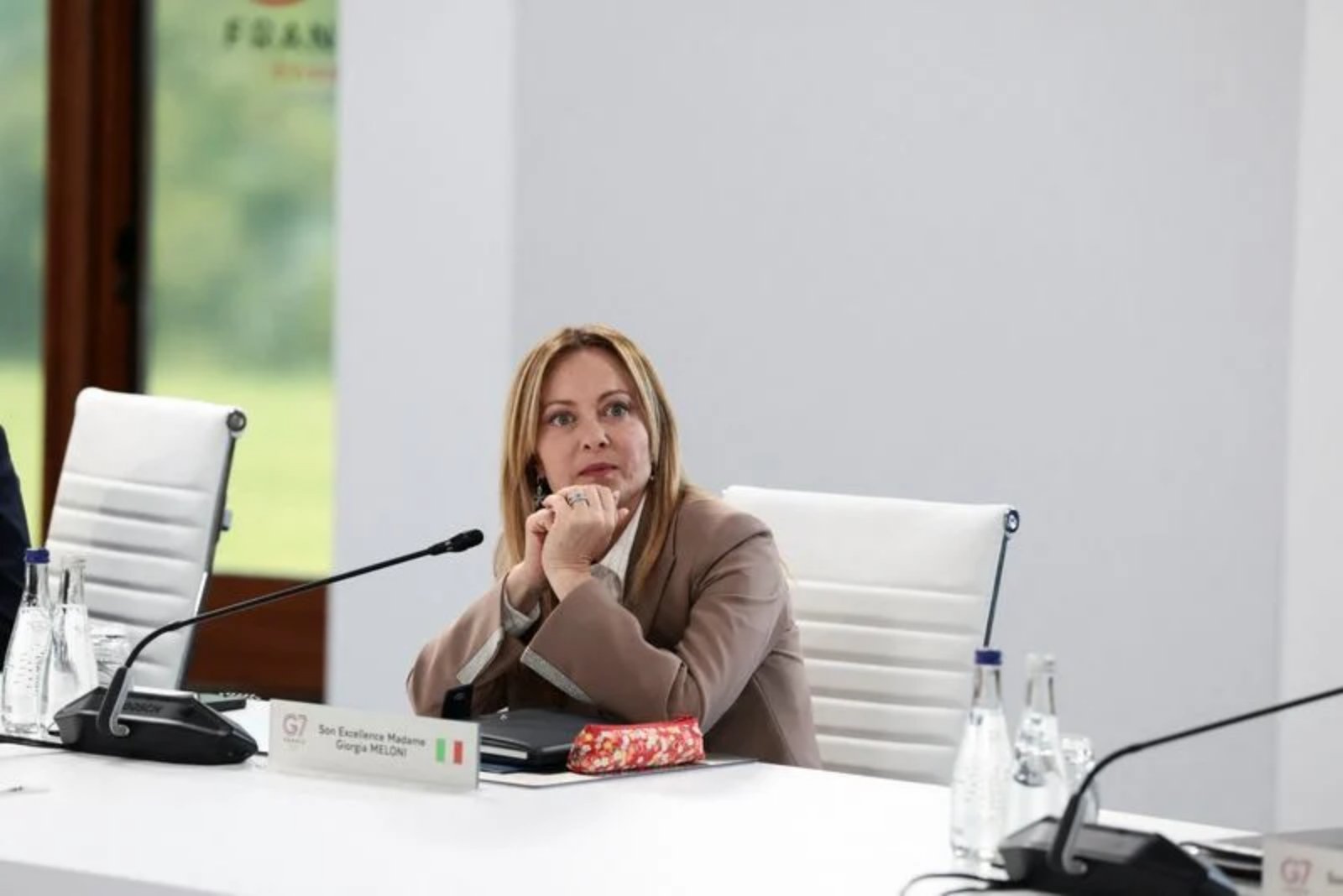
ROME, June 19 - Italian Prime Minister Giorgia Meloni on Friday accused former close ally Donald Trump of inventing a story about her after the U.S. president told an Italian television channel that she had "begged" him to take a photo with her at a G7 summit.
Meloni said she was "astonished" by his comments, calling them "completely made up" and criticised what she framed as Mr. Trump’s softer approach to leaders she described as enemies of the West, compared with the deference he shows toward long-standing allies.
The latest public spat signals a sharp deterioration in relations between the two leaders, occurring only days after scenes at the G7 summit suggested the pair had steadied a relationship that had been strained earlier this year amid disagreements over the war in Iran.
Video recorded at the event in France shows Meloni and Trump engaged in a prolonged conversation. In remarks to La7 TV channel during a short interview, the U.S. president appeared to downplay the exchange, saying he had not been obliged to speak with her and suggesting he had done so as a courtesy.
La7 quoted him as saying: "She’s probably happy I talked to her. I didn’t have to talk to her." The channel also reported Trump as saying: "She begged me to take a picture with her. She wanted a picture with me so badly. I wouldn’t have taken it, but I felt sorry for her," according to La7’s translation.
La7 did not provide the original audio recording, releasing only a dubbed version of the remarks.
Meloni fired back in a public statement: "Donald Trump’s statements are completely made up. I am frankly astonished. I don’t know why the president of the United States behaves like this towards his allies: it is not the first time, moreover."
She added: "I can only say it is disappointing that he does not show the same determination with the enemies of the West and of the United States, whose leaders he instead treats with far greater indulgence." She concluded the rebuke with: "There is one thing he should remember: neither I nor Italy ever beg."
Meloni’s relationship with Trump has shifted over time. She was once a vocal supporter and was the only European leader to attend his inauguration in 2025. That earlier alignment later gave way to criticism: Meloni publicly criticised the U.S. president for his attack on Pope Leo over the pope’s condemnation of the Iran conflict and distanced herself from Trump after the war began.
That distancing prompted a sharp response from Trump, who accused Meloni of lacking courage. The exchange on Friday adds a new public dispute to a relationship that has already seen both public support and pointed rebukes.
Summary
Italian Prime Minister Giorgia Meloni has rejected U.S. President Donald Trump’s claim that she "begged" him for a photograph at the G7 summit, calling the account fabricated and expressing concern that Trump treats adversaries with more indulgence than allies. The confrontation follows recent signs of rapprochement at the G7 after earlier tensions over the war in Iran.
Key points
- Meloni described Trump’s account as "completely made up" and said she was "astonished" by his remarks.
- The exchange represents a sharp deterioration in relations, despite recent appearances at the G7 that suggested the two leaders had steadied a previously strained relationship.
- Meloni was once a vocal supporter of Trump and attended his 2025 inauguration, but later distanced herself after he lashed out at Pope Leo over the Iran conflict; Trump then accused her of lacking courage.
Risks and uncertainties
- Diplomatic friction between Italy and the United States may increase following the public exchange - the article documents a marked deterioration in ties but does not specify subsequent diplomatic actions.
- Public perceptions may be shaped by differing media accounts - La7 released only a dubbed version of Trump’s remarks, and the original audio was not published.
- Political alignment between the two leaders remains uncertain - prior support shifted after Meloni criticised Trump over his response to the pope’s stance on the Iran conflict, and both leaders have issued public rebukes.