
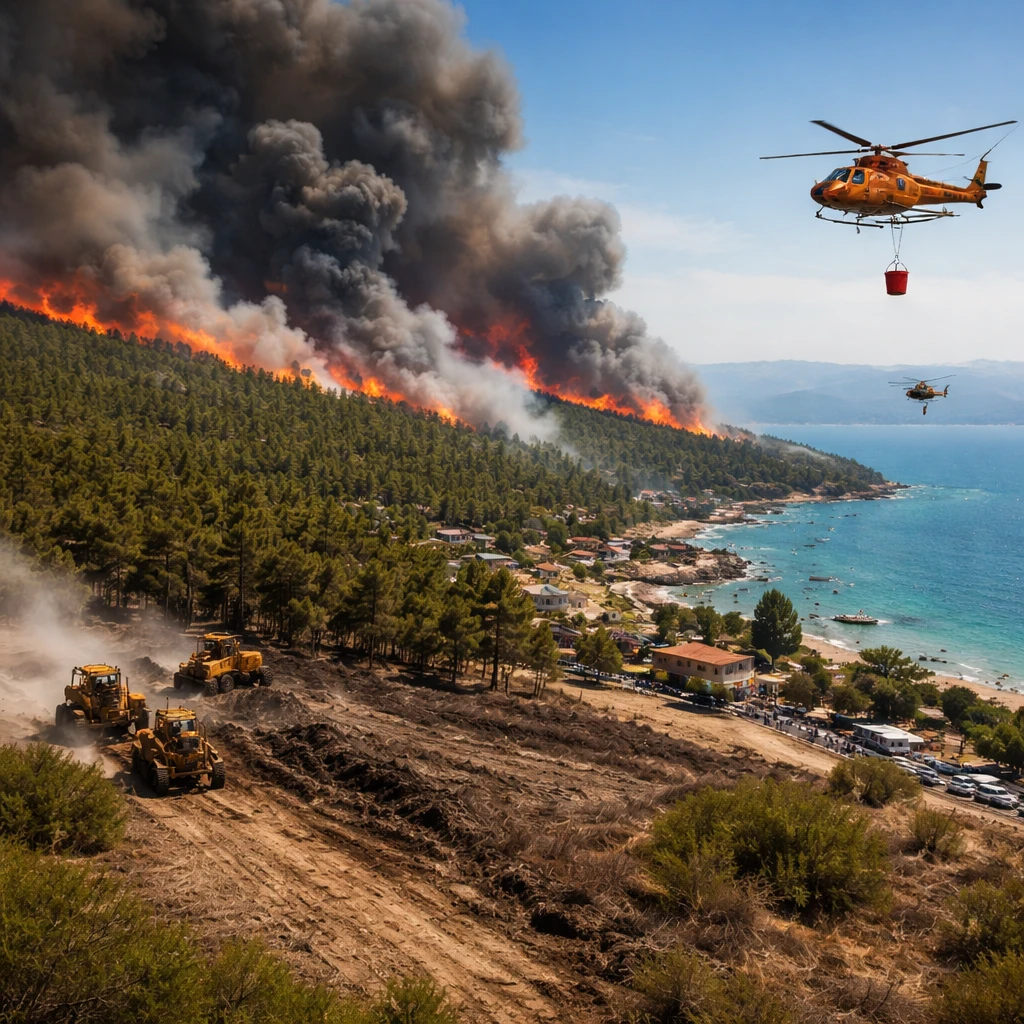
PSATHA, Greece - Aug 3 - Firefighting teams remained engaged on the fourth day of a major wildfire northwest of Athens on Monday, confronting strong, changeable winds that have allowed flames to spread into populated and agricultural areas.
Emergency crews reported extensive damage to homes, dense pine forests and thousands of hectares of farmland, and authorities ordered evacuations by both land and sea as smoke and flames advanced toward settlements.
The situation escalated when two crew members aboard a firefighting helicopter were killed on Sunday after their aircraft collided in mid-air with a second helicopter near the seaside community of Psatha, roughly 40 km (25 miles) from Athens. The two crew aboard the second helicopter survived the encounter and were taken from the scene.
On Monday more than 400 firefighters were on the front lines, supported by 21 aircraft operating near the communities of Kandili and Agia Skepi. Observers described plumes of thick black smoke and visible red tongues of flame consuming extensive stands of pine forest.
Ground crews employed heavy machinery to carve out fire breaks intended to halt the advance of flames toward inhabited areas, according to a Greek fire brigade official. The use of such equipment is part of a broader effort to protect homes and critical infrastructure as aerial operations face constraints.
Deputy Climate Crisis Minister Kostas Katsafados told public broadcaster ERT that strong and erratic winds in recent days had prevented water bombers from drawing seawater, effectively limiting the contribution of aerial assets and leaving firefighters on the ground to confront the blazes largely unaided from the air.
The mid-air collision is under investigation. Aviation accident investigator Faidon Karaiosifidis said investigators currently believe the formation flown by the two helicopters was not appropriate. "The only thing we can say at this stage is that the formation of the two helicopters was not appropriate," he said. "Their vertical and horizontal separation, as well as the descent rate, were inadequate." The crash occurred at low altitude, authorities said.
Greece had experienced a comparably mild fire season by local standards until recent days. Last week, three firefighters were killed in two separate incidents on July 29 on Crete and the Peloponnese, underscoring the intensity of recent operations and the danger faced by crews.
Local residents in the Psatha area have previously raised concerns about forest management, saying that although vegetation clearance around homes has taken place, the broader maintenance and construction of fire breaks within the forests requires further attention.
Fire service unions say the extended and intense period of operations has strained a fire service that remains thinly staffed and equipped. Nikos Lavranos, head of the Federation of Unions of Fire Service Employees, pointed to the staffing legacy of a hiring freeze that followed Greece's 2009-2018 debt crisis and warned of the toll on personnel. "A firefighter who is useful to fellow citizens and society is a rested firefighter, not an exhausted one," he said.
Preliminary findings from a separate incident last week point to an electrical cause in the Boeotia area. Fire brigade investigators indicate a fire that spread roughly 25 km (15 miles) may have been ignited by sparks from vibrating conductors on a private power line that transmits electricity from wind turbines. An electrical engineer and a contractor have been arrested and are being investigated for arson in connection with that incident.
Authorities noted that faulty power lines have been the leading cause of major wildfires in Greece in recent years, followed by arson and negligence. The wider region of Europe has experienced an intense wildfire season after a period of record-breaking heatwaves and low rainfall, conditions experts say have been worsened by a rapidly changing climate. France and Spain saw large blazes earlier in the summer that had eased over the weekend, offering some temporary relief in other affected areas.
Operational update: Firefighting operations continue with more than 400 personnel and 21 aircraft deployed in the Psatha front. Heavy machinery is actively creating containment lines to protect populated areas. Investigations into the helicopter collision and the Boeotia spark-origin fire are ongoing.