
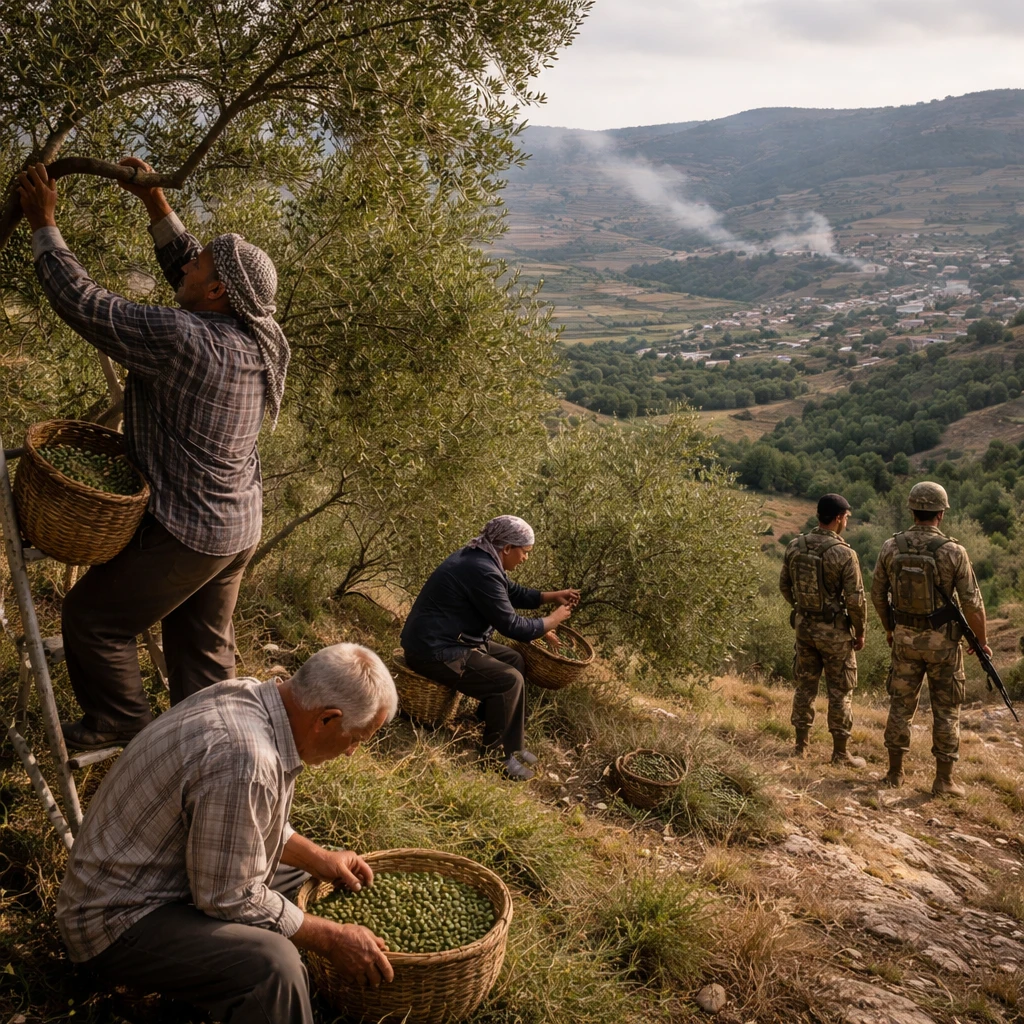
On terraces above a green valley in southern Lebanon, residents of the village of Zibqin are climbing into olive trees to pick the season's fruit, watched over by soldiers of the Lebanese Army. The village lies next to what Israel describes as a self-declared "security zone" in southern Lebanon - an area where Israeli forces have torn down dozens of villages, saying the armed group Hezbollah had embedded itself in civilian infrastructure, a charge Hezbollah denies.
Despite a ceasefire struck in June between the two sides, Israeli shelling frequently hits the valley beneath the olive groves, and the harvest is unfolding under the constant risk of renewed strikes. The situation in Zibqin underscores how violence is again disrupting a yearly cycle that many families depend on for income and food, even as reports elsewhere in the region note rising tensions: Palestinians, Israeli rights groups and the United Nations have reported increased violence and theft of olives by Israeli settlers in the Israeli-occupied West Bank.
Many farmers in Zibqin said they felt compelled to return to the groves because harvesting is central to their livelihoods. Ali Bzieh, 65, a farmer from the village, sat beneath an olive tree and described the pressure to gather the crop. "This is my land, this is my livelihood, this is a harvest we wait for from one year to the next," he said. "We have an attachment to this land, to the plants, and to the crops - we don't leave them."
Limited protection
After the June ceasefire, many families returned to Zibqin, but the local situation remains fragile, according to Raef Bzieh, a local official. "The ongoing bombing and the aggressions taking place on the outskirts of the village have of course caused worry and panic among the people," he said.
Residents requested that the Lebanese Army accompany them to their fields to reduce risk during the harvest. Even with soldiers present, some villagers say the protection is not enough. "But if the Israelis decide to cause harm, they can harm us, and the army," said Mustafa Barakat, a 50-year-old carpenter from the village. "They have struck the Lebanese Army more than once."
The conflict has taken a toll on military personnel as well. According to statements posted by the Lebanese Army on X, Israeli attacks have killed 26 Lebanese soldiers in 2026. The Lebanese Army says it is not a party to the fight between Hezbollah and Israel.
In response to questions, the Israeli military told Reuters that its strikes inside Lebanon target Hezbollah and its infrastructure and are not aimed at the Lebanese Army or civilians. The Israeli military also said it is working to "enable the olive harvest and assist residents in carrying it out". Posts on the Israeli military's website report that 38 Israeli soldiers have been killed in southern Lebanon in 2026.
Harvest reshaped by conflict
For villagers like Barakat, the conflict has altered a once communal seasonal routine. He recalled how harvest days used to begin at dawn and continue until sunset. Those times have become restricted: he now goes into the groves only when the Lebanese Army is on site.
"In the past, we used to treat this (harvest) season like an outing," he said, remembering family gatherings in the fields where relatives prepared food and worked together. "Now, you can't bring children… bombing could occur, and they could get hurt," he added.
The war has also affected the trees and yields. Ali said that displacement during the year meant they could not tend the olive trees as they normally would, and that his harvest was half of a typical year's yield. He had been displaced for several months and said he hoped the situation would not deteriorate further and force his family to flee again.
Many residents remain prepared for renewed escalation. Some continue to pay rent on apartments in areas farther north in case they must leave. Others have already reserved alternative accommodation to use if the situation deteriorates.
Continuity and identity
Despite the risks, the olive harvest has not been abandoned. For those who returned, working the land is a matter of identity and survival. "This land is our identity, it is the passport we carry," Barakat said. "If we abandon it, we are truly left without an identity."
As the harvest continues under military escort and the threat of strikes, the farmers of Zibqin are trying to preserve both a source of income and a connection to land they say has sustained their families for generations.