
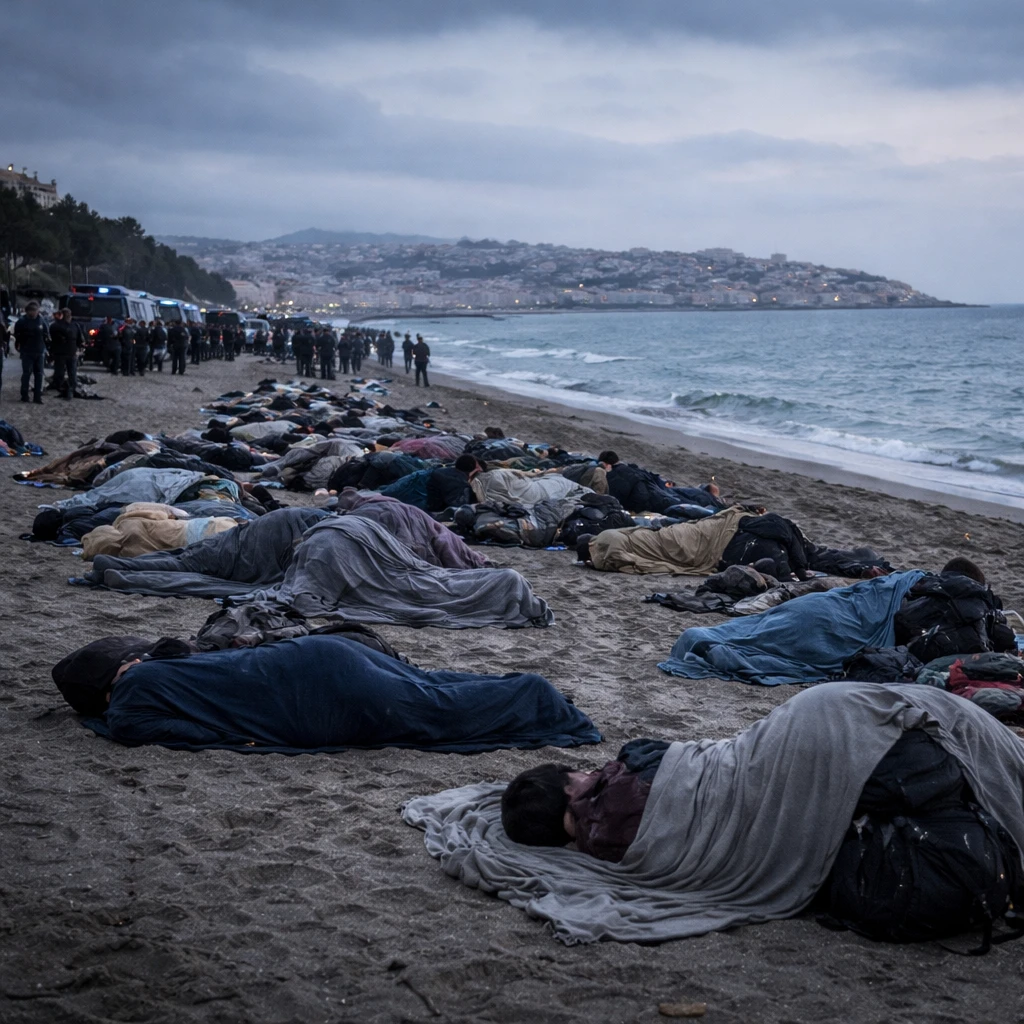
Hundreds of people have pitched makeshift shelter on a Ceuta beach as local officials work to manage the large number of migrants who remain in the Spanish North African enclave after a sudden border surge last week. Authorities say about 69,500 migrants were returned to Morocco over a four-day period - a figure that surpassed initial estimates of roughly 50,000 arrivals recorded on Thursday.
Spanish authorities report the official death toll from the episode at the land border stands at 72 on the Spanish side, with a further 11 deaths recorded on the Moroccan side. Many of those who left Ceuta said they had been forced by closed shops and a lack of food, faced hostility from local residents, or lacked the ability to continue their journey to mainland Spain.
Ceuta and Melilla, Spain's two North African enclaves, lie on Morocco's Mediterranean coast and repeatedly face attempts by migrants seeking entry into Europe. Video footage from the enclave showed scores of migrants - predominantly from sub-Saharan Africa - lying on the sand of El Trampolin beach, many wrapped in towels against the wind, while army and police vehicles patrolled a road nearby.
Ceuta's regional leader, Juan Jesus Vivas, told broadcaster Telecinco that between 3,000 and 5,000 migrants remained in the enclave and that the city's two migrant reception centres - one for adults and another for minors - had "collapsed" under the pressure. A local official, Alberto Gaitan, said the city was processing 862 migrant minors, who benefit from special legal protections against deportation.
The crisis has prompted heightened anti-immigration rhetoric across Europe and created diplomatic tensions within the European Union over how to address border policy. Spain has publicly criticised some EU partners for what it calls an unhelpful and polarising response to the situation.
Foreign Minister Jose Manuel Albares said on Monday that Spain had previously provided assistance to other EU countries during migration crises and now expected reciprocal support. The European Union has convened an emergency video conference of interior ministers scheduled for Tuesday to discuss the situation.
Albares also levelled a sharp critique at Italy's government, accusing it of contributing to the spread of misinformation. He said Morocco had quickly provided police support without attaching conditions to its cooperation, enabling the rapid return of most people who crossed the border.
By contrast, Vivas expressed deep mistrust of Rabat, saying there was a widespread perception in Ceuta that Morocco had either permitted or orchestrated the mass crossing. "Morocco has shown us that it isn’t reliable. There’s no alternative but to put in place whatever means are necessary to ensure it cannot do this again," he told newspaper El Pais.
Morocco's Interior Ministry issued a statement blaming the surge on misinformation circulating on social media, the actions of human trafficking networks, and a mistaken interpretation of a Spanish court ruling that restricted the immediate return of migrants intercepted at sea. The ministry said Morocco was "committed to strengthening international cooperation and coordination in combating irregular migration and human trafficking."
Reports in El Pais and Cadena SER, citing officials familiar with intelligence assessments, said Spanish intelligence services have concluded that Moroccan authorities did not plan the mass crossing but effectively allowed it to occur. Those reports asserted Moroccan border controls were increasingly relaxed through July and were reportedly removed as crowds pushed toward the Tarajal crossing during Morocco's Throne Day holiday.
Morocco's Interior Ministry did not immediately respond to a request for comment about those reports.
Tensions have also surfaced within Madrid's government over the question of prior intelligence. Spain's Interior Minister, Fernando Grande-Marlaska, said on Saturday that the foreign intelligence agency CNI - which is under the Defence Ministry's control - did not warn him of an imminent surge.
El Pais reported that revelation had created strains between the Interior and Defence ministries. An Interior Ministry spokesperson sought to downplay the reported tensions, while Defence Minister Margarita Robles declined to detail whether the CNI had prior intelligence of the mass crossing, noting that the agency's work is secret and praising the "exceptional" performance of Spain's security services personnel.
For now, local authorities in Ceuta continue to process arrivals and manage humanitarian needs amid damaged infrastructure and full reception centres. The situation remains fluid, with diplomatic exchanges and domestic political debates ongoing as Madrid seeks both regional cooperation and backing from European partners.