
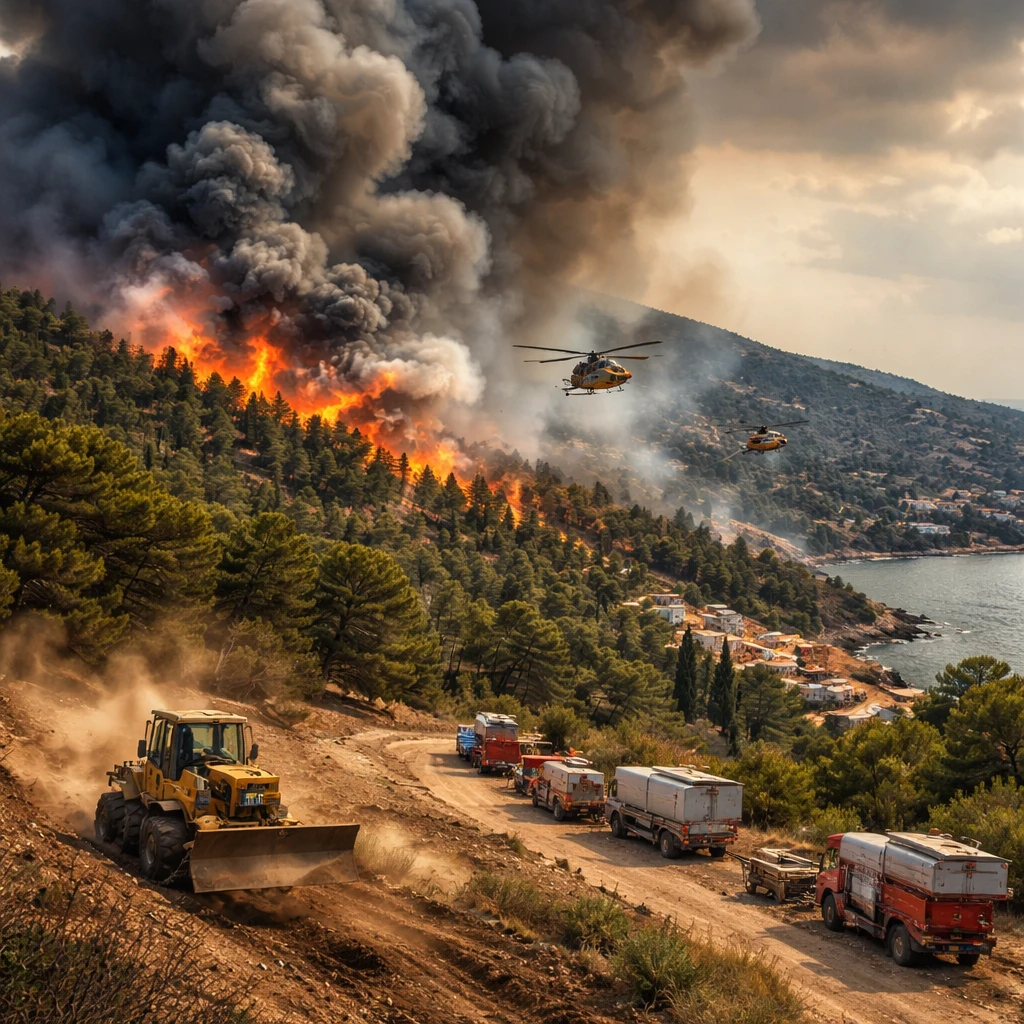
Emergency teams continued battling an extensive wildfire northwest of Athens on the fourth day of operations, as flames driven by strong winds consumed homes, thousands of hectares of farmland and pine forest and prompted evacuations both by land and by sea.
On Sunday, two people serving on one firefighting helicopter were killed after that aircraft collided in mid-air with a second firefighting helicopter near the seaside community of Psatha, about 40 miles from Athens. The two victims were a Greek national and a Danish national. The second aircraft’s crew, consisting of a Greek national and a British national, survived the incident.
Firefighting resources were reinforced early on Monday around the communities of Kandili and Agia Skepi, with water tanks, heavy ground forces and 21 aircraft deployed to the affected area. Reuters images showed thick black smoke and red flames overtaking lush pine stands as crews sought to limit the blaze’s advance.
Local authorities used heavy machinery to construct fire breaks in an effort to prevent the flames from reaching homes, a Greek fire brigade official said. Ground crews have been working alongside aerial units where possible, but strong winds over recent days have complicated operations.
Deputy Climate Crisis Minister Kostas Katsafados described the situation in stark terms, saying: "We’re fighting an unequal battle with the impact of the climate crisis." He added that the strong winds in the area recently made it impossible for water bombers to draw sea water and carry out dumping runs, leaving firefighters on the ground to confront the blaze largely without aerial water support.
The deadly air collision came amid a broader, difficult week for Greek emergency services. On July 29 three firefighters were killed in two separate incidents, one on Crete and another on the Peloponnese, marking a grim start to the season even as other recent fire seasons have at times been relatively mild by local standards.
Authorities said they are trying to establish the precise circumstances of the mid-air crash, which occurred while both helicopters were operating at low altitude. Footage that circulated on social media showed the rotor blades of one helicopter appearing to clip the underside of the other.
Separately, a preliminary investigation by the Greek fire brigade points to sparks from vibrating conductors on a private power line as the origin of the outbreak in the Boeotia area northwest of Athens last week. That blaze spread into a pine forest close to the capital.
Two Greek nationals, described by authorities as an electrical engineer and a contractor, have been arrested and face felony arson charges in connection with the incident. Officials note that faulty power lines have emerged as the leading cause of major wildfires in Greece in recent years, surpassing arson and negligence as primary causes.
Across Europe, this summer has seen extensive wildfire activity following record-breaking heatwaves and scant rainfall, conditions that scientists say have been exacerbated by a changing climate. While France and Spain experienced particularly destructive blazes earlier in the season, authorities in those countries reported an easing of intense activity over the weekend that provided some respite.
The ongoing operations northwest of Athens highlight several operational challenges: rapidly shifting winds that limit aerial firefighting effectiveness, the need to protect populated areas and agricultural land, and the human toll among emergency responders. Investigations into the origin of the fires and the circumstances surrounding the helicopter collision remain active.