
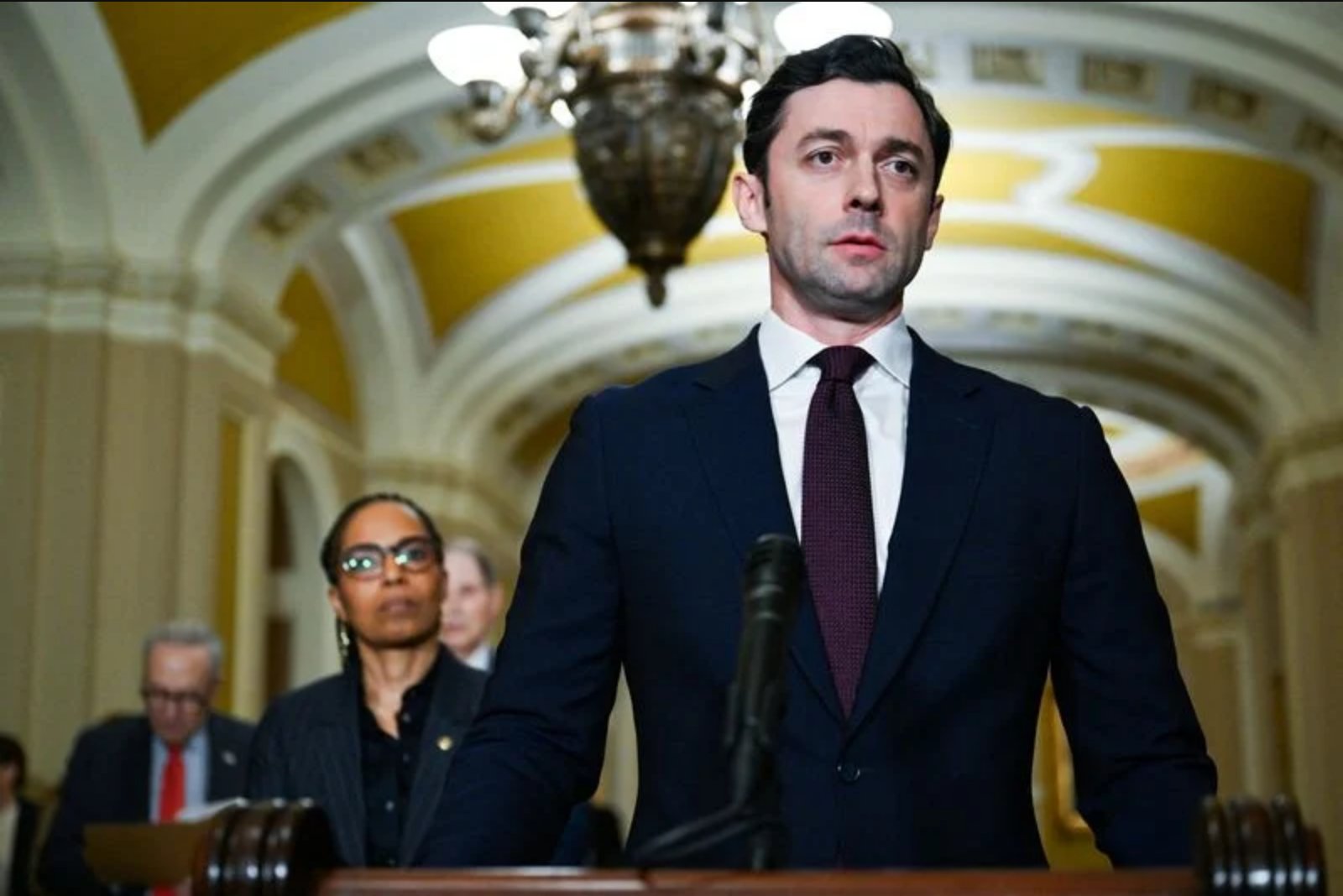
Republican voters in Georgia are set to pick their U.S. Senate nominee in a runoff election on Tuesday, with Representative Mike Collins and former college football coach Derek Dooley competing to take on Democratic incumbent Jon Ossoff.
Collins finished first in the May 19 primary with 40% of the vote, about 10 percentage points ahead of Dooley. Over the past weekend, former President Donald Trump formally endorsed Collins, labeling him a "WARRIOR and WINNER" and saying Collins supported Trump "from the very beginning." Collins has been referred to by some as "MAGA Mike".
The victor of the runoff will challenge Ossoff, who is the only incumbent Senate Democrat up for reelection in a state that President Trump won in 2024, and who has been mentioned as a potential Democratic presidential candidate in 2028. Republicans currently hold a 53-47 majority in the Senate, giving them relatively limited openings to add seats; top Republican pickup targets include Georgia and Michigan, both states that the president narrowly carried.
Local dynamics and incumbent strength
Despite Ossoff’s positioning to the left of many Georgia voters, political observers point to his active constituent services and significant time spent in the state as factors strengthening his reelection prospects. Charles Bullock, a political science professor at the University of Georgia, said that even some Republican campaign consultants and activists he speaks with "are pretty much willing to concede that, yeah, Ossoff’s going to be able to hold this seat," reflecting a view that the incumbent’s local presence makes the contest difficult for challengers.
Fundraising and outside spending
Fundraising numbers underscore Ossoff’s advantage. He has raised $60 million in total and reported entering May with nearly $33 million on hand. Political prognosticators currently view him as the favorite for reelection. Neither Collins nor Dooley has reported raising more than $5 million, and both reported having less than $2 million cash on hand as of May 27.
Outside groups are also positioning resources around the race. The Democratic Senate Majority PAC has reserved $20 million in television advertising in Georgia, while the Republican Senate Leadership Fund has pledged to invest $44 million into efforts to flip the seat.
Broader Senate map and implications
For Democrats to win control of the Senate in November’s midterm elections, they would need to net four seats. Electoral forecasters have recently shifted the outlook in several states, with Sabato’s Crystal Ball moving North Carolina’s open seat to lean Democratic and reclassifying Alaska and Ohio from Republican-leaning to toss-ups.
The Democratic Party has strong nominees in several of these competitive races: former North Carolina Governor Roy Cooper in North Carolina, former Representative Mary Peltola in Alaska, and former Senator Sherrod Brown in Ohio. Observers say those candidacies are aided by factors including the former president’s low approval rating and concerns about the high cost of living, which the article links in part to the ongoing U.S.-Israel war with Iran.
Sitting Republican Senator Susan Collins of Maine is highlighted as the most vulnerable incumbent Republican, representing a state that Democratic presidential candidate Kamala Harris carried by nearly 7 percentage points in 2024. Collins will face Graham Platner, a progressive oysterman who won the Democratic nomination despite several controversies.
Democrats also see potential in adding states to the competitive map, citing nominations in Iowa and Texas by state Representative Josh Turek, a paralympian, and state Representative James Talarico, a Presbyterian seminarian. In 2024, President Trump won Iowa by 13 percentage points and Texas by 14 percentage points.
Outlook
The Georgia runoff will decide which Republican faces a well-funded incumbent with a strong on-the-ground operation. While national observers mark Georgia as a key battleground, the contest is one of several that will determine which party controls the Senate after the midterms.