
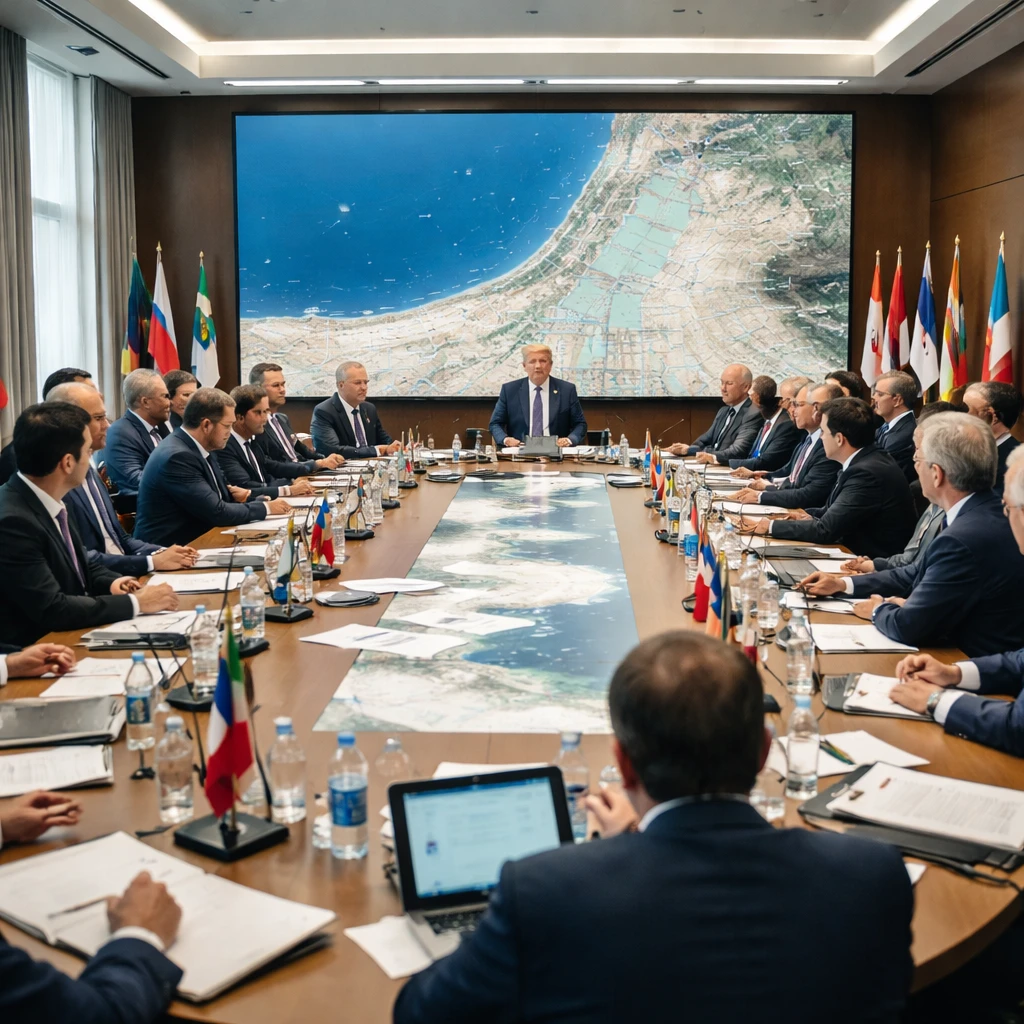
U.S. President Donald Trump announced on Thursday that his so-called Board of Peace had reached an agreement calling for the complete disarmament of Hamas and other armed factions in Gaza and for Israeli forces to withdraw from the territory as that disarmament is carried out. Trump characterized the arrangement as "historic" and said it would be rolled out in phases. As of late April, Israeli forces controlled about two-thirds of Gaza.
The Board of Peace is a U.S.-led initiative that has attracted both praise from allied backers and criticism from rights advocates and other states. Supporters present it as an innovative approach to resolving complex conflicts and coordinating post-conflict reconstruction. Detractors describe the effort as resembling an imperial governance model and have questioned whether it undermines or marginalizes the role of the United Nations.
What is the Board of Peace?
The board was first proposed by Trump in September when he unveiled his plan for ending the war in Gaza. Trump subsequently indicated the board would not be limited to Gaza, saying its remit would expand to other conflicts worldwide and that he would chair it. Such a role traditionally falls to the United Nations.
The board’s charter sets out membership rules that include a three-year term limit for members unless they pay $1 billion each to become permanent members. In January, the White House named several figures to the initiative’s founding Executive Board: U.S. Secretary of State Marco Rubio, Trump’s special envoy Steve Witkoff, former British Prime Minister Tony Blair and Jared Kushner.
Which countries are listed as founding members?
The board’s official website lists more than two dozen founding members spanning the Middle East, Europe, Asia and Latin America. Among Washington’s primary regional partners included are Israel and Saudi Arabia, along with Egypt and Qatar, which were instrumental in mediating the October ceasefire talks between Israel and Hamas. Additional Middle Eastern participants listed are Bahrain, Jordan, Kuwait, Morocco, Turkey and the United Arab Emirates.
Beyond the region, the founding membership includes Albania, Argentina, Armenia, Azerbaijan, Belarus, Bulgaria, Cambodia, El Salvador, Hungary, Indonesia, Kazakhstan, Kosovo, Mongolia, Pakistan, Paraguay, Uzbekistan and Vietnam.
Which major countries have not joined?
Several key Western allies and prominent Global South powers have declined to join. Leaders from Britain, the European Union, France, Germany, Norway and Sweden stated they will not participate. Brazil and Mexico have said they will not join, citing the absence of a Palestinian representative on the board. Canada was removed from an invitation earlier in the year after Trump objected to a speech by Prime Minister Mark Carney in Davos.
The Vatican has declined to sign on, saying that crisis management should be handled by the United Nations. China and Russia - both veto-wielding members of the U.N. Security Council - have not joined, according to the board’s membership lists. Other large democracies such as India and South Africa also did not accept the offer to participate.
What authority does the board have?
The U.N. Security Council in November adopted a U.S.-drafted resolution that recognized the board in a limited and transitional capacity, welcoming it as a temporary administration meant to establish a framework and coordinate funding for Gaza’s redevelopment under Trump’s plan. The resolution authorized the board to deploy an International Stabilization Force in Gaza on a temporary basis and restricted the board’s formal scope to Gaza and to operations through 2027.
The resolution requires the board to report to the 15-member Security Council every six months. China and Russia abstained from the vote, voicing concern that the resolution did not define a clear continuing role for the United Nations in Gaza’s future governance.
Outside the narrowly defined mandate in the Security Council resolution, the board’s legal authorities remain uncertain. It is unclear what enforcement tools or wider international legal standing the board possesses beyond Gaza, or how it would coordinate and integrate with the U.N. and other international organizations for broader peace-building operations. The charter states the board will perform "peace-building functions in accordance with international law."
The charter also vests extensive executive powers in the board’s chairman, President Trump, including the ability to veto decisions and to remove members, subject to constraints spelled out in the charter.
What criticisms has the board faced?
Rights advocates have raised several objections. Some say that an arrangement in which Trump oversees a board charged with supervising a foreign territory’s affairs evokes a colonial or imperial dynamic. Critics have pointed to the absence of any Palestinian representative on an entity intended to administer a Palestinian territory on a temporary basis.
Questions have been raised about specific appointments on the board. Tony Blair’s inclusion has been controversial for some, given his association with the Iraq war and debates over foreign interventions. The presence on the board of several countries with contested human rights records - including certain Middle Eastern governments, Belarus and El Salvador - has also drawn scrutiny from rights groups.
There has been particular unease about Israel’s place on a body charged with overseeing Gaza’s temporary governance. Gaza has been left devastated by an Israeli military campaign that, according to the article’s account, killed tens of thousands, produced widespread hunger, internally displaced the enclave’s entire population and prompted assessments of genocide by rights experts, scholars and U.N. inquiries. Israel has defended its actions as self-defense after Hamas militants killed 1,200 people and took more than 250 hostages in a 2023 attack.
How has the board operated in recent months?
According to Trump, the board’s first meeting took place in February, and he said nations had contributed $7 billion to a Gaza reconstruction fund to rebuild the enclave once Hamas disarms. Estimates for the total cost of rebuilding Gaza, which the article says has been reduced to rubble after more than 2.5 years of Israel’s assault, range up to $70 billion.
Days after the start of the U.S.-Israeli war on Iran, Indonesia - a listed board member - announced it had put discussions with the board on hold because of the Iran conflict. Despite that pause, the board continued to hold talks related to Trump’s Gaza plan.
U.N. Secretary-General Antonio Guterres said in April that he was cooperating with the board on Gaza. Later that month, the Financial Times reported that the board had held discussions with state-owned Dubai multinational DP World about potential roles in managing supply chains and infrastructure projects in Gaza. In early July, a board official indicated plans for a pilot humanitarian zone for Palestinians in Gaza were being considered.
What remains unresolved?
Fundamental questions persist about the board’s long-term legitimacy, legal reach and operational capacity. While the Security Council resolution gives the board a constrained and temporary role in Gaza through 2027, it does not clarify how the board would function beyond that timeline or how it would reconcile its stated global ambitions with the U.N.-centered architecture that typically governs international peace-building operations.
With a mix of participating states, notable absences among major powers, and critiques over membership and structure, the Board of Peace faces political and practical headwinds as it seeks to implement its plans for Gaza and present itself as a model for future conflict zones.
Summary: President Trump’s Board of Peace says it has secured a phased plan for Hamas disarmament and Israeli withdrawal from Gaza and has drawn over two dozen founding members. The initiative received limited recognition in a U.N. Security Council resolution narrowly authorizing its role in Gaza through 2027, but it has been criticized for its structure, member composition and lack of Palestinian representation. The board has engaged in fundraising and held talks on logistics and reconstruction, while important global players have declined to join.