
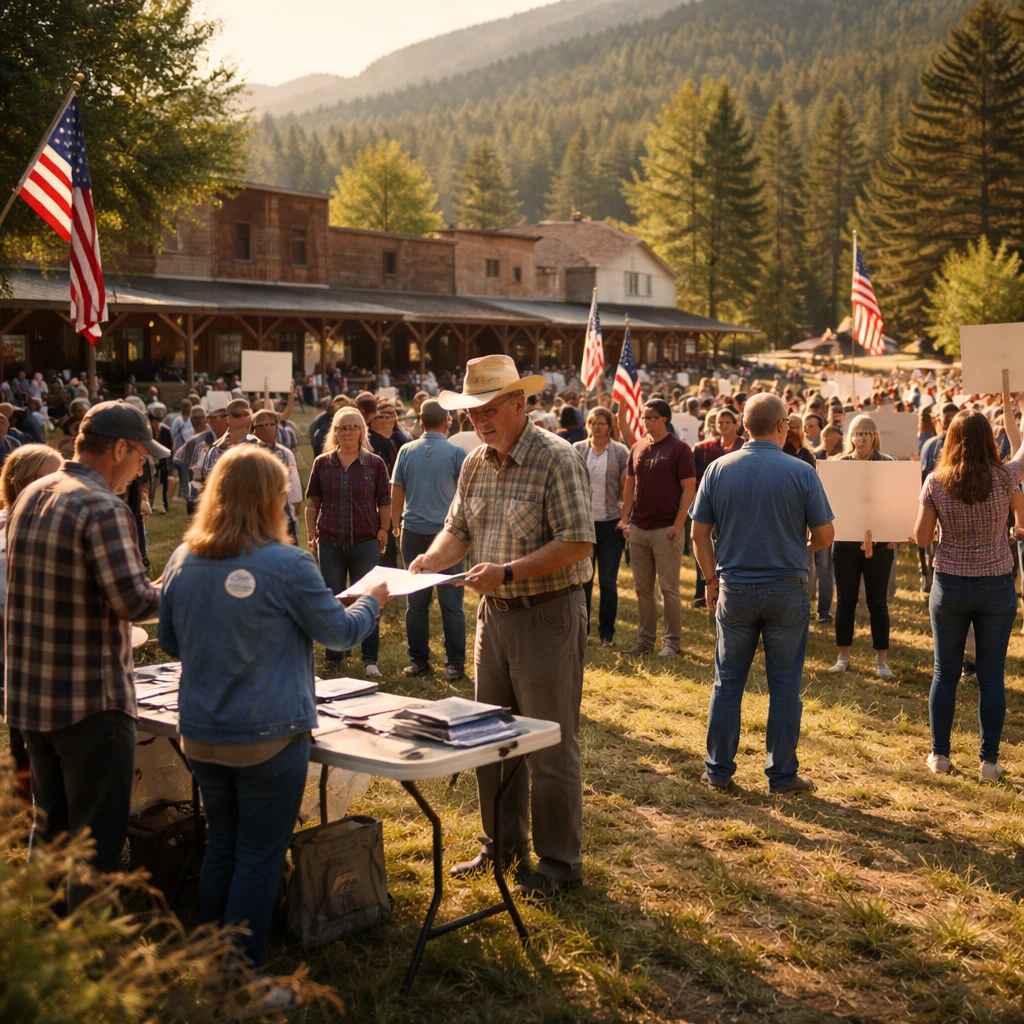
More than 15 years after the U.S. Supreme Court's 2010 Citizens United ruling reshaped the financing of American campaigns, Montana is poised to test a new approach to curbing corporate influence in elections. In November, voters in the state will decide on Initiative 194, known as the Montana Plan, which would bar corporations and other "artificial persons" from spending money on elections.
Rather than mounting a direct legal challenge to Citizens United, proponents of the ballot measure are seeking to work around that decision by targeting the state-conferred powers corporations enjoy. The move is part of a broader, coordinated strategy being pursued in more than 30 states and could set a precedent with national implications, including the possibility of another confrontation at the Supreme Court.
Tom Moore, a lawyer with the Center for American Progress and described by supporters as the legal architect of the movement, said the initiative responds to mounting frustration across political lines. "Americans are losing the belief that they have any influence over our politics," he said.
Hawaii's legislature enacted a similar law earlier this year, a development credited to organizers working on the Montana effort. That parallel activity underscores the expansion of this strategy beyond a single state and the potential for wider adoption.
That the measure reached the ballot in Montana - a state that President Donald Trump carried by nearly 20 points in 2024 - may surprise observers who associate limits on corporate political activity with more liberal jurisdictions. Yet the push taps into a longstanding local distrust of concentrated economic power. Interviews with voters, historians and political scientists suggest a deep-rooted skepticism in Montana of moneyed influence, a sentiment echoed by national polling showing broad support for restoring limits on political spending.
A Brennan Center for Justice survey cited this year found that 79% of Americans across parties would back a constitutional amendment to reinstate limits on political spending. No independent public polling has yet been released specifically on Initiative 194, however.
The Montana Plan has drawn a varied coalition. It is being promoted by populist Democrat Sam Forstag, who has made the initiative central to his campaign for Montana's 1st Congressional District, and has received backing from former Republican Governor Marc Racicot. The state Republican party and a number of business groups oppose the measure.
Local supporters include conservatives who say the initiative addresses out-of-state spending. Steve Hadnagy, a self-described conservative libertarian from the copper-mining town of Butte, said he plans to vote yes on I-194 to block corporate money flowing into Montana from outside. "They’re dumping millions of dollars into elections here, setting up the candidates they want in power who will do what they ask," he said. "I think people want to do something about it."
Supporters point to the dramatic growth of outside spending since Citizens United, the decision that held corporations and unions have a First Amendment right to spend unlimited money independently of campaigns. That ruling helped give rise to super PACs and 501(c)(4) nonprofits, commonly known as C4s, which can spend on elections without disclosing donors.
OpenSecrets data cited by advocates shows known corporate contributions to federal outside political groups climbed from $13 million in 2010 to more than $600 million so far this year. In Montana, the Transparent Election Initiative, the organization behind the Montana Plan, reports that tracked independent political expenditures jumped from $33,000 in 2008 to $162 million in 2024, also based on OpenSecrets figures. Advocates emphasize that those numbers understate the true magnitude because much spending remains opaque.
"No one knows how much corporate spending is pouring into elections," said Craig Holman, a longtime campaign finance expert at Public Citizen.
The Montana Plan's legal design focuses on corporate powers rather than corporate rights. State governments confer and define corporate charters and the scope of corporate activity. I-194 would prohibit all "artificial persons" from political spending, language that would encompass corporations, unions, C4s and any corporation doing business in Montana, even if it is not chartered in the state.
The initiative would not stop wealthy individuals from spending freely, but it would eliminate their ability to do so anonymously, supporters say.
Montana's business community has been the most prominent source of opposition. Lorraine Clarno, CEO of the Kalispell Chamber of Commerce, noted that her group has used contributions from local businesses to educate the public on ballot measures ranging from school levies to jail funding. The Montana Chamber of Commerce sought to prevent I-194 from appearing on the ballot through litigation but was unsuccessful. Its president, Todd O’Hair, has called the measure plainly unconstitutional.
Legal scholars are divided over how the courts might respond. Justin Levitt, a Loyola University law professor, described the initiative as "bold and unusual," suggesting it could force the Supreme Court to weigh the corporate free-speech rights recognized in 2010 against longstanding legal precedent upholding states' authority to define the permissible activities of corporations. By contrast, UCLA law professor Richard Hasen characterized the effort as "an end run" around Citizens United and expressed skepticism that the conservative majority on the Supreme Court would accept it.
Moore said versions of I-194 are active or being considered in roughly 32 states, either as ballot initiatives or pending legislation, indicating the potential for broad legal and political reverberations depending on Montana's vote.
Distrust of corporate power has deep roots in Montana. In the late 19th and early 20th centuries, so-called Copper Kings exerted outsized influence over state politics, bribing legislators and purchasing a U.S. Senate seat, a scandal still recounted in local classrooms. That history contributed to a 1912 ballot initiative in which Montana voters passed the Corrupt Practices Act to ban corporate election spending. That state law remained in force until it was struck down by the U.S. Supreme Court in 2012.
Brenda Wahler, a fourth-generation Montanan and historian, recalled fierce opposition from large copper companies when the 1912 measure passed. "People in Montana have used the power of the ballot to take back power for well over 100 years," she said.
Forstag, a former Forest Service smokejumper and union leader, has tied the Montana Plan to broader concerns about economic fairness. He said the initiative speaks to many of the systemic problems affecting working people and has made it a centerpiece of his congressional bid. Speaking during a campaign stop in Columbia Falls, Forstag said the proposal is woven through the issues that leave working families disadvantaged.
Columbia Falls, once a blue-collar town anchored by an aluminum plant that has since closed, has seen rising housing costs tied in part to newcomers from states such as Texas and California. Local voters describe a sense that political influence has shifted away from everyday residents and toward outsiders with deep pockets.
Independent voter Keith Meehan, 52, displayed a pro-Montana Plan yard sign he picked up at a Forstag rally and said he remembers a time when campaigns relied less on negative mailers, robocalls and television spots. "People used to listen to what every candidate had to say," he said. "It would be awesome to have a more level playing field again."
The outcome in Montana will be closely watched by advocates, opponents and legal scholars alike. A vote for I-194 could embolden similar efforts in other states and invite judicial review that tests the boundaries of state authority over corporate powers. A vote against it would leave in place the existing balance that has allowed outside spending to expand since Citizens United.
For now, the campaign over corporate money in politics has brought together an unlikely mix of supporters and opponents in a state where distrust of concentrated wealth has a long pedigree. How Montana voters respond in November will determine whether that history translates into a new legal and political frontier for regulating money in American elections.