
Overview
The United States has announced a plan to remove roughly 5,000 troops from its forces stationed in Germany, the largest U.S. base in Europe. German Defence Minister Boris Pistorius said the move should act as a catalyst for Europe to build stronger defence capabilities. Meanwhile, two prominent Republican members of Congress voiced alarm, urging that forces not be removed from the continent.
The decision and immediate effects
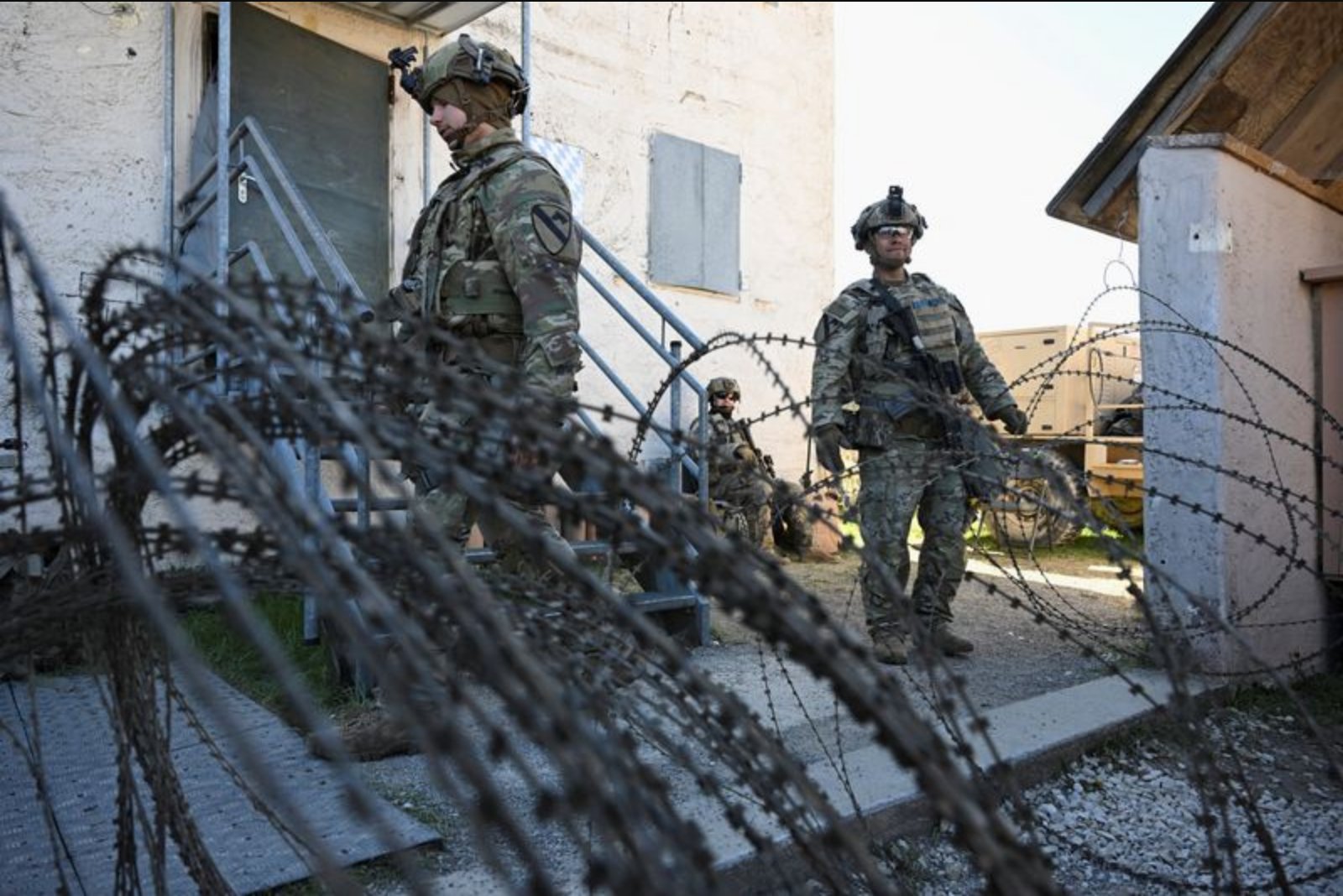
The Pentagon disclosed the troop drawdown on Friday, and provided limited detail beyond the scale and timing. The U.S. military presence in Germany currently numbers almost 40,000 soldiers. Officials said the withdrawal is expected to be completed over the next six to 12 months, but did not identify specific bases that would be affected nor whether the personnel would return to the United States or be redeployed elsewhere in Europe or beyond.
In conjunction with the reductions, a plan originating in the Biden administration to station a U.S. battalion equipped with long-range Tomahawk missiles in Germany has been dropped. German officials had supported that deployment as a strong deterrent against Russia, and the cancellation represents a setback for those plans.
German government response
Defence Minister Boris Pistorius framed the move as an expectation rather than an unexpected shock, saying the partial withdrawal would affect the current U.S. presence in Germany and that Europeans must assume greater responsibility for their own security. He highlighted steps Germany is taking to increase its capabilities by expanding its armed forces, accelerating procurement, and improving military infrastructure.
Germany is pursuing a plan to raise the active-duty strength of the Bundeswehr from around 185,000 to 260,000 soldiers, although some critics argue for an even larger increase in response to the perceived threat from Russia.
Reaction from U.S. Republican lawmakers
Senator Roger Wicker and Representative Mike Rogers, chairs of the Senate and House armed services committees, issued a joint statement expressing they were "very concerned." They argued that troops should not be moved out of Europe and instead should be shifted eastward. In their joint statement they warned: "Prematurely reducing America’s forward presence in Europe before those capabilities are fully realized risks undermining deterrence and sending the wrong signal to (Russian President) Vladimir Putin."
President Donald Trump, speaking to reporters in Florida, said: "We’re going to cut way down and we’re cutting a lot further than 5,000," when asked about the plan. Trump has previously called for a smaller military footprint in Germany, a position he first promoted during his initial term, and has repeatedly urged European countries to assume greater responsibility for their defence.
NATO coordination and allied concerns
A NATO spokesperson said the alliance is engaging with the United States to understand the details of the decision. Some NATO members have pledged to take on a larger share of collective defence, but analysts note that fiscal constraints and capability gaps mean it will take years for Europe to fully meet those commitments.
Poland’s Prime Minister Donald Tusk, whose country is seeking reassurances of continued U.S. support on NATO’s eastern flank amid the Russia-Ukraine war, expressed alarm. He warned that the alliance faces a deeper danger from internal disintegration than from external foes, posting on X: "The greatest threat to the transatlantic community are not its external enemies, but the ongoing disintegration of our alliance. We must all do what it takes to reverse this disastrous trend."
Operational implications: brigade withdrawal and cancelled long-range fires battalion
The Pentagon decision will result in the withdrawal of one full brigade from Germany. Equally significant, the planned long-range fires battalion that was due to be deployed later this year has been cancelled. That battalion would have added long-range strike capability to NATO’s posture in Europe and was viewed by some German officials as a key element of deterrence against Russia while European partners worked to develop similar capabilities.
Christian Moelling, director of European defence think tank EDINA, wrote on X that the U.S. ‘‘holds a factual monopoly inside NATO’’ on long-range fires and that the cancellation "is operationally more serious than the troop number." The loss of that capability within NATO will factor into assessments of deterrence while European nations seek to field their own long-range systems.
Political and economic context
The troop announcement came amid broader strains in transatlantic relations. Earlier the same weekend, President Trump said he would raise tariffs on EU automobile imports to 25%, accusing the EU of failing to uphold a trade deal - a move that could impose costs measured in billions on the German economy. Officials in Germany viewed both the troop and tariff announcements together as part of pressure emanating from the White House.
Peter Beyer, a foreign policy official from Chancellor Friedrich Merz’s CDU party, argued the two actions should be seen against a backdrop of political pressure on Mr. Trump at home and abroad, weak polling, and unresolved conflicts in Ukraine, Venezuela and Iran. Beyer said: "Against this backdrop, both the troop withdrawal and the trade policy seem less like the expression of a coherent strategy and more like a political reflex and a reaction born of frustration."
Historical background to the U.S. presence
The U.S. military presence in Germany dates back to the post-World War Two occupation and swelled during the Cold War to hundreds of thousands in the 1960s as the United States maintained forces to counter the Soviet Union. Key facilities in Germany include the Ramstein airbase and the Landstuhl hospital, both of which have been used to support U.S. military operations, including logistical and medical support during the recent conflict with Iran and prior campaigns in Iraq and Afghanistan.
What happens next
The Pentagon has given a broad timetable of six to 12 months for completing the reductions but has left open crucial details about locations and ultimate dispositions of the withdrawn units. NATO officials say they are coordinating to understand the operational and strategic implications. For European capitals, the immediate questions are how quickly they can scale up forces and procurement to fill capability gaps and what rebalancing of force posture will be necessary if U.S. long-range fires remain unavailable within the NATO framework.
As this process unfolds, political fallout between the United States and key European allies, as well as the economic implications of parallel trade measures, will remain central to allied discussions about burden sharing and deterrence.