
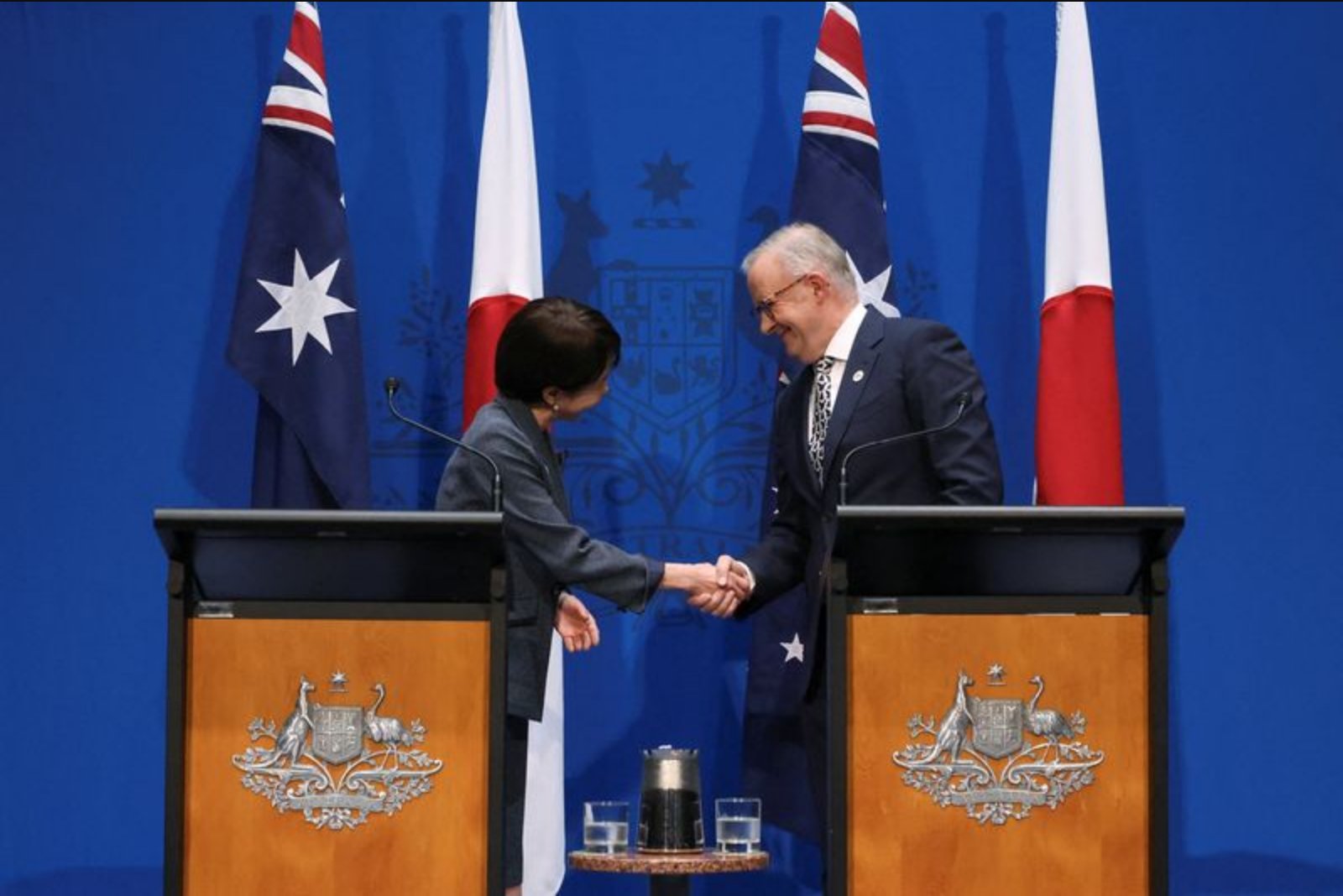
Australia and Japan have expanded a bilateral program to bolster critical minerals capabilities, pledging a combined A$1.67 billion in backing during a state visit by Japan's prime minister. The two governments said the funding aims to support strategic projects that address urgent vulnerabilities in mining, refining and manufacturing supply chains.
Under the announced arrangement, the Australian government intends to commit up to A$1.3 billion. The government of Japan has contributed roughly A$370 million in investments and grants so far and indicated it will supply additional investments and grants as specific projects advance.
The officials said the targeted projects are intended to focus on the parts of the supply chain judged most critical and most immediately exposed - spanning extraction, processing and downstream manufacturing - rather than a broad-based program of support.
Several projects were flagged as potential recipients of government funding or already benefiting from private and public-sector Japanese involvement:
- Lynas Corp - The announcement builds on existing long-term support from Sojitz and the Japan Organization for Metals and Energy Security (JOGMEC) for Lynas, which is identified as the world's largest producer of rare earths outside China.
- Alcoa with Sojitz and the Japanese government - Working to establish gallium recovery capability at one of Alcoa's operating alumina refineries in Western Australia. Gallium recovered at the refinery is intended for use in semiconductors, LEDs and solar cells.
- Magnium Australia - A Western Australian operation planning to produce high-purity magnesium for use in automotive and aerospace applications.
- Tivan's Speewah Fluorite project - Located in Western Australia, the project aims to supply acid-grade fluorite, a feedstock for hydrofluoric acid used in semiconductors, electric vehicles and other advanced applications.
- Copi Critical Minerals Project - A mineral sands development in New South Wales seeking to provide critical minerals and rare earth elements. The project is owned by RZ Resources and includes participation from JX Advanced Metals and Marubeni.
- Ardea Resources' Kalgoorlie Nickel project, Goongarrie - Noted as one of Australia's largest nickel-cobalt resources, it is being progressed as a joint venture with Sumitomo Metal Mining and Mitsubishi.
The announcement included a currency reference: $1 equals 1.3877 Australian dollars.
Market data displayed alongside the coverage showed a range of short-term moves in related securities and currency pairs. The Australian dollar versus the U.S. dollar was effectively flat at +0.01% (USD/AUD -0.01%). Quoted equity movements included LYC -1.72%, 2768 +6.11%, 8002 -5.22%, 8058 +4.59%, 5713 +1.16%, TVN +3.28%, ARL -2.27% and AAI -1.5%.
Officials framed the package as a step to shore up supply chains by prioritizing strategic projects across the mining-to-manufacturing spectrum, while noting Japan's commitment to provide further financial support as projects develop and require additional investment.
What this means for markets and industry
The funding window announced by the two governments concentrates public and private capital on select projects that link raw material extraction to higher-value processing and manufacturing activities. The intended beneficiaries span sectors including mining, advanced manufacturing, semiconductors, electric vehicles, automotive and aerospace.