
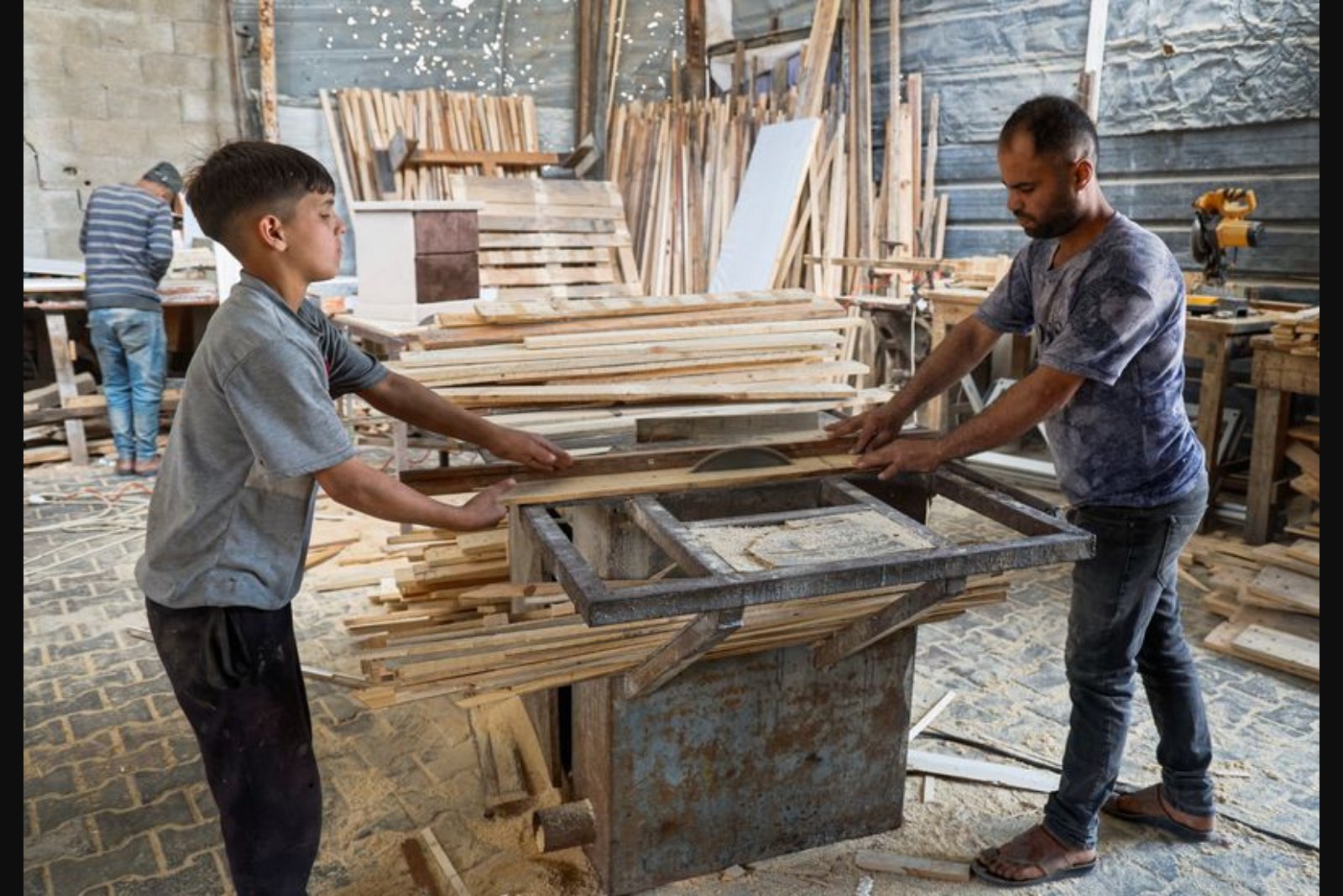
Gaza’s scarcity of timber and construction supplies has pushed a number of local carpenters to rely on discarded shipping pallets and other scrap wood to make fundamental pieces of household furniture for people uprooted by the conflict between Hamas and Israel.
In a modest workshop in southern Gaza, carpenters strip used pallets and reassemble the planks into bed frames, cupboards and shelving units for families who have been living in tents after fleeing fighting. Regular sources of construction wood have become either unavailable or too costly for many households, driving demand for the recycled material.
Mohammed Wafi, 34, a carpenter based in Khan Younis, said that once a limited number of aid trucks resumed entering Gaza, pallets were among the few wood items that could be obtained locally. He told Reuters that as more families moved into tent camps, requests for his pallet-made furniture increased.
"Today people say, ’I just need something to get by, something to get my clothes off the floor’... especially those (living) in tents," Wafi said, describing the immediate needs of displaced households. He pointed to the public health pressure inside tent camps, noting that rats and cockroaches have become a growing problem. "Due to the rats and cockroaches, they need a tent or a bed to be lifted off the ground," he added. Wafi has worked in carpentry for 16 years.
Local aid workers and residents report an increase in rodents and parasites in tent encampments, with animals biting people as they sleep, gnawing through possessions and risking the spread of disease.
The Israeli military agency COGAT, which coordinates aid into Gaza, did not respond to a request for comment on the restrictions or the availability of construction materials. The agency has stated previously - and Israeli policy reflects - that wood is considered a dual-use item because it can have both civilian and potential military applications, and therefore its entry is restricted.
At the same time, the cost of basic hardware has risen dramatically, further complicating production. Wafi said a kilo of nails that used to sell for 5 shekels - about $1.70 - now costs roughly 100 to 130 shekels. Hinges and other metal fittings have also increased markedly in price.
Despite those cost increases, furniture made from recycled pallets remains substantially cheaper than factory-made sets. Wafi said a simple pallet-based bedroom set - consisting of a bed, closet and dresser - retails for between 4,000 and 5,000 shekels, compared with roughly 18,000 shekels for a conventional set.
Manufacturing is nevertheless constrained. Shortages of electricity and of additional wood supplies have slowed production lines, and carpenters say they cannot always guarantee delivery times to customers.
The fragile humanitarian situation is occurring alongside recurring violations of the ceasefire. Since the ceasefire began in October, Palestinian and Israeli tallies record more than 830 Palestinians and four Israeli soldiers killed, according to the respective tallies cited in reporting. Israel has cited security concerns as the reason for some of the curbs on Gaza, and COGAT has previously said it devotes considerable effort to ensuring aid reaches Gaza while denying that it restricts supplies.
In tent settlements near Khan Younis, residents recount the difference a simple pallet bed can make. Mohammed Tayseer, who has lived in a tent for two years, said he used to sleep on the ground until recently. "The ground is sandy and dirty, and as you can see, you find the clothes full of sand. There are rats and mice," he said. "One’s back hurts and is stiff from sleeping on the floor... now (we) have a bed," Tayseer added.
As demand for low-cost furniture grows in displacement camps across Gaza, small carpentry operations are adapting to a constrained supply environment. They are piecing together functional solutions from what materials are available while coping with rising input costs and irregular energy access - challenges that affect their capacity to meet orders and the ability of displaced families to secure basic household needs.