
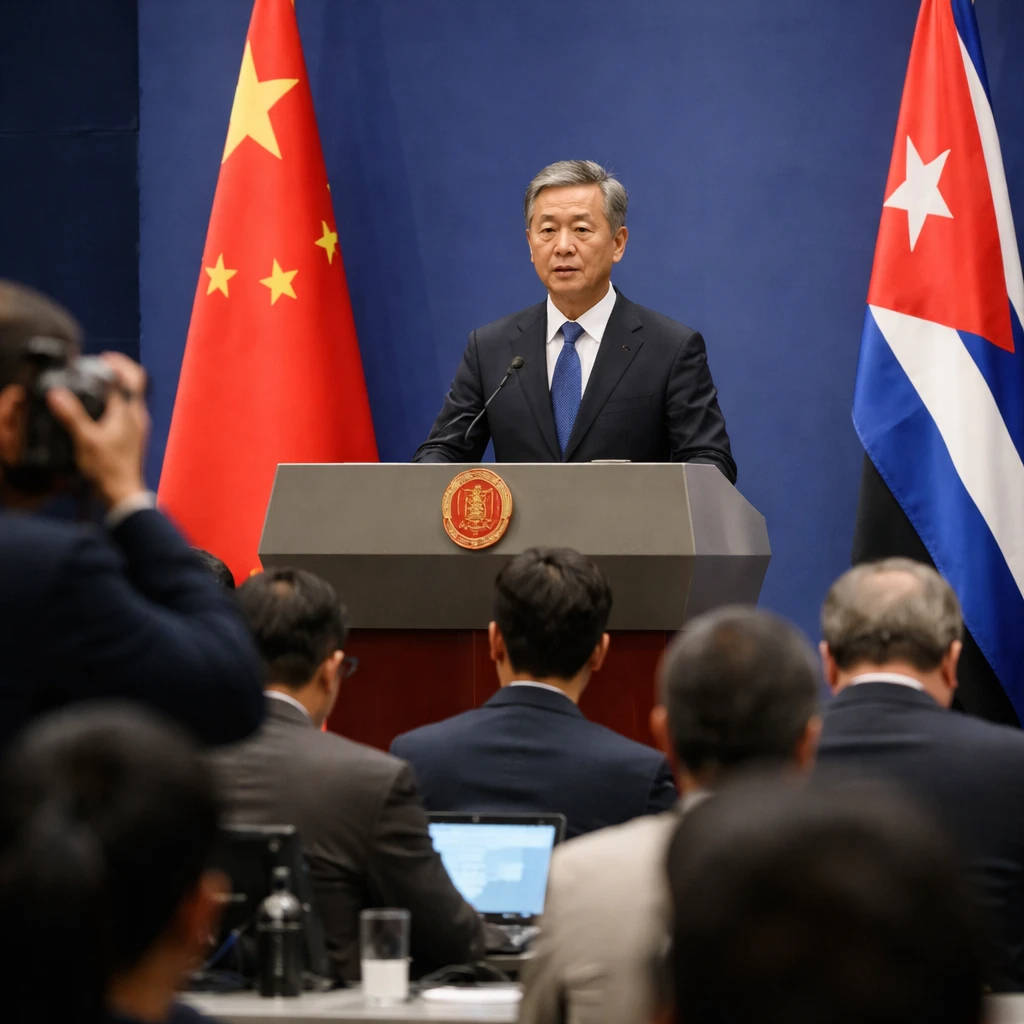
China's foreign ministry on Tuesday issued a strong rebuke of Washington's recent expansion of sanctions against Cuba, describing the steps as "illegal unilateral sanctions" that "seriously violated" the basic norms governing international relations.
The statement responded to an executive order signed by U.S. President Donald Trump on Friday that broadened U.S. sanctions against the Cuban government, an action that administration officials said was intended to increase pressure on Havana following the ousting of Venezuela's leader. Two White House officials said the executive order expanded the scope of U.S. measures.
Beijing framed the U.S. moves as an affront to the Cuban people's rights, saying the sanctions and the broader embargo "violated the Cuban people’s right to existence and development." The foreign ministry also urged the United States to "immediately end the embargo and sanctions against Cuba and any form of coercive pressure."
In its public remarks, the ministry emphasized China's support for Cuba's efforts to defend national sovereignty and security, and reiterated Beijing's opposition to any interference in Cuba's internal affairs.
Context and developments
According to the information released by the U.S. administration, the presidential executive order was issued as part of a policy shift aimed at increasing pressure on the Cuban government. China characterized the expanded measures as a step that undermines international norms and the legitimate rights of the Cuban people.
Beijing also noted a recent escalation in ties between the United States and Cuba that began earlier in the year, pointing to a tense episode in January after the United States captured Venezuelan leader Nicolas Maduro, who has long been a close ally of Cuba.
Key points
- China has called the expanded U.S. sanctions on Cuba "illegal" and demanded an immediate end to the embargo and other coercive measures.
- The U.S. executive order widening sanctions was issued after the ouster of Venezuela's leader, and U.S. officials said the move was designed to increase pressure on Havana.
- China stated it supports Cuba's pursuit of national sovereignty and security and opposes external interference in its internal affairs.
Risks and uncertainties
- Diplomatic tensions between the United States and Cuba could persist or widen, creating uncertainty for international diplomatic relations and any sectors relying on stable bilateral engagement.
- Escalation of sanctions and counter-statements from major powers may complicate efforts to resolve regional tensions, a development that could affect political risk assessments for investors and governments in the region.
Implications
China's statement signals continued diplomatic backing for Cuba and a clear objection to what it described as unilateral coercive measures. The exchange highlights persistent disagreements between Washington and Beijing on the appropriate use of sanctions and on respect for national sovereignty. Beyond politics, ongoing tensions could influence assessments of regional stability and the operating environment for entities with exposure to Cuba or to related diplomatic disputes.