
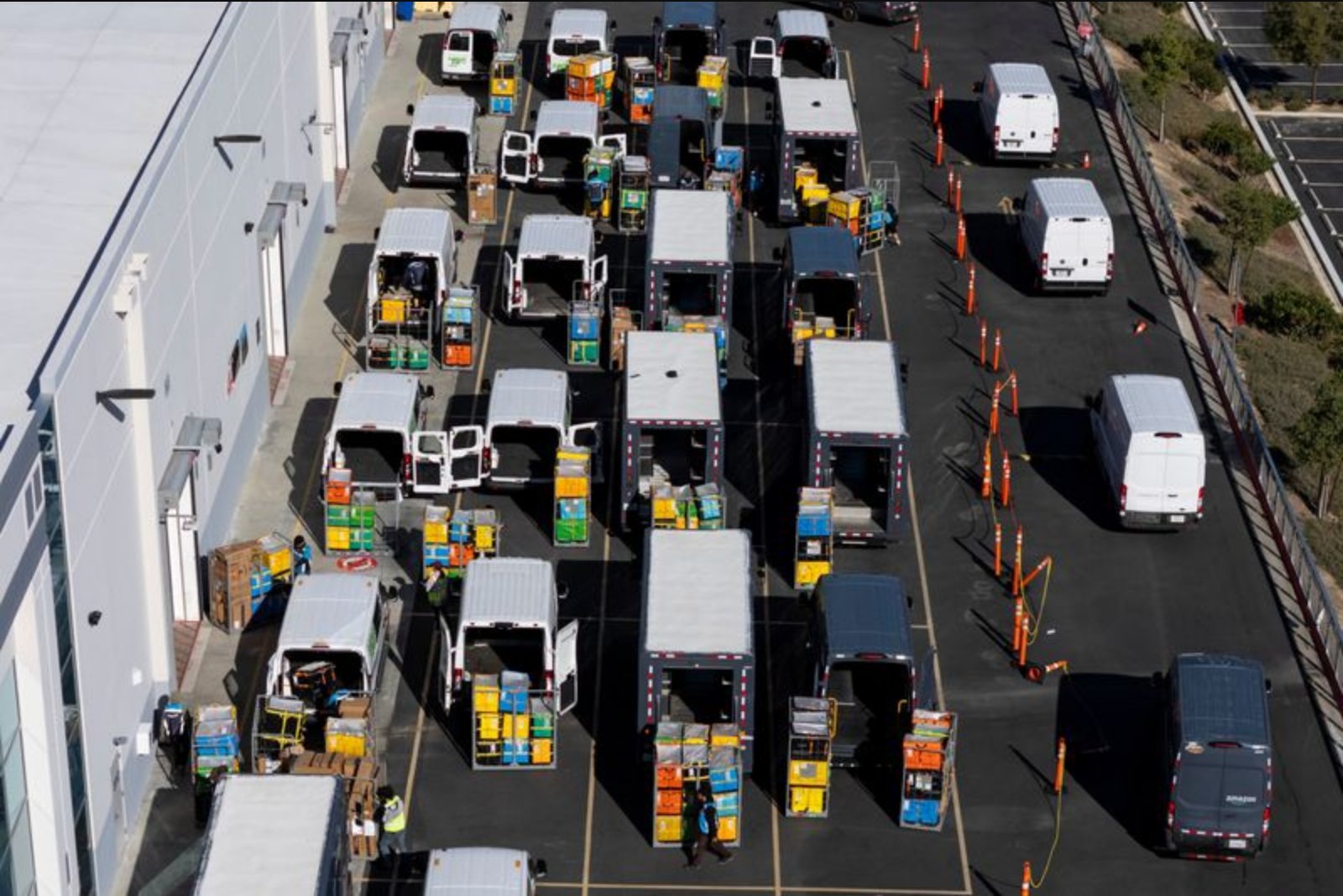
Amazon said on Monday it will permit third-party companies to store and move goods through its global supply-chain infrastructure under a new service called Amazon Supply Chain Services. The service will cover shipments and storage across ocean, road, rail and air, and is pitched at businesses in sectors including retail, healthcare and manufacturing.
The company will offer a range of distribution and fulfillment functions, including access to inventory forecasting tools and delivery timeframes that span roughly two to five days. Amazon said firms can use these logistics solutions across all of their sales channels - from their own e-commerce sites and social-media storefronts to physical retail locations.
Amazon highlighted several early customers for the service, naming Procter & Gamble, 3M and American Eagle Outfitters as companies that have signed on to use the new offering.
Market reaction and scale
News of the launch produced notable moves in related equities. Shares of FedEx and UPS fell by more than 9% each, while Amazon's shares rose nearly 1%. Industry peers in contract logistics also saw declines: DHL fell about 7.3% and GXO dropped nearly 13%, while Maersk's shares were little changed.
Amazon points to a substantial transport and warehousing platform as the basis for the new service, including a fleet of more than 100 cargo aircraft - a figure that places it behind only FedEx and UPS in terms of cargo-plane counts - together with an extensive set of fulfillment centers and sorting hubs.
Positioning and strategy
The new offering targets the business-to-business shipping market, a segment described in the announcement as attractive to logistics providers for its denser, more predictable and lower-cost deliveries compared with consumer parcel shipments. Analysts quoted in response framed the move as a significant competitive development for traditional parcel carriers.
Analysts at Evercore ISI characterized the launch as "a direct competitive blow" to parcel firms such as UPS and FedEx. Parth Talsania, CEO of Equisights Research, described the initiative as Amazon's effort to convert logistics from a cost center into a product, drawing a strategic parallel to the way Amazon Web Services was originally developed to rework the company’s internal IT infrastructure before becoming a major external business.
Analysts at Baird warned of potential near-term pressure across segments such as less-than-truckload, air-freight and forwarding as markets assess the competitive implications of Amazon's move.
Potential implications for customers and competitors
For companies that sign up, the service offers access to Amazon's delivery speed, networked forecasting and fulfillment tools across multiple sales channels. For incumbent logistics firms and contract providers, the expansion raises the prospect of intensified competition around price and transit times in both B2B and retail-focused segments.
How carriers and third-party logistics providers respond remains to be seen. The announcement has already produced meaningful share-price responses in companies seen as most exposed by analysts.
Note: This article reports on the facts announced by the company and the market reactions and analyst comments as presented.