
Summary - Futures on Canada’s main stock index inched higher on Tuesday as markets digested a fresh round of strikes in the Gulf region and mixed macro and corporate signals. A partial thaw in shipping disruptions contributed to tempered declines in oil, while investors monitored earnings and the potential for further interest rate action.
Market snapshot
By 08:18 ET (12:18 GMT) on Tuesday, the S&P/TSX 60 index standard futures contract was up 5 points, or roughly 0.3%. That modest uptick followed a 0.7% slide in the Toronto Stock Exchange’s S&P/TSX composite index on Monday, which closed at 33,638.87.
Energy equities were among the better performers, supported by a jump in oil prices after new attacks in and around the Strait of Hormuz. Offsetting some of that strength were investor concerns that the Bank of Canada could resume a tightening path if inflation proves persistent.
U.S. futures and Wall Street context
U.S. futures also advanced on Tuesday. At 07:19 ET (11:19 GMT), Dow futures were higher by 70 points, or 0.1%; S&P 500 futures had risen 19 points, or 0.3%; and Nasdaq 100 futures were up 126 points, or 0.5%.
The main U.S. averages fell in the previous session after the United States and Iran exchanged fresh strikes in the Gulf, putting strain on an already fragile ceasefire. Oil rallied above $110 a barrel amid efforts by the U.S. to reopen the almost-closed Strait of Hormuz, prompting gains in energy stocks. At the same time, shares of FedEx and United Parcel Service dropped after Amazon.com said it would introduce a new offering that increases competition for those delivery firms.
Geopolitical developments and shipping
On Monday, both the U.S. and Iran carried out new attacks as Tehran reacted to a U.S. push to use military force to re-open shipping lanes through the Strait of Hormuz - a waterway that accounts for about a fifth of global oil shipments. Multiple merchant vessels in the Gulf reported fires or explosions, according to accounts from the region.
The U.S. said it had assisted two American-flagged ships in transiting the strait and had repelled attacks from Iranian drones and armed small boats. The conflict showed signs of spreading across the Middle East; air defenses in the United Arab Emirates engaged ballistic missiles and drones reportedly launched from Iran, and an oil terminal in Fujairah was also struck.
U.S. President Donald Trump, under growing pressure from some lawmakers over the campaign, provided limited details about his plan to restore maritime traffic - a program referred to as "Project Freedom". Iran’s foreign minister warned Washington against becoming ensnared in a prolonged and costly engagement.
In an interview with ABC News, President Trump suggested the war could continue for another three weeks even as he asserted that the U.S. had "already won" the conflict. Defense Secretary Pete Hegseth later emphasized that Washington did not want to reignite hostilities, describing the effort to unblock the strait as a "temporary" measure and saying the U.S. was "not looking for a fight."
Signs of shipping relief and bunker market reaction
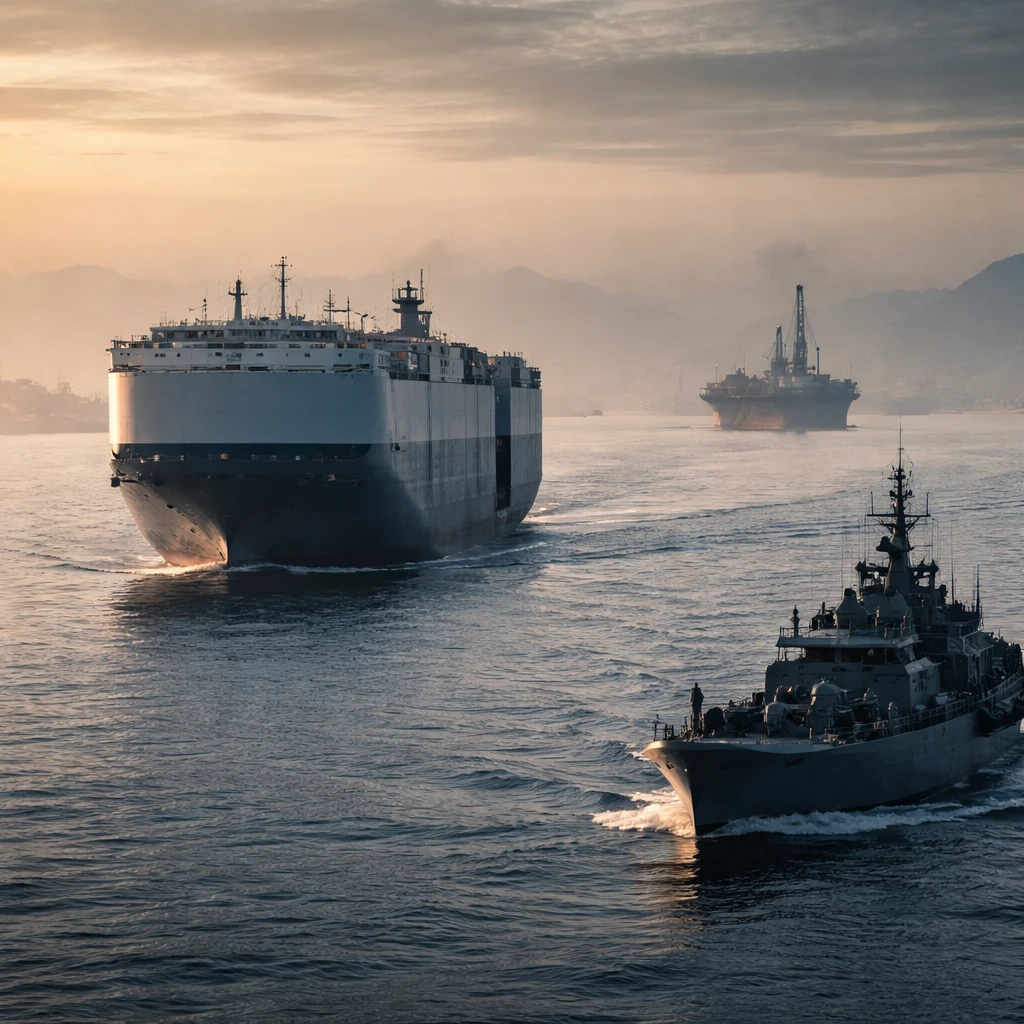
Although the strait has been effectively shut to tanker traffic for much of the more than two-month long conflict, there were indications the U.S. operation to escort select vessels might be loosening Iran’s control over the corridor. Shipping company Maersk said that a U.S.-flagged vehicle carrier run by a subsidiary of the firm had left the Gulf through the strait with U.S. military assistance.
Those developments coincided with oil retreating from its recent highs. Brent crude futures, the global benchmark, were last down 1.6% at $112.65 a barrel, though they remained elevated compared with pre-war levels. U.S. West Texas Intermediate crude futures fell 2.3% to $103.98 a barrel.
Commodities: gold and oil
Gold edged higher on Tuesday after falling to a five-week low in the previous session, but the metal’s gains were subdued. Elevated oil prices have left uncertainty over the path for interest rates, constraining bullion’s appeal. Since the conflict began in late February, gold prices have slid by more than 10%, pressured by inflation concerns, rising rate expectations, and a firmer U.S. dollar that makes gold more expensive for overseas buyers.
Corporate news and earnings focus
Canadian e-commerce company Shopify was in the spotlight ahead of the trading day after issuing a second-quarter forecast that was broadly in line with Wall Street expectations. The company’s outlook was one of several firm-level data points investors considered while weighing macro risks.
Advanced Micro Devices is set to top the list of corporate releases after the closing bell on Tuesday, with investors awaiting updates on the company’s competitive trajectory against AI-focused rival Nvidia. In February, AMD estimated that revenue would decline slightly in the first quarter to about $9.8 billion, plus or minus $300 million, versus $10.27 billion in the prior three months. That softer projection followed resumed sales into China, a development that helped top-line performance while underscoring the company’s broader competitive challenge.
Data analytics firm Palantir reported results that beat quarterly estimates and raised its revenue guidance, yet its shares fell in premarket trading after Chief Financial Officer David Glazer warned that the company’s expenses are expected to rise in 2026.
More broadly, earnings season has provided some support for markets that have been rattled by the Iran conflict, driven largely by robust results from AI-linked hyperscalers. According to LSEG I/B/E/S data cited in reporting, S&P 500 companies were expected to post aggregate profit growth of 28% year-over-year for the first quarter, a figure that more than doubled earlier expectations from the start of the reporting period in early April.
Michael Brown, Senior Research Strategist at Pepperstone, noted in a market comment that the underlying fundamentals of the market remained solid and that, combined with the current geopolitical dynamics, could allow bulls to maintain control and leave pullbacks as buying opportunities.
What this means for market participants
For investors and market-watchers, the session highlighted the dual forces shaping risk assets: geopolitics that intermittently lift energy and defense-related names, and corporate and macro indicators that influence broader equity performance. Energy and shipping sectors appear acutely sensitive to developments in the Gulf, while logistics and parcel-delivery companies are reacting to shifts in competitive dynamics triggered by big e-commerce platforms.
At the same time, central bank considerations remain relevant; the prospect of further rate hikes to combat entrenched inflation is a recurring headwind for equities and a driver of currency and bond market moves.
Bottom line
Tuesday’s modest gains in TSX futures reflected markets attempting to balance renewed tension in the Gulf with signs the U.S. escort effort may be easing the worst disruptions to shipping. Energy stocks benefited from recent crude strength, but worries about central bank policy and the pulse of corporate earnings kept sentiment cautious. Traders will continue to monitor developments in the Strait of Hormuz, oil price trajectories, and upcoming corporate reports for further clues on the direction of markets.