
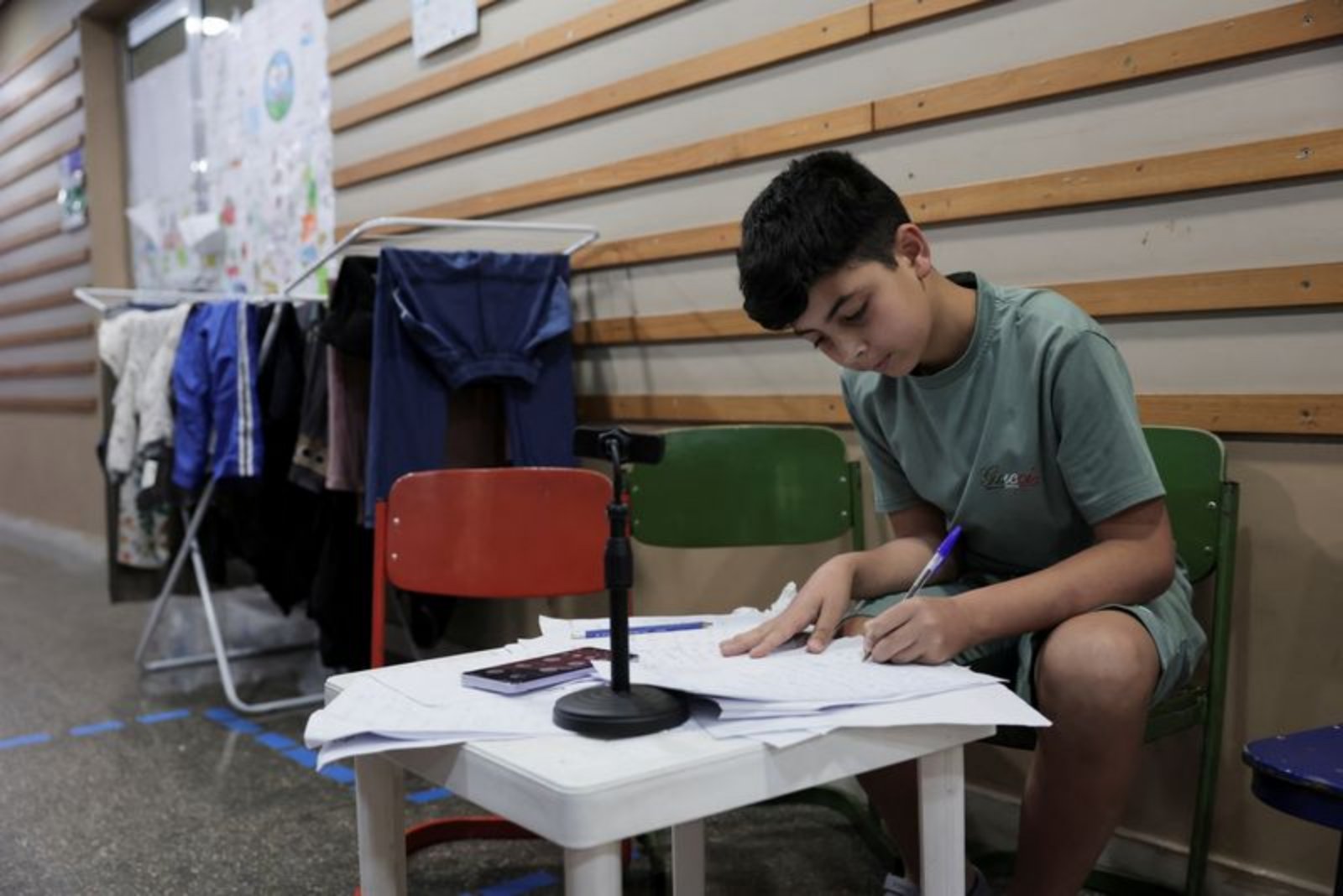
The Rafic Hariri School in central Beirut, traditionally an educational institution, has been serving this spring as a temporary refuge for people uprooted by the fighting between Israel and the Lebanese armed group Hezbollah. More than 1,500 displaced men, women and children are now living in classrooms and in tents pitched in the school's courtyard, while regular instruction has been moved online as the school remains closed to students.
Parents whose children have been attending classes remotely protested in early May, demanding that the school reopen and pupils be allowed to return to in-person lessons. In response, a representative for the school administration issued a statement saying the administration sympathised with those displaced but also emphasised that students have rights to access the school premises.
The level of displacement in Lebanon since the onset of this round of hostilities has been substantial. Officials report that the two-month war has forced more than a million people from their homes. While many displaced families are staying with relatives or paying to rent apartments, at least 124,000 people are sheltering in government-run collective facilities. The majority of those displaced come from Lebanon's Shi'ite community, which furnishes much of Hezbollah's support base, and many have relocated to areas dominated by other sectarian groups, a movement that has intensified existing communal tensions.
The school's namesake, Rafic Hariri, is a former prime minister whose 2005 assassination triggered a period of prolonged instability in Lebanon. An international tribunal later determined that members of Hezbollah bore responsibility for his killing. In the current climate, critics of Hezbollah have accused the group of dragging Lebanon back into conflict by initiating cross-border fire in support of Iran. These divides, observers say, have revived memories of the country's 1975-1990 civil war for some Lebanese citizens.
In comments relayed by the school representative, there was concern that history could repeat itself. The representative recalled that during the 2024 conflict between Israel and Hezbollah, displaced people entered the school and caused damage, leaving the administration to pay for repairs without assistance from the state. She said that displaced families entered the school again this year without prior permission from administrators.
Those sheltering at the school describe the situation differently. Mohammed Hammoud, 40, who supervises displaced families at the site and is himself from southern Lebanon, said the families were given keys and did not force access. He said they would vacate the premises if the school administration formally requested that they leave, but he urged the government to identify alternative accommodation for the families before any eviction.
Lebanon's Social Affairs Minister Haneen Sayed informed Reuters in March that the government was preparing plans to manage long-term displacement. For many of the people at the Hariri School, returning to their homes is not feasible while the fighting continues. One resident, known as Um Mahmoud, said her apartment in the south had been severely damaged by Israeli strikes and was uninhabitable. Speaking from the communal kitchen in the converted school, she said repairs were impossible while active hostilities persisted and that she feared for her safety should she attempt to stay in the damaged apartment.
Volunteers have assisted displaced families in establishing a large communal kitchen on the school grounds. The kitchen prepares thousands of meals each day and distributes them both to the people living inside the school and to neighbors in the surrounding area as a gesture of goodwill between the displaced and the host community.
Although an agreement for a ceasefire was reached on April 16, exchanges of fire have not ceased entirely, particularly in southern Lebanon where Israeli forces occupy a strip of territory inside Lebanese borders. Israel has stated that its presence aims to protect northern Israeli communities from attacks by Hezbollah militants operating within civilian areas. Lebanese authorities report that nearly 2,700 people have been killed in Israeli strikes across Lebanon since March 2.
Summary
The conversion of the Rafic Hariri School into a collective shelter for more than 1,500 displaced people has heightened social tensions in Beirut, as parents demand the return of in-person schooling while displaced families, mainly from the Shi'ite community, remain unable to return to their damaged homes. The situation highlights broader displacement across Lebanon, with over a million people uprooted and at least 124,000 in government shelters.
Key points
- Over 1,500 displaced people are housed at the Rafic Hariri School, forcing the institution to remain closed and move classes online.
- The two-month conflict has displaced more than one million people in Lebanon; at least 124,000 are in government-run collective shelters.
- The displaced population is predominantly from Lebanon's Shi'ite community, a shift that has increased sectarian strains in areas inhabited by other communities.
Sectors impacted
- Education - school closures and remote learning disrupt routines and resources for students and families.
- Social services and humanitarian aid - increased demand for shelter, food distribution and government coordination.
- Housing and reconstruction - large numbers of damaged homes reduce available housing stock and create long-term shelter needs.
Risks and uncertainties
- Escalation of sectarian tensions - displaced Shi'ite families living in areas dominated by other sects may deepen social divisions, affecting community stability and local governance. This could complicate delivery of services in affected neighborhoods.
- Insufficient state support for damaged infrastructure - the school's prior experience of incurring repair costs after damage during earlier hostilities highlights the risk that public or private institutions may bear financial burdens without adequate government assistance, with implications for municipal and education budgets.
- Protracted displacement - many families cannot return while fighting continues, creating persistent demand for shelter, food and other humanitarian services; prolonged needs may strain charitable volunteer networks and government programs.
Risks impact
- Education sector - ongoing closures and damage risk long-term learning loss and pressure on school finances.
- Public finances and social services - emergency sheltering and reconstruction needs could demand sustained government spending or international assistance.
- Local economies and housing markets - damaged residences and population movements may alter rental markets and household spending patterns in host communities.
Tags: Lebanon, Displacement, Education, Hezbollah, Conflict