
Stock Markets May 7, 2026 05:31 AM

Bank of America Sees Philippine Growth Slowing as Inflation Accelerates

Q1 GDP undershoots expectations; bank raises peak inflation forecast and flags further policy tightening

By Marcus Reed

Bank of America reported the Philippines expanded 2.8% year-over-year in Q1 2026, below consensus and slightly above the bank's near-term forecast. The slowdown was broad-based, with industrial and agricultural contraction and a third straight quarterly dip in investment spending, while services continued to grow. The bank kept its baseline GDP projections for 2026 and 2027 but warned of rising inflation pressures across fuel, electricity and food and expects additional central bank rate hikes.

Bank of America Sees Philippine Growth Slowing as Inflation Accelerates

Key Points

  • Q1 2026 GDP grew 2.8% year-over-year, below consensus of 3.3% and slower than Q4 2025's 3.0%; close to Bank of America's Q1 forecast of 2.6%.
  • Industrial output and agriculture contracted -0.2% and -0.1% year-over-year respectively, while services (63% of GDP) expanded 4.5% in Q1; investment spending fell 3.3% year-over-year with construction down 4.5%.
  • Bank of America retains baseline GDP forecasts of 2% for 2026 and 3% for 2027, expects inflation to peak near 10% year-over-year in Q4 2026, and anticipates two 25 basis-point policy rate hikes to reach 5.0%.

Bank of America released an assessment of the Philippine economy showing year-over-year GDP growth of 2.8% in the first quarter of 2026. That pace fell short of the 3.3% consensus expectation and was slower than the 3.0% growth recorded in the fourth quarter of 2025. The Q1 outturn was close to the bank's own short-term estimate of 2.6% and leaves the economy aligned with Bank of America's baseline projection of 2% GDP growth for 2026.

The deceleration in Q1 permeated most major components of output when compared with the prior quarter, with only government spending registering a modest pick-up. Production in industry contracted by 0.2% year-over-year, while agriculture declined 0.1% year-over-year. Together those sectors account for 37% of the economy. By contrast, the services sector, which makes up the bulk of GDP at 63%, expanded by 4.5% in the quarter.

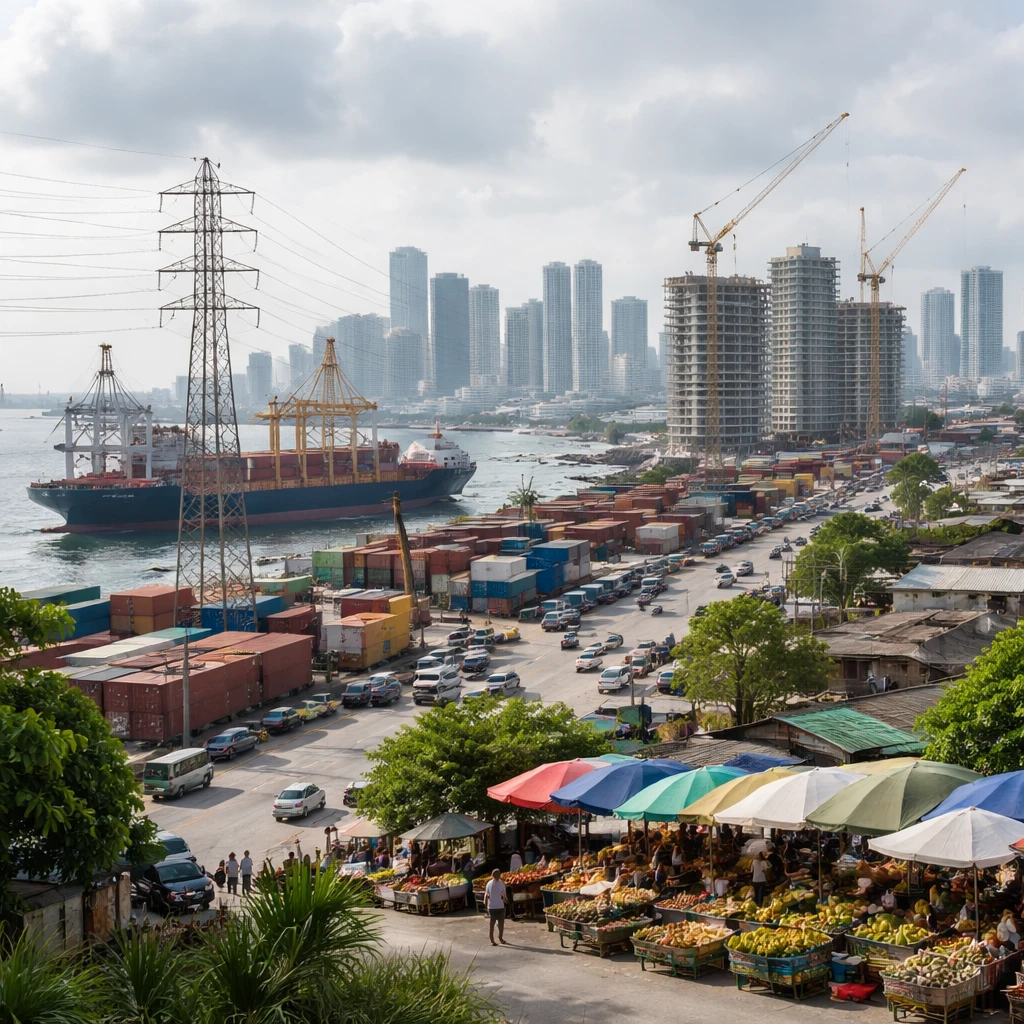
Investment demand showed continued weakness, dropping 3.3% year-over-year in Q1. This marked the third quarterly contraction in investment spending, with construction within the investment category posting the largest fall at 4.5%, identified as the weakest segment. Bank of America noted that the fall in investment outlays, alongside import growth, acted to offset moderate increases in household consumption, exports and government spending.

Looking beyond the quarter, Bank of America held to its baseline forecasts of 2% GDP growth for 2026 and 3% for 2027. Those projections incorporate an assumption that the Middle East conflict will be resolved during the second half of 2026, and on that basis the bank expects an average Brent crude price of $92.50 per barrel for the year, compared with the year-to-date average of $86 per barrel.

Price pressures are a growing concern. After an April inflation reading of 7.2% year-over-year, Bank of America reported that inflation is spreading beyond fuel into electricity and food. The bank now expects headline inflation to peak near 10% year-over-year in the fourth quarter of 2026, with average inflation for 2026 at 7.3% before easing to 5.3% in 2027.

On monetary policy, Bank of America anticipates that the Bangko Sentral ng Pilipinas will raise its policy rate by 25 basis points at each of its next two meetings in June and August, which would bring the policy rate to 5.0%.


Implications

The data point to a broad-based growth slowdown, persistent inflationary pressures and an outlook that assumes an easing of geopolitical tensions and higher oil prices relative to the year-to-date average. Key balances to watch include investment contraction and import trends that have partially offset domestic demand gains.

Risks

  • The baseline GDP and inflation projections rest on an assumed resolution to the Middle East conflict in the second half of 2026; deviation from that assumption would affect oil price and growth forecasts - impacts span energy, transport and import-dependent sectors.
  • Inflation appears to be broadening beyond fuel into electricity and food, raising the risk of higher and more persistent price pressures that could weigh on consumption and increase monetary policy tightening - this affects household spending, utilities, and food markets.
  • Continued contraction in investment, driven by a sharp fall in construction activity, poses downside risk to domestic demand and capital formation, which could influence the construction, materials and related logistics sectors.

More from Stock Markets

Berenberg Gives Chapters Group a 'Buy' Start, Sets €42 Target on Rapid Growth Path May 7, 2026 Indian equities close marginally lower as FMCG, healthcare and tech weigh on indices May 7, 2026 ElectroMobility Poland, Foxconn to build EV production and R&D hub in southern Poland May 7, 2026 Taiwan CPI Accelerates to 1.74% in April as Energy Costs Surge May 7, 2026 AI Model Highlights Small-Cap Magnera After Strong Quarter; Stock Pops Again in Premarket May 7, 2026