
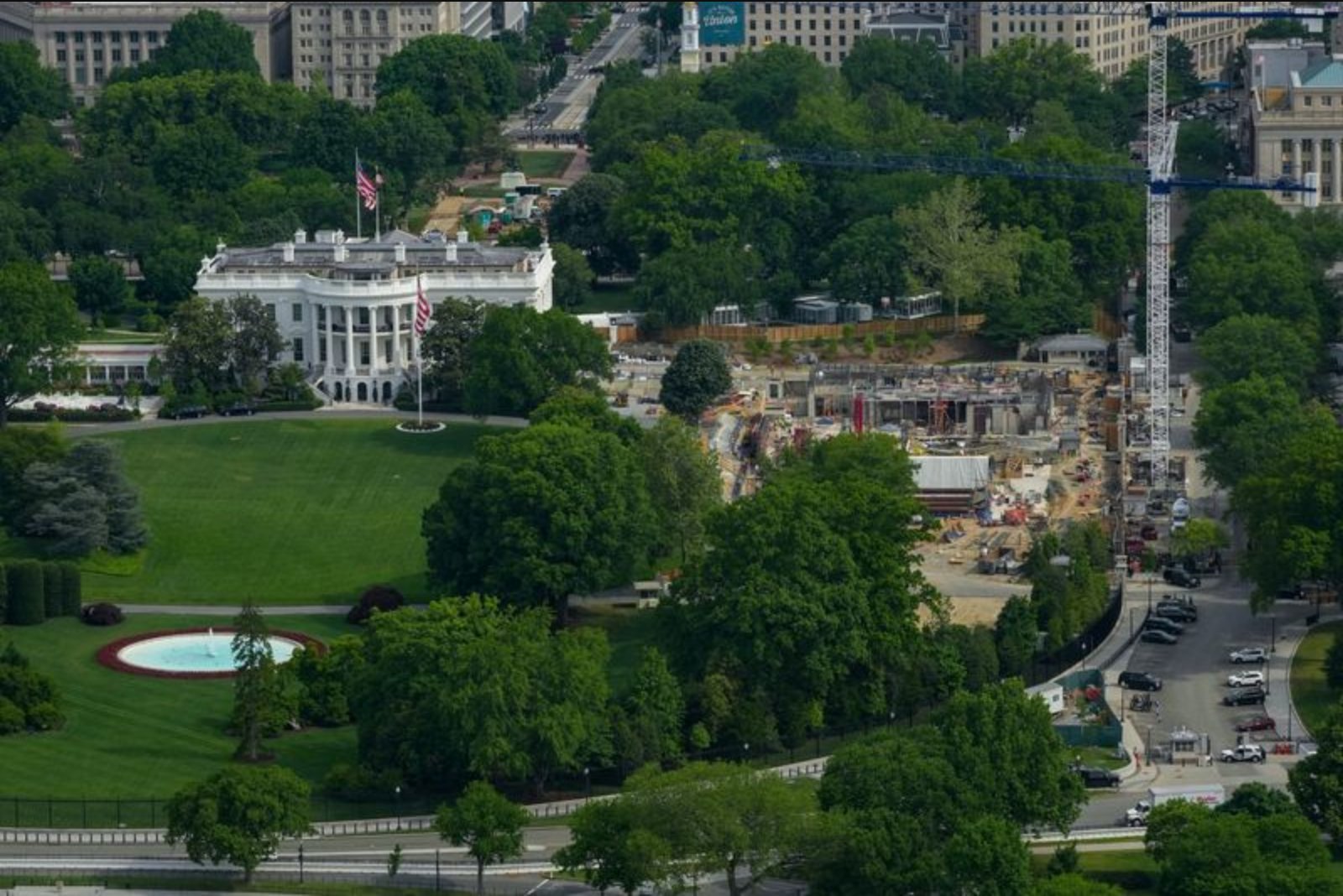
President Donald Trump is overseeing a broad program of construction and renovation across Washington that ranges from an opulent new White House ballroom to a proposed monumental arch and a major reworking of a national performing arts center. The projects represent an extensive reimagining of federal landmarks and public spaces, and they have prompted both legal challenges and public backlash over historic preservation, cost and priorities.
Overview
The president has described several of the initiatives as large-scale upgrades intended to reshape prominent sites in the capital. Among the most prominent items are plans for a 90,000-square-foot White House ballroom estimated to cost $400 million, a proposed 250-foot Independence Arch on a roundabout across the Potomac, a two-year closure and overhaul of the Kennedy Center, and extensive alterations to the White House interior and grounds that include a remodeled Oval Office, a patio-style Rose Garden and changes to the Lincoln Bedroom bathroom.
WHITE HOUSE BALLROOM
Mr. Trump has touted a planned ballroom for the White House that he says will be "the Greatest of its kind ever built." The design is intended to match the existing White House in both height and scale and is projected to seat 1,000 guests. The administration has estimated the ballroom will cost $400 million and said funding will come from wealthy individuals and corporations.
The project has proved contentious. The construction involved demolition of the East Wing - a move critics say contradicted earlier assurances that the wing would not be removed. Preservationists and opponents have complained about the loss of the East Wing, which previously housed the first lady's offices and the White House movie theater, and have warned that the new structure could visually overpower the main mansion.
Residents and workers in the area have also been affected by the demolition and construction. The ongoing work generates daily construction noise between the White House and the Treasury Department, a disruption the article reports is likely to continue for much of the president's three remaining years in office.
Public sentiment has leaned against the ballroom. A Washington Post-ABC News-Ipsos poll cited in reporting found 56% of Americans opposed the project and 28% in favor. Legal proceedings have been part of the process: an appeals court on April 17 allowed the administration to continue construction on the East Wing site while setting a June hearing to review a lower court judge's order to halt the project.
KENNEDY CENTER RENOVATION
The John F. Kennedy Center for the Performing Arts, which Congress authorized to honor the late Democratic president, has become another focal point. A Trump-appointed board voted last year to rename the facility the Trump–Kennedy Center. After that change, the center experienced a wave of show cancellations and falling ticket sales.
On February 1, the president announced the Kennedy Center would close for two years beginning on July 4 for what he described as a major overhaul. He has cited issues with plumbing and deteriorating masonry as reasons for the renovation and has said he will not tear down the structure but will renovate it. Critics point out that Mr. Trump made similar assurances about other projects prior to demolition activity. The administration has estimated the Kennedy Center renovation will cost $200 million.
REFLECTING POOL
Mr. Trump has also taken an active role in work on the Reflecting Pool near the Lincoln Memorial, the site adjacent to where Martin Luther King Jr. delivered his "I Have a Dream" speech. He described the pool as being in poor condition and said he intervened to have it cleaned, restored and repaired at a cost he characterized as a fraction of an earlier, high estimate.
According to statements attributed to the president, the pool was resurfaced using materials described as "American flag blue." The president posted a social media image over the weekend that featured an AI-generated depiction of a shirtless Mr. Trump and other cabinet officials floating in the pool.
INDEPENDENCE ARCH
Across the Potomac River from the Lincoln Memorial, Mr. Trump has proposed erecting what he calls the Independence Arch on a nondescript highway roundabout. The concept is an arch with eagle statues and a Liberty-like figure perched atop. Reported estimates put the height of the structure at 250 feet.
The planned height would exceed that of the Lincoln Memorial and approach the scale of the U.S. Capitol, which stands at 288 feet. For comparison, the Arc de Triomphe in Paris is 164 feet high. The president told reporters on January 31 that he wanted a large arch because "we're the biggest, most powerful nation." The project faces at least one technical uncertainty: a structure of roughly that height could interfere with the flight path of southbound planes on the final approach to Ronald Reagan Washington National Airport, located a few miles away.
THE OVAL OFFICE AND INTERIOR CHANGES
When Mr. Trump returned to the Oval Office in January 2025 he initiated an extensive redecoration. The room was updated with gold accents and numerous statuettes, and portraits of historical Americans were taken from storage and displayed, some of which observers said were not easily identifiable. A copy of the Declaration of Independence now hangs on the wall behind a black sheet.
Busts of Abraham Lincoln and Benjamin Franklin were placed on tables near the president's desk. The accumulation of decorative objects gives the room a cluttered, old-library ambiance compared with previous administrations' styles. Mr. Trump has expressed satisfaction with the redesign and has reportedly shown the room to visitors.
ROSE GARDEN AND WHITE HOUSE GROUNDS
Outside the Oval Office, changes extend to the grounds. The Rose Garden's traditional grass lawn was removed and replaced with a white stone patio furnished with umbrella-covered tables, a configuration the administration likened to patio space the president has at his Mar-a-Lago Club in Palm Beach, Florida. The white stone was defended on practical grounds: officials said women wearing high heels had sunk into the soil.
Along a nearby colonnade walkway, portraits of America's 47 presidents were installed with a plaque beneath each that reportedly bears Mr. Trump's personal view of the subject. The president replaced the portrait of Joe Biden with an image of an autopen, a device Mr. Trump and some other Republicans have criticized Mr. Biden for using to sign documents despite its use by several recent presidents.
Additional changes on the grounds include the installation of large flagpoles on both the North and South Lawns.
LINCOLN BATHROOM
Inside the White House, the green-tiled, retro-styled bathroom in the Lincoln Bedroom was removed and a modern replacement installed featuring white and black marble. The green-tiled bathroom dated to President Truman's renovation in the 1950s, according to a Washington Post article from 2007. That article noted that when President George W. Bush and first lady Laura Bush renovated the Lincoln Bedroom they left the bathroom intact, describing it then as "well-preserved."
PUBLIC REACTION, PRESERVATION CONCERNS AND LEGAL CHALLENGES
The projects have drawn sharp criticism from Americans focused on economic and preservation priorities. Preservationists have objected to the demolition of historically significant spaces and warned that new large-scale structures could dwarf existing monuments. Some critics have also questioned the timing and expense of the projects amid broader public concerns about pocketbook issues.
Legal challenges have influenced the trajectory of at least one major undertaking. The appeals court decision on April 17 allowed work on the White House ballroom to continue while legal review proceeds, and a June hearing was scheduled to consider a judge's earlier order to stop construction. Meanwhile, the Kennedy Center's renaming and renovation have had immediate market effects for that institution, including cancelled performances and falling ticket sales after the board's decision to rename the facility.
CONCLUSION
President Trump's comprehensive reshaping of the capital's built environment spans internal White House redecorations to large, potentially skyline-altering projects. Each initiative carries its own set of design, logistical and legal complexities, and several have already prompted public debate, financial projections and court interventions. Whether some of the most ambitious elements - including the 250-foot Independence Arch and the 90,000-square-foot ballroom - will be completed as envisioned remains subject to legal review, aviation considerations and ongoing public reaction.