
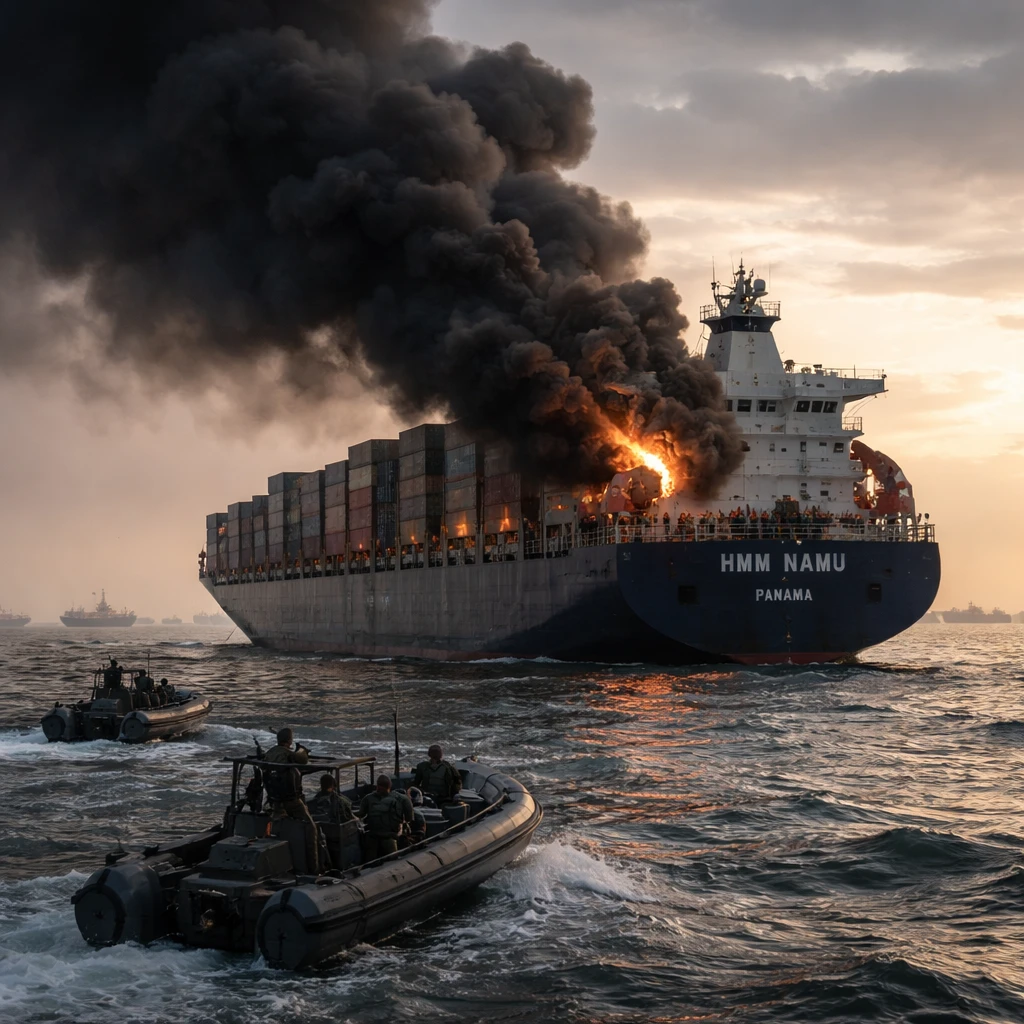
South Korean authorities announced on Tuesday that they will conduct an inquiry into the cause of an explosion and fire aboard a South Korean-operated cargo vessel in the Strait of Hormuz, an incident that U.S. President Donald Trump described as the result of an Iranian attack.
In an official statement, South Korea's Foreign Ministry said: "The exact cause of the accident would be figured out after the vessel is towed and its damage is assessed." The ministry said the Panama-flagged ship, operated by HMM, had been empty and at anchor when the explosion and subsequent fire occurred on Monday.
The vessel, identified as HMM Namu, is a 35,000-ton general cargo ship. South Korean officials reported there were no casualties and that the blaze had been put out. An HMM spokesperson confirmed that all 24 crew members remained on board the ship and that the fire had originated in the engine room. The spokesperson added that surveillance-camera footage indicated the fire had been extinguished.
Authorities plan to tow HMM Namu to a nearby port so inspectors can evaluate the extent of the damage and arrange for repairs, the Foreign Ministry said. British maritime risk-management firm Vanguard indicated that investigators would consider a range of possible causes, including an attack, a drifting sea mine, or another external object.
Following the incident, South Korea's Ministry of Oceans and Fisheries issued guidance on Tuesday asking Korean vessels operating in the area to relocate to safer positions. The ministry also said it was maintaining close communications with shipping companies and vessels that were stranded as a result of developments in the waterway.
The South Korean government reported that 26 South Korean-flagged vessels were stranded around the Strait of Hormuz. The waterway is a major international transit route and, according to authorities cited in the incident comments, typically carries about one-fifth of global oil and liquefied natural gas shipments.
President Trump posted on the Truth Social platform that Iran had fired shots at the ship and other targets as U.S. forces conducted an operation intended to reopen the Strait of Hormuz to shipping. In the same post, he urged allied action and suggested it could be time for countries such as South Korea to participate in efforts to escort stranded vessels through the waterway.
Requests for comment on the president's post were not immediately answered by South Korea's Foreign Ministry, Defence Ministry, or the presidential office, according to officials. Seoul has previously stated that it would weigh carefully any invitation to join a multinational naval deployment to secure passage through the strait, while emphasizing that such a deployment would require approval from its legislature.
The investigation into HMM Namu's explosion and fire will proceed once the ship has been towed and inspectors complete their assessment, South Korean officials said. For now, the immediate focus remains on determining the origin of the blast and ensuring the safety of vessels and crews operating in and near the Strait of Hormuz.