
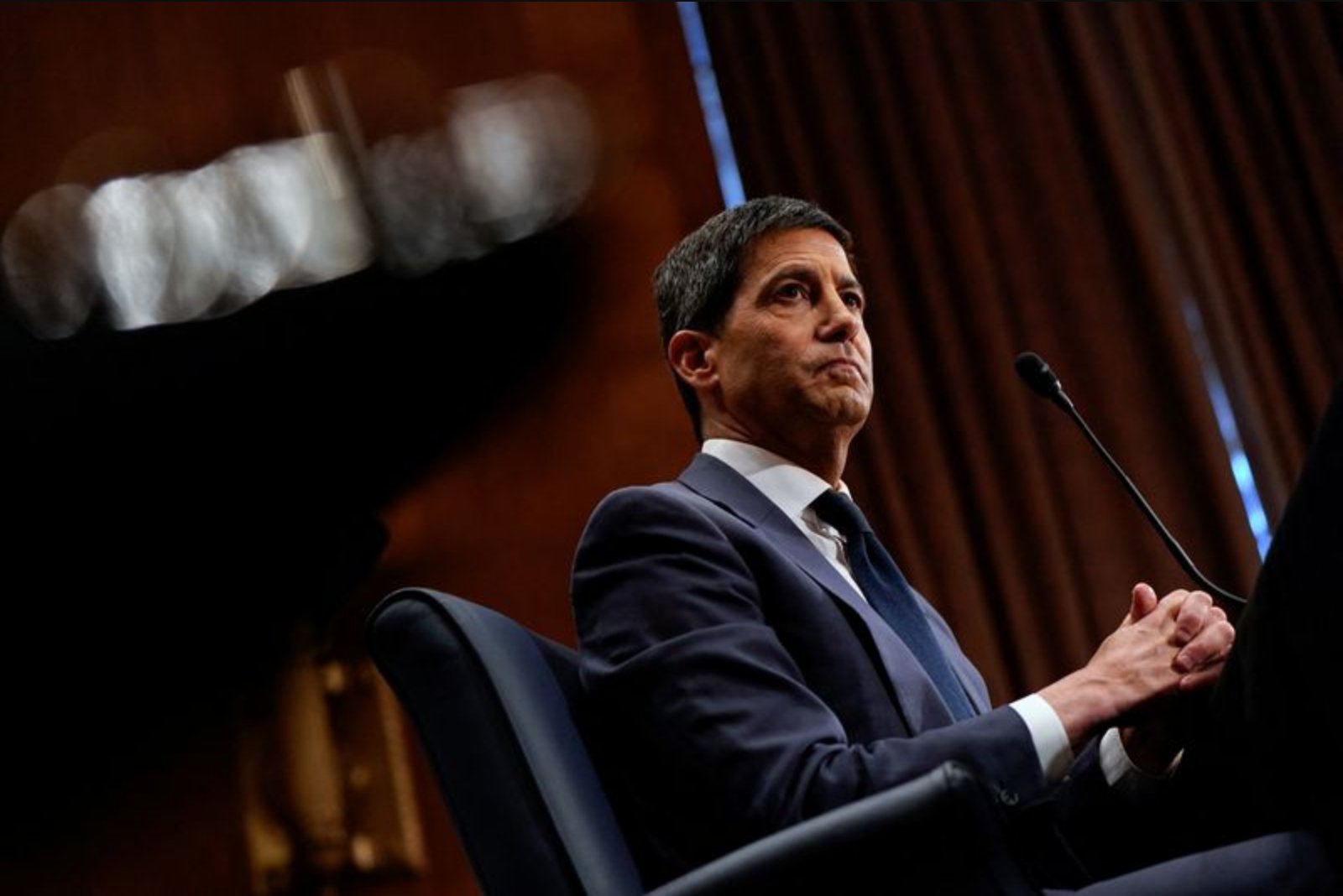
WASHINGTON - Kevin Warsh faces a defining choice early in his tenure as head of the U.S. Federal Reserve: whether to contribute an interest rate projection - the so-called "dot" - to the central bank's quarterly Summary of Economic Projections at the June meeting.
The decision carries weight because it would signal to President Donald Trump and observers whether Warsh favors the lower-rate stance Trump has promoted or whether he aligns with more conventional Fed views. It is not certain Warsh will submit a dot at all; abstaining would allow him to conceal his rate preferences during his initial months as the Fed's top policymaker.
"That would be a strategic question for him," said former St. Louis Fed President James Bullard, now dean of the Mitch Daniels School of Business at Purdue University. With the Fed meeting five weeks away - scheduled for June 16-17 - and Warsh's confirmation still moving through the Senate, timing is a practical constraint. A White House signature on confirmation papers may come after the meeting and a swearing-in must be scheduled, creating the possibility that Warsh could simply opt out of submitting a projection for that SEP.
Bullard noted, "maybe he could just say I didn’t have anything to put in this time," underscoring that abstention is a realistic procedural option.
The quarterly interest rate projections are released anonymously, but Warsh's likely posture would become apparent by comparing any dot he supplied to that of outgoing Governor Stephen Miran. Miran, the Trump-appointed governor who currently occupies the Fed board seat Warsh is slated to take, has submitted projections since joining the Fed in September that are markedly lower than those of his colleagues and includes a call for aggressive rate cuts.
When Miran's projection disappears from the dot plot upon his departure, Warsh's submission - if it is not similarly outside the consensus - would likely blend with more mainstream projections. That outcome would mean Miran's distinct low-rate view would no longer be visible in the public dot plot. By contrast, if Warsh were to supply a comparably contrarian projection, it would stand out and could prompt immediate questions about his independence from the president.
Withholding a projection is not without precedent. Bullard himself, while serving as a policymaker, stopped providing long-run estimates for the Fed's quarterly report. He argued that forecasts beyond a two-to-three-year horizon were likely to be wrong, could confuse the public, and might undercut the Fed's credibility.
There have been other instances when the Fed suspended projections. The central bank called off its SEP projections in March 2020 as the COVID-19 pandemic disrupted the economy and made even short-term forecasting impractical.
Warsh's apparent skepticism toward detailed forward guidance fits into this context. He has reservations about offering extensive information about future policy moves because, in his view, it risks tying policymakers' hands. Since 2007 the Fed has gradually increased the transparency and quantity of data it releases, and it added the rate projections to the SEP in 2012 when interest rates remained near zero and the central bank sought to provide guidance about its exit from the zero lower bound.
Yet in more ordinary conditions many Fed officials share Warsh's concern that the SEP rate views can be misread as a firm promise rather than a collection of up to 19 uncoordinated projections produced under different and sometimes conflicting assumptions.
Observers expect Warsh to pursue changes to the SEP itself. Ellen Meade, a former senior adviser to the Fed board and now a Duke University economics professor, suggested Warsh could pair a decision to withhold his initial dot with a broader push to revise the SEP. "He could just decide, I have got a lot to do in June, why do I need this headache?" Meade said.
Meade added that Warsh might encourage colleagues to delay the SEP release until adjustments could be agreed, potentially setting a deadline for revisions. "Then you’re kind of putting feet to the fire," she said.
Warsh's choices in this early phase - whether to supply a dot, to abstain, or to initiate SEP reforms - will shape how his views are perceived publicly and how the Fed's internal diversity of opinion is manifested in its official publications. The timing of his confirmation and swearing-in will be central to what is possible at the June meeting and what, if anything, enters the public record about his monetary outlook.