
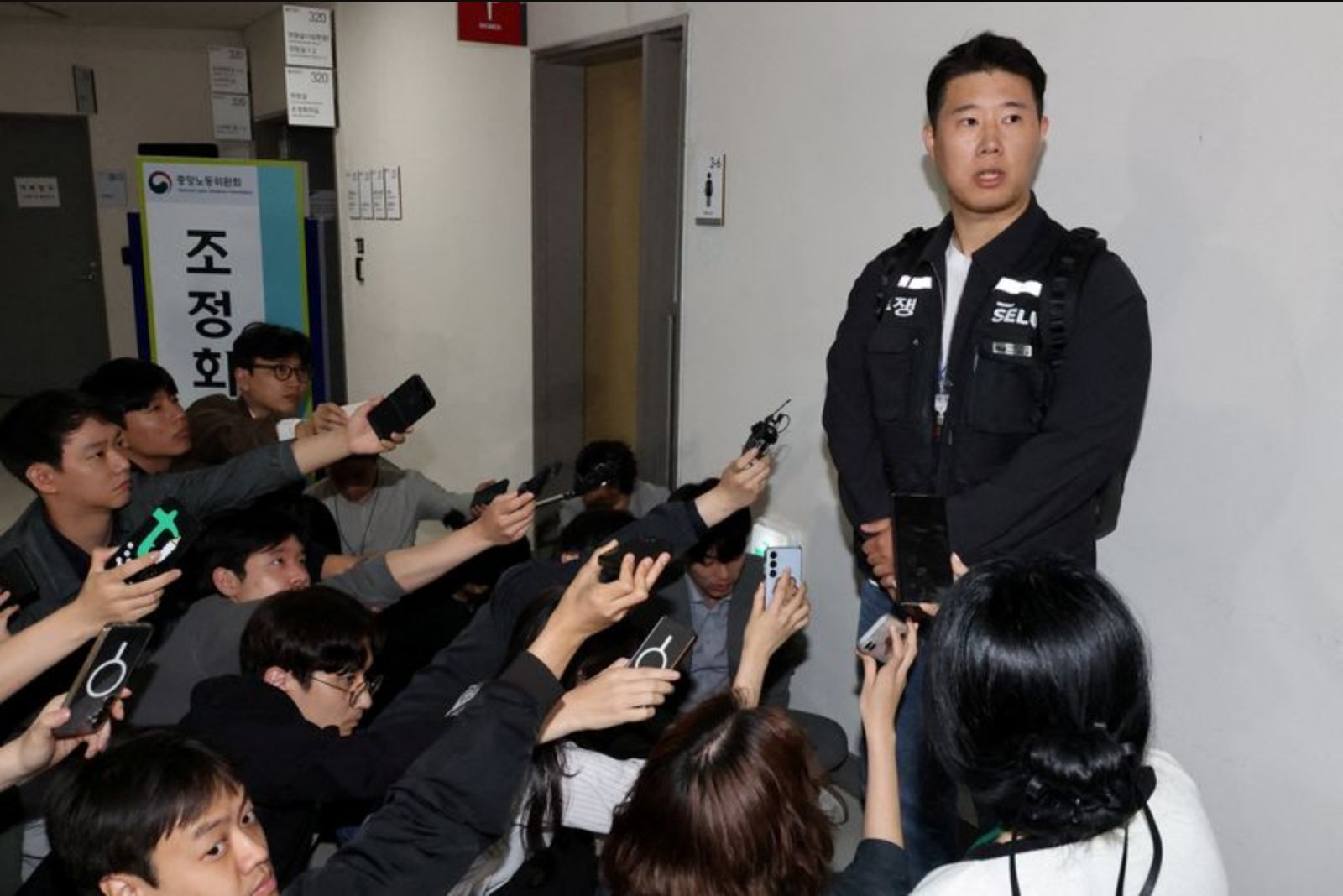
Samsung Electronics and its labor union failed to resolve a dispute over pay on Wednesday after two days of extended, government-mediated negotiations, leaving open the real possibility of a lengthy strike that officials say could reverberate through the company and the wider South Korean economy.
The breakdown followed marathon talks held on Monday and Tuesday under the auspices of mediators. In response to the stalemate, the government convened an emergency meeting of relevant ministers. A statement from the prime minister's office said Prime Minister Kim Min-seok instructed authorities to monitor the situation closely "considering the gravity of the impact on the national economy" and to offer "proactive support to ensure dialogue between the union and management can continue so this doesn’t lead to a strike under any circumstances."
Semiconductors have become a particularly large share of South Korea's external sales, underlining the stakes of any work stoppage. According to government figures cited by officials, semiconductors represented 37% of the country's exports in April, up from 20% a year earlier.
Market reactions and competitor moves
Shares in Samsung, the world's largest memory chip maker and a significant supplier of artificial intelligence chips, initially fell sharply on the news of the failed talks, dropping as much as 6%. Later in the session, after reports of the ministerial meeting, Samsung stock closed up 1.8%.
Rival SK Hynix registered a strong gain, with shares jumping 7.7% as investors priced in the possibility that it could capture business displaced by a Samsung disruption and amid growing expectations that SK Hynix will pursue a U.S. listing later in the year.
Union demands and company response
The union has framed its demands around what it calls a substantial disparity in bonus pay relative to SK Hynix. It has set an ultimatum: an 18-day strike beginning on May 21 if the company does not meet its terms. The union warned that more than 50,000 workers could participate in the action.
Union representative Choi Seung-ho said the company offered a "one-off performance payment" for 2026 but declined to accept the union’s request for a broader overhaul of the pay structure and for changes that would extend beyond a single year. The union's proposal includes eliminating the current cap on bonus pay, which is set at 50% of annual base salary; allocating 15% of annual operating profit to performance bonuses; and providing clearer rules on how bonus payments are calculated.
Choi said the union does not intend to return to negotiations before the scheduled strike date but left open the possibility of considering "a proper proposal" should the company present one.
Samsung said it regretted the failure of talks and pledged to continue "sincere dialogue" with the union to avoid what it described as a worst-case scenario. The company warned that if a fixed proportion of operating profit were designated for performance bonuses, its ability to fund future investment could be restricted in periods of industry downturn.
Mediation and potential government action
The National Labor Relations Commission, which served as mediator in the negotiations, said it had offered various compromise options but concluded the talks after finding a wide gulf between the parties' positions and noting the union's request to suspend discussions.
The standoff has prompted speculation that the government might use an emergency arbitration order. Under the law, authorities can issue such an order if a dispute is judged likely to harm the economy or daily life; the order would immediately ban industrial action for 30 days while the commission carries out mediation and arbitration. Officials noted that the law has been infrequently invoked and that using it would represent an exceptional measure for a government described as labor-friendly.
Asked about the possibility of invoking emergency arbitration, Labour Minister Kim Young-hoon said on Wednesday that the dispute should be settled through dialogue. The union has warned that resorting to an emergency arbitration order would damage labour relations.
Context inside Samsung and worker sentiment
Tensions within Samsung have been heightened by a recent compensation decision at SK Hynix. Last September, SK Hynix acceded to its union's demand for changes to compensation that included removing the cap on bonus pay. That deal has driven frustration among Samsung employees and helped swell union membership at Samsung.
Union membership at Samsung now exceeds 90,000 workers, representing more than 70% of the company's South Korean workforce, according to union figures. That discontent has been further amplified by record profits at Samsung tied to rising demand related to artificial intelligence, and by the firm's recent milestone of surpassing $1 trillion in market capitalization, making it the second Asian company after TSMC to reach that valuation.
Potential economic and market consequences
- A walkout involving more than 50,000 workers could delay shipments to customers and contribute to higher chip prices.
- Competitors may benefit if Samsung's output is disrupted, as indicated by the share movements in rival companies.
- Given the growing weight of semiconductors in national exports, an extended stoppage could have broader implications for South Korea's export-dependent economy.
At present, both sides remain at an impasse with a firm strike date set, government officials calling for continued dialogue, and industry observers weighing the risks of a disruption to the global chip supply chain. The dispute's next developments will likely hinge on whether the company presents a new proposal that the union deems "proper," or whether the government takes extraordinary measures to prevent industrial action.