
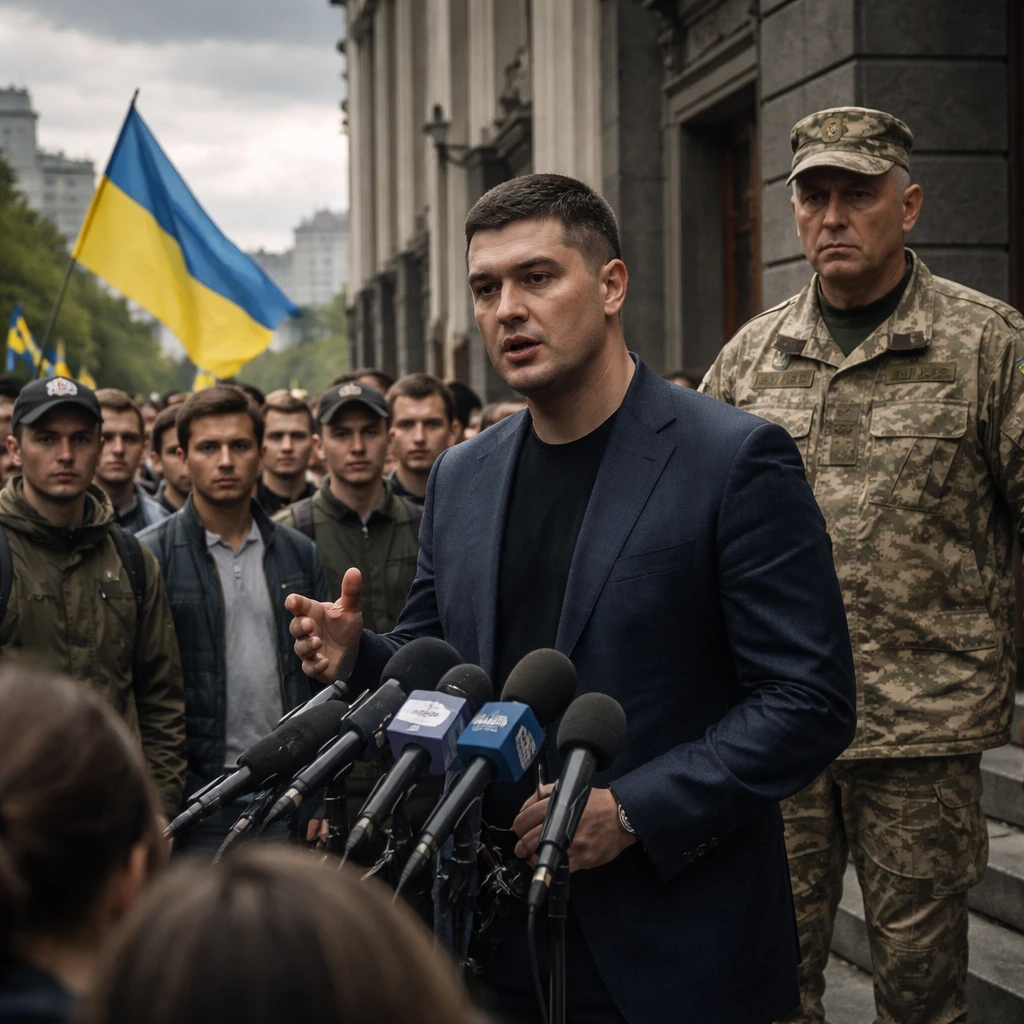
Mykhailo Fedorov, who was removed from his post as defence minister in a recent government overhaul after six months on the job, made a forceful public attack on General Oleksandr Syrskyi on Thursday, accusing the armed forces chief of deliberately undermining his programs and blocking initiatives intended to bolster Ukraine's defence.
Fedorov, 35, told reporters that he had tried to work with Syrskyi and had sought the president's intervention to replace the general, but eventually concluded that Syrskyi had been working to sabotage his efforts behind the scenes. "We hit a situation where all the initiatives we proposed were blocked, and Syrskyi, considering all the problems we discussed today, is not ready to look (me) in the eye and talk openly about the problems," Fedorov said at a news conference.
In unusually barbed language aimed at the man who has led the Ukrainian armed forces since February 2024, Fedorov accused Syrskyi of presiding over "a dysfunctional culture of lies, poorly organised units and lack of personal responsibility in the military." He added that, "Instead of working out how to asymmetrically defeat Russia ... he has worked out how to split the country." The remarks coincided with parliamentary discussions about the composition of a new cabinet.
Syrskyi responded with a brief statement thanking Fedorov for his work as defence minister and urging focus on the war. He did not directly address Fedorov's substantive criticisms.
Analysts and officials say the dispute exposes a deeper strategic debate over the conduct of the war in an era transformed by drone technology. Years of attritional combat have coincided with a rapid evolution in how the conflict is waged, with drones used for strike missions, logistics and medical evacuations. Fedorov, a prominent advocate for leveraging technology to gain an edge, oversaw a rapid expansion in the production of middle-range and deep-strike drones and helped streamline defence procurement procedures during his brief tenure.
Those efforts were accompanied by a visible improvement in Ukraine's battlefield posture, alongside a highly publicised campaign of drone attacks that have struck oil infrastructure and military targets deep inside Russia. Support for Fedorov was visible on the streets of Kyiv on Thursday, where a rare wartime demonstration drew hundreds of mainly under-30s who turned out to back his approach.
While praising Syrskyi's earlier military achievements, Fedorov argued that the dynamics of warfare have shifted dramatically and that drones are central to that transformation. "The war has totally changed," he said, stressing the need to adapt tactics and organizational structures to the new reality.
Syrskyi, 60, brings a contrasting profile. Educated in the Soviet military system with training in Moscow in the 1980s, he served as head of the ground forces from 2019 and gained prominence by leading the defence of Kyiv in 2022 and a rapid counteroffensive in Kharkiv later that year. He assumed overall command of the armed forces in February 2024 following the dismissal of his predecessor, Valeriy Zaluzhnyi.
The dispute between a tech-oriented minister and a more traditionally trained commander highlights not only tactical disagreements but also organizational and cultural frictions as the military seeks to balance technological innovation with personnel shortages and front-line needs.
President Volodymyr Zelenskiy publicly acknowledged the existence of the rift between Fedorov and Syrskyi, saying he could not immediately say how the dispute would be resolved. Zelenskiy also pointed to the chronic shortfall of infantry soldiers as a central challenge for the military - a problem neither the defence ministry nor the armed forces have yet solved.
A particular source of domestic tension has been the phenomenon popularly known as "bus-ification" - draft officers arriving to take civilian men into military service. Zelenskiy suggested that Ihor Klymenko, the interior minister widely discussed as a potential successor to Fedorov, could be in a position to address abuses associated with the drafting process.
The fallout from Fedorov's dismissal triggered further personnel changes and public statements of support. Mykhailo Drapatyi, a commander who had served as land forces chief from 2024 to 2025 before being demoted by Syrskyi, voiced backing for Fedorov. Pavlo Yelizarov, a deputy commander of Ukraine's air force who had been appointed by Fedorov to counter Russian drone attacks, announced his resignation in response to the defence minister's removal. Yelizarov described the decision as "a great evil" for Ukraine's defence.
Fedorov left open the possibility of returning to the post, though he did not specify a path by which that might occur. The public nature of the confrontation, the subsequent resignations, and the mobilization of supporters underline the strains within Ukraine's defence establishment at a time when operational cohesion is vital.
As Kyiv seeks to maintain momentum on multiple fronts - sustaining drone production and employment, addressing manpower shortages, and protecting critical infrastructure - the dispute illuminated on Thursday raises questions about internal coordination and unity of command at a critical juncture in the conflict.