
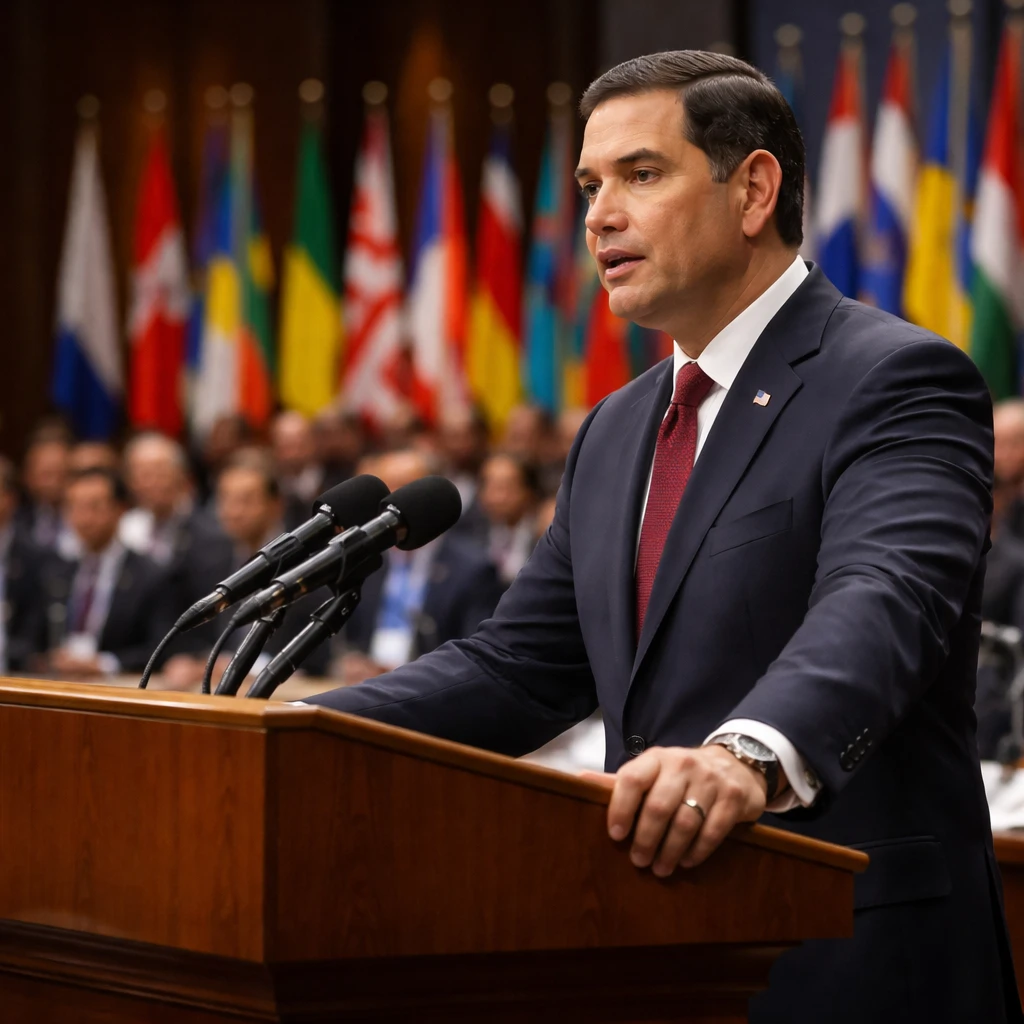
Secretary of State Marco Rubio on Thursday opened a Washington conference with a call for an expanded international counterterrorism focus on what he called "far-left terror," telling officials from more than 60 countries that leftist violence has been insufficiently addressed by existing strategies.
Speaking at the Ministerial on the Resurgence of Political Terrorism, Rubio said coordinated global action had sharply reduced the threat from Islamic militancy, describing that menace as "severely diminished." At the same time, he characterized the rise of left-wing violence as an "undeniable reality" and a "blind spot" for current counterterrorism efforts.
"We can and we must identify and map this threat and rebuild our counterterrorism architecture to defeat it," Rubio told the assembled ministers and officials, framing the issue as transnational in nature. He said these groups target politicians and critical infrastructure and are motivated by what he described as a hatred of the West and its success.
The administration has signaled a clear focus on left-wing movements. President Donald Trump has made countering left-wing groups a stated priority, having singled out the movement during the 2024 campaign and promising action following the killing of conservative activist and Trump ally Charlie Kirk last year.
Rubio said the U.S. convened a law enforcement workshop in May to address the threat posed by far-left groups and that a second workshop would be co-hosted with Germany. "We will either cooperate across our borders, or the terrorists will continue to exploit the gaps between them," he said, adding: "The United States is building the infrastructure, the partnership and the strategy to defeat the scourge of far-left terror."
Since November, the U.S. has designated four European organizations as Foreign Terrorist Organizations: Antifa Ost; the Informal Anarchist Federation/International Revolutionary Front; Armed Proletarian Justice; and Revolutionary Class Self-Defense. The designations include rewards of up to $10 million for information on their financing.
In his remarks, Rubio alleged connections between leftist militant groups and foreign actors hostile to the United States, citing Iranian proxy networks as being "increasingly intimately tied to leftist militant groups around the world." He also accused Cuba's Communist leadership of having "helped build the far left" in the United States. In both cases he did not present evidence to support those assertions as part of his speech.
Civil liberties organizations, including the American Civil Liberties Union, have warned that labeling groups as far-left terror organizations risks sweeping up lawful protest activity and targeting political opponents rather than focusing on genuine security threats.
This ministerial appears aimed at prompting partners to map networks, share intelligence and align legal tools to respond to an array of politically motivated violence. The administration's steps to date - designations, rewards for information, and law enforcement workshops - indicate an effort to construct an institutional response across borders.
Rubio's address framed the push as preventive and infrastructural, urging cooperation and the development of partnerships. The speech highlights the administration's intent to expand the definition of political terrorism to include left-wing militant activity as part of a broader counterterrorism agenda.