
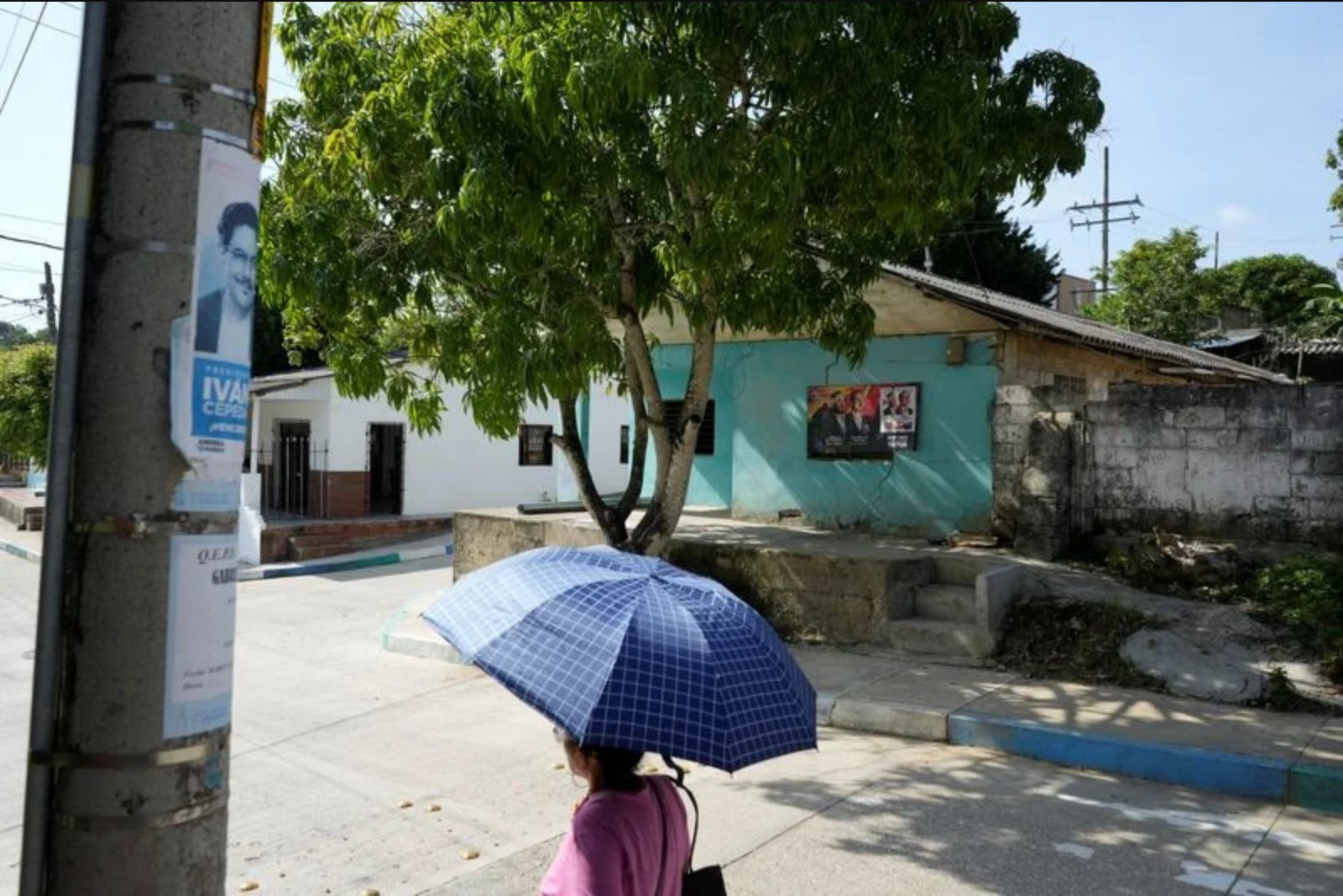
On Colombia's Caribbean coastline, two neighboring municipalities that share similar streetscapes and daily rhythms are sharply divided politically as the country heads into a presidential run-off.
Both Tubara and Juan de Acosta sit near the port city of Barranquilla, where single-story houses cluster around town plazas, residents avoid going out during the hottest part of the day, and mango trees line sidewalks where children make their way home from school. Yet the two towns differ in how their residents voted in the first round of the presidential election, which narrowed the field to a left-right contest.
In Juan de Acosta, voters gave 55% of their support to right-wing candidate Abelardo De La Espriella, who has campaigned with a pledge to impose strict measures on armed groups and criminal gangs. His message of security and force has appealed in a municipality that has experienced a recent spike in murders and persistent extortion amid increased drug trafficking along its coastline.
Next door in Tubara, leftist senator Ivan Cepeda captured just under 60% of the vote. Cepeda's platform, focused on expanding reforms to healthcare, pensions and education, resonated with many residents there who prioritize social programs.
De La Espriella, 47, a lawyer and businessman with no prior political office, has used military-style imagery and language in his campaign. He refers to himself as "the Tiger," leads a movement calling itself "Defenders of the Homeland," and salutes at rallies and in campaign publicity despite never having served in the military. That posture, combined with his promise to crack down on crime, helped him build a lead of several points over Cepeda in the first round. Recent polling cited in the run-up to the second round puts him about eight points ahead.
Residents in Juan de Acosta described how the spike in violence and extortion has changed daily life. "You set up your business and tomorrow they come and say 'if you don’t give us 50,000, 30,000 or 40,000 (pesos), it’s over,'" said Nicanor Alba, speaking while chopping and bagging pork ribs at his butcher stand near the town plaza. Alba also noted a personal toll: his brother was murdered five years ago, and he said several friends and neighbors have been repeatedly targeted by extortion.
"That had never been seen before in Juan de Acosta, it’s a bunch of people," the butcher said, explaining why he plans to vote for De La Espriella.
Local authorities describe how Juan de Acosta's geography has made it attractive to drug traffickers. Colonel Eddy Sanchez, police commander for Atlantico province, said the municipality's road links to the interior combined with its coastline make it a "strategic point" for drug networks. Historically, two criminal groups - Los Pepes and Los Costenos - have operated in the area, including selling drugs, Sanchez said. More recently, the country's largest crime gang, the Clan del Golfo, has also arrived.
"The Clan del Golfo uses this municipality as a platform to reach maritime areas and, using speedboats, ship drugs abroad," Sanchez said. He added that such activity leads to issues of violence, though he noted that murders recorded in the municipality have fallen from 15 in 2025 to just 2 in 2026 so far, which aligns with the municipality's historic average. Police classified 14 of last year's killings as contract killings.
By contrast, Tubara recorded no murders in 2025 and had only one homicide so far in 2026, Sanchez said. The difference between the two towns is, in the police account, a matter of territorial disputes among criminal groups. "It’s a territorial dispute, where some gangs are trying to enter the municipality while others are trying to push them out to fully control local drug trafficking," said Oscar Andres Arteta, Juan de Acosta’s interior secretary. He added that the local government and police are working together to fight extortion.
Economic and personal security concerns are shaping votes. Juan Gabriel Coronel, who runs a small store selling meat, ice cream and dry goods in Juan de Acosta, said he plans to support De La Espriella in hopes of curbing violence and extortion. Coronel, 42, also cited personal healthcare concerns: he had a liver transplant 17 years ago and said he has never been denied his medication until recently.
Coronel is a client of a healthcare provider that the government took over in 2024 because of alleged care failures. For the last six months he has had to pay for his medication out of pocket, he said, a development that informs his vote.
On the campaign trail and at the community level, both candidates and their supporters are working to expand turnout for the second round. In a first round with 13 candidates, Cepeda, 63 and the son of a murdered communist leader, won all but one Caribbean province. Analysts say he must increase his vote share in the region and in the capital, Bogota, to have a viable chance in the run-off.
Political scientist Luis Fernando Trejos of the Universidad del Norte said Cepeda will need an additional 2.5 million to 3 million votes to win. De La Espriella, who secured about 700,000 more votes than Cepeda in the first round, likewise needs to broaden his support base. More than 41 million Colombians are eligible to vote, but participation in the first round was under 24 million.
Both candidates have courted local powerbrokers on the coast. De La Espriella has underscored his coastal roots, emphasizing that he was raised in the inland Caribbean city of Monteria. His campaign billboards portray his tiger alter ego in a Barranquilla soccer jersey and include the slogan "Abelardo is coastal like you. .... Coastal votes coastal." He has also accused Cepeda of planning a large-scale vote-buying operation on the coast, an allegation Cepeda's campaign has strongly denied.
In Tubara, supporters of Cepeda have been active in arranging logistics to improve turnout. Clara Algarin, a clinical psychologist and former city councilor, said she has been organizing transportation for voters who were unable to reach polling stations for the first round. Algarin expressed support for policies implemented by current leftist President Gustavo Petro, notably the expansion of free public university places for undergraduates and a state pension of 230,000 pesos per month for people unable to save for retirement.
"My mother worked as a domestic servant from the age of 16. She never had the possibility of being paid a pension before," Algarin said, explaining why those measures are meaningful to her family.
Her husband, Javier Gomez, who runs a bakery, displays a bright Cepeda banner on his porch and said he was content to pay his employee the 23% minimum wage increase instituted this year by Petro. "The work that (the employee) does deserves the payment of a living wage," Gomez said as he packed fresh bread.
As Colombians prepare to vote in the run-off, the contrasting priorities of security and social reform are on display in these neighboring towns. Local experiences with violence, extortion, healthcare access and wage increases are translating into distinct political choices - illustrating how proximate communities can respond differently to national debates about crime and social policy.
($1 = about 3,500 pesos)