
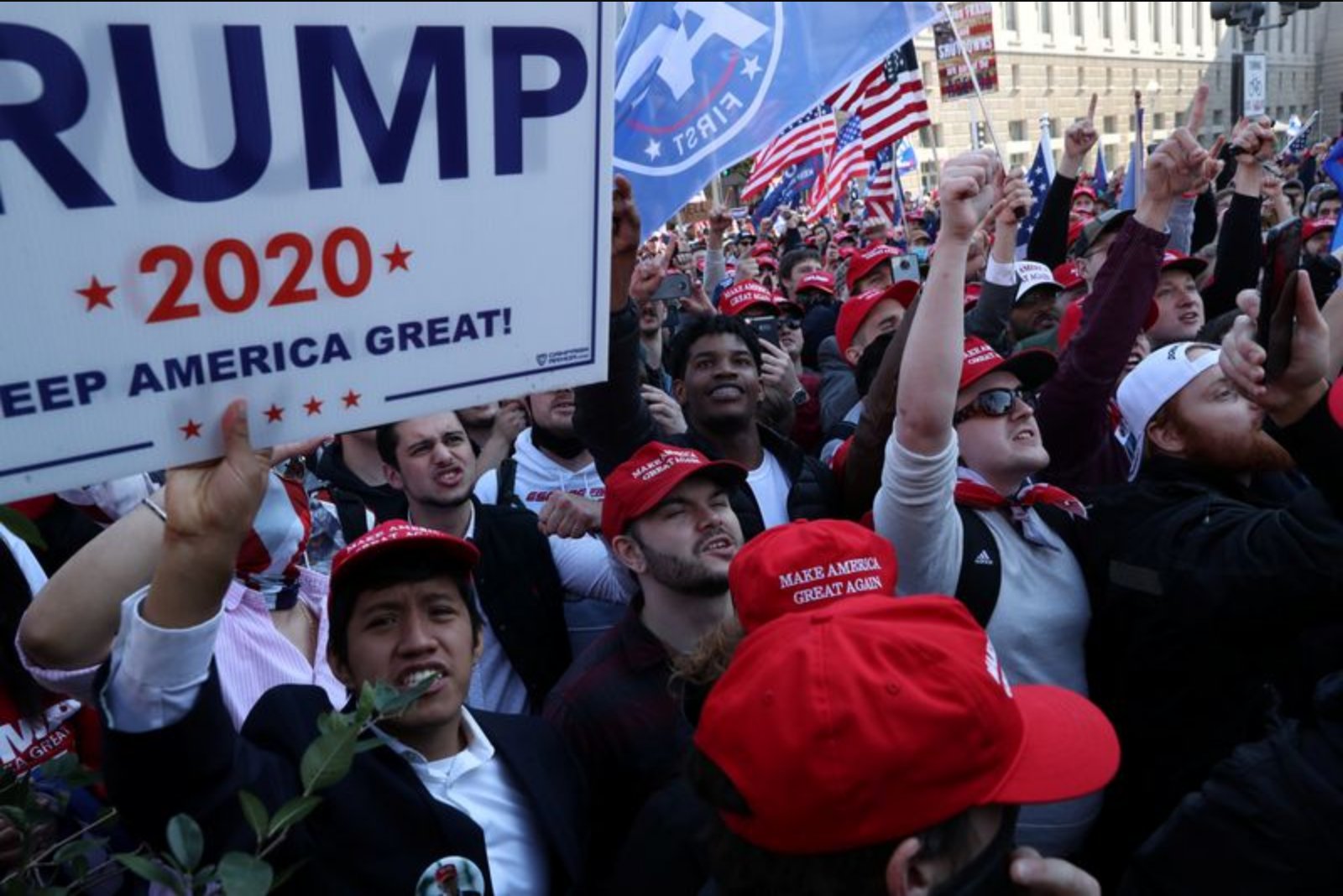
President Donald Trump has repeatedly asserted that the 2020 presidential election was stolen from him - saying so at least 107 times in the last six months, according to a review of his public appearances, interviews and online posts. That claim, which has been widely discredited by courts, election officials and prior reviews, has remained a near-daily focus of his public remarks as he confronts foreign-policy tensions and heads into a politically consequential midterm season.
That review found he frequently returns to the topic in clusters. One Saturday in April, while a fragile ceasefire with Iran was in effect, he posted allegations about the 2020 vote seven times on his Truth Social account. He has raised the subject in a range of settings - during at least six meetings with world leaders, at two professional sports team celebrations, and during White House observances of Hanukkah and Christmas.
In unscripted remarks at the World Economic Forum in Davos in January, he warned that "people will soon be prosecuted for what they did." He repeated his rigged-election claims at a White House picnic for lawmakers and again while speaking to reporters before boarding Air Force One. On one occasion he said, "If we had Jesus Christ come down and count the votes, I would have won California," later adding, "But it’s a rigged vote." He lost that state by 29 percentage points in 2020 and by more than 20 percentage points in 2024.
Aides and interviewers sometimes downplay his comments, treating them as routine. Critics describe the comments as the plaints of a sore loser. But according to two White House officials and two people familiar with the matter who spoke on the condition of anonymity to discuss internal strategy, the repeated focus on 2020 serves a forward-looking political purpose: to justify new voting restrictions, to strengthen party unity and to energize supporters ahead of the November midterm elections that will determine control of Congress.
Multiple election experts say the persistent narrative that the 2020 outcome was illegitimate also creates a basis to challenge future losses and to undercut the legitimacy of Democratic victories should they regain power. Alexandra Chandler, an election expert at the nonpartisan advocacy organization Protect Democracy, summarized the approach bluntly: "He’s not looking back; this is about the midterms. He’s trying to create a fog of disinformation with this. So then if he dials it up further with federal interference, the public will not react as surprised."
How the rhetoric has surfaced
The review documented a broad pattern of repetition across venues and formats. In April, after initiating a national battle over redistricting months earlier, the president denounced the results of Virginia’s congressional map-redrawing process as "rigged," without providing evidence of fraud. The White House reiterated that the administration is focused on ensuring public confidence in elections.
"President Trump is committed to ensuring that Americans have full confidence in the administration of elections, and that includes totally accurate and up-to-date voter rolls free of errors and unlawfully registered non-citizen voters," White House spokeswoman Abigail Jackson said in a statement.
Public opinion and party alignment
An April poll found that 63% of Republican voters accept the false claim that the 2020 election was stolen. The same survey showed that 82% of Republicans said they agreed large numbers of fraudulent ballots are cast by non-citizens in U.S. elections. By contrast, only 9% of Democrats and 21% of independents said they believed the 2020 result was due to wrongdoing; 18% of Democrats and 38% of independents expressed concerns about ballots cast by non-citizens.
These attitudes matter because they shape the political environment for proposals that would alter voting procedures. Multiple courts, state officials and prior reviews have found no evidence of widespread fraud in the 2020 election. Still, the president appointed an election-security official last year to re-examine his 2020 loss; those renewed probes have produced no new evidence that substantively changes that conclusion.
Policy moves and legal fights
Administration discussions and actions have reflected the push to change voting infrastructure and procedures. Last year, administration officials explored banning certain voting machines used in more than half of U.S. states while considering potential federal involvement in areas traditionally administered by states. The conversation has included heightened scrutiny of mail-in voting; the president has pushed measures that would require proof of citizenship to register to vote and has pressed for other changes to how elections are conducted.
The president intensified his rhetoric in December when he sought to pardon Tina Peters, a Colorado county clerk who was convicted by the state on charges connected to tampering with voting equipment following the 2020 election. He has continued to press congressional Republicans to pass the Save America Act, a bill that would require proof of citizenship for voting, and has signed executive orders aimed at restricting mail-in voting. Those executive orders are being challenged in court by Democrats, and the U.S. Senate has not advanced a nationwide overhaul of voting requirements.
Despite the national legislative impasse, several states have implemented proof-of-citizenship rules and tightened voter identification requirements in ways that mirror aspects of the proposals the president has championed.
Political uses of the 2020 narrative
The president has also employed the stolen-election narrative to shift blame for complex foreign and domestic policy issues. In December, he told Ukraine's president that the "rigged" U.S. election enabled Russia’s 2022 invasion. In February, while speaking to families who had lost relatives in crimes tied to immigration, he suggested they would be "home with your son, daughter" if the election had not been "rigged."
The issue has become a litmus test within the party for some nominees to federal posts. Several of his judicial and other nominees have declined under oath to state explicitly to Democratic senators that Biden won in 2020, instead saying that Congress certified the election.
Internal resistance and GOP fractures
Not all Republicans have embraced the persistent claims. In battleground states, a group called RightCount relaunched efforts to defend state-run election administration and to counter attempts to nationalize election controversies. Former Arizona Governor Jan Brewer, a supporter of the president and a member of that group, said: "All the accusations that have been made have all been refuted, but he doesn’t want to listen."
In Louisiana, U.S. Senator Bill Cassidy, who lost his Republican primary last week after the president declined to back his campaign, used his concession speech to criticize the persistence of the stolen-election narrative. Cassidy had angered the president by supporting his impeachment following the January 6, 2021, attack on the U.S. Capitol. "When you participate in democracy, sometimes it doesn’t turn out the way you want it to," Cassidy said. "But you don’t pout. You don’t whine. You don’t claim the election was stolen."
What remains uncertain
Observers and officials differ on how far the rhetoric will move policy or public behavior before the midterm elections. Support among Republican voters for the stolen-election claim has been steady, and the continuing emphasis on alleged fraud may shape both the policy agenda and the partisan dynamics in the months ahead. At the same time, some Republicans are working to reaffirm confidence in state-administered elections and to resist nationalizing disputes that have been litigated and investigated without turning up evidence of widespread fraud.
As the November elections near, the combination of sustained messaging from the president, state-level policy changes and ongoing legal challenges will determine whether the rhetoric translates into durable changes to how Americans vote and how election infrastructure is regulated.