
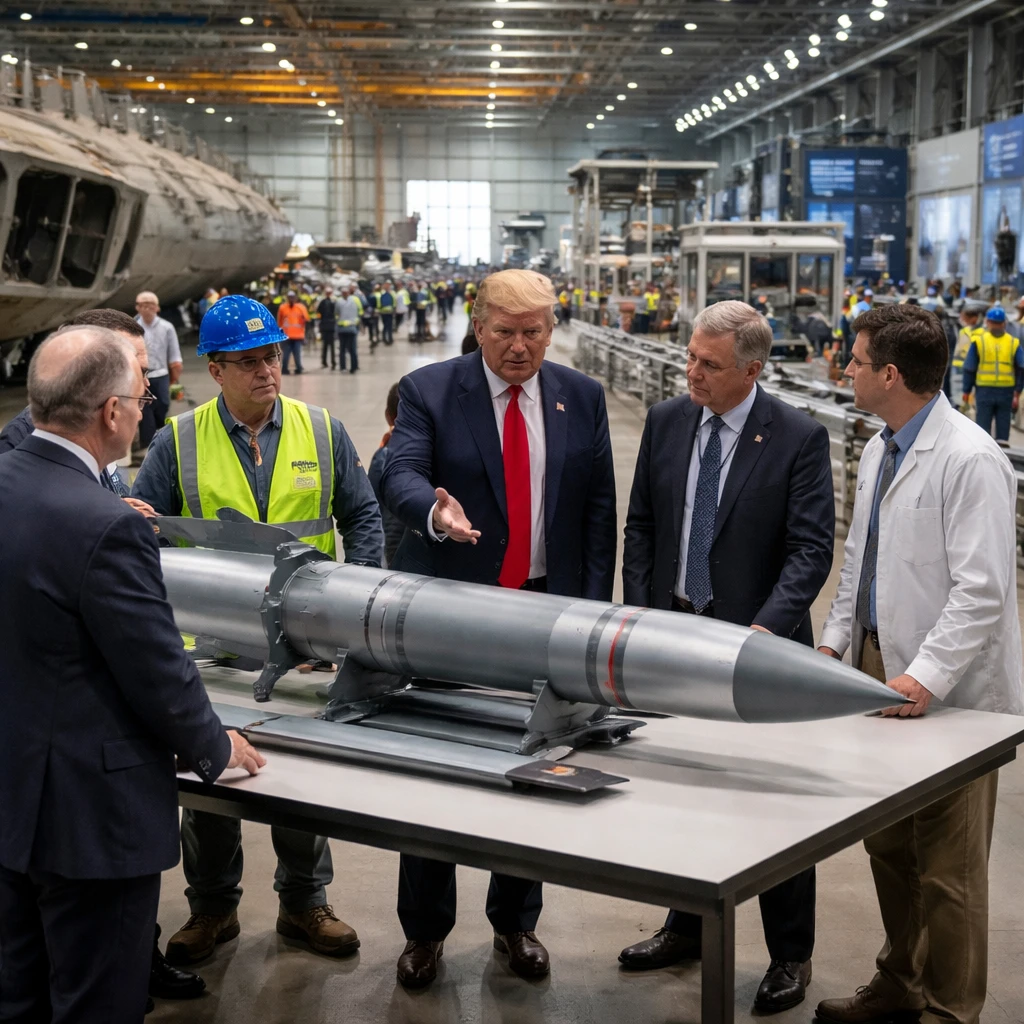
President Donald Trump on Wednesday called on senior executives in the defense industry to accelerate weapons production and broaden manufacturing capacity as ongoing conflicts in Ukraine and the Middle East deplete U.S. stockpiles and reveal bottlenecks across the nation’s industrial base.
Speaking at Pennsylvania Senator Dave McCormick's Defense and Innovation Summit at the U.S. Army War College in Carlisle, Trump told armsmakers, "We have the best quality in the world, but we need a little more speed." His remarks framed defense production as a priority for the administration amid extended combat operations that have consumed large amounts of missiles, interceptors and other munitions.
The summit convened senior military leaders, defense contractors, investors and technology executives to examine ways to strengthen the U.S. industrial base and expedite delivery of modern weapons systems. Senator McCormick used the gathering to announce more than 30 investments and partnerships aimed at enlarging the state's defense industrial base, bolstering the emerging technology sector and increasing the research workforce.
Major commitments outlined at the event included a $2.5 billion shipbuilding agreement between Rhoads Industries and General Dynamics' Electric Boat, $1.5 billion in ship orders for Hanwha, and planned expansions in AI, robotics, space and advanced manufacturing. Those announcements were presented as part of a broader push to convert defense needs into domestic factory investment and advanced manufacturing activity.
The push to expand defense manufacturing has been cast by the administration as part of a larger economic strategy to restore U.S. industrial capacity. Officials increasingly view Pentagon demand as a catalyst for bringing investment into domestic supply chains and production lines. That emphasis on industrial scale and speed was echoed by senior Pentagon acquisition officials who described new procurement strategies meant to back heavy industry investment.
Earlier on Wednesday, the Defense Department unveiled the National Security Finance Fund, a vehicle intended to provide financial support and credit to firms addressing shortfalls in supplies of critical minerals that are considered vital to national security. The fund is one of several levers the administration is deploying to tackle supply-side constraints identified by both military and industry representatives.
Late in June, Trump met with munitions manufacturers at the White House to press the industry for faster output. Officials at the summit said the United States has both supplied large volumes of weapons to allies and used munitions in its own operations, creating concern about inventories of key air-defense systems and precision-guided weapons. That dynamic has increased pressure on contractors to raise production levels quickly.
Soaring demand for rocket motors - the propulsion components used in many missiles and other weapons - has prompted fresh examination of supply chains. The pressure for higher volume and faster delivery has also drawn interest from new entrants. Startup firms, inspired by Silicon Valley approaches, are now competing alongside long-established defense companies to meet needs for speed, scale and cost efficiency.
Legacy manufacturers of solid rocket motors, including Northrop Grumman and L3Harris, reported intensifying their research and development efforts to adopt newer production technologies such as 3D printing and updated mixing techniques for propellants. These moves were described at the summit as part of industry attempts to boost throughput and reduce production bottlenecks.
Michael Duffey, who oversees Pentagon procurement, told attendees that the department is relying on long-term procurement contracts to give defense firms the confidence to commit to large-scale factory expansions. Duffey cited roughly $20 billion in private investment connected to plans to raise production of Patriot missiles and other high-demand weapons, saying, "The global environment now demands that we produce at this scale, at this speed, at this volume."
The discussions at the summit and the accompanying investment announcements underscore a policy direction that ties defense needs directly to industrial policy, financing mechanisms and public-private partnerships. Participants framed the effort as addressing immediate inventory shortfalls while attempting to create a more resilient production base for future contingencies.
Context and next steps
Attendees left the summit with a focus on converting procurement signals into private capital investment and on using targeted financing to shore up critical supply chains. The effectiveness of those measures will depend on whether firms can convert financing and procurement commitments into expanded, faster production without creating new bottlenecks elsewhere in the industrial base.