
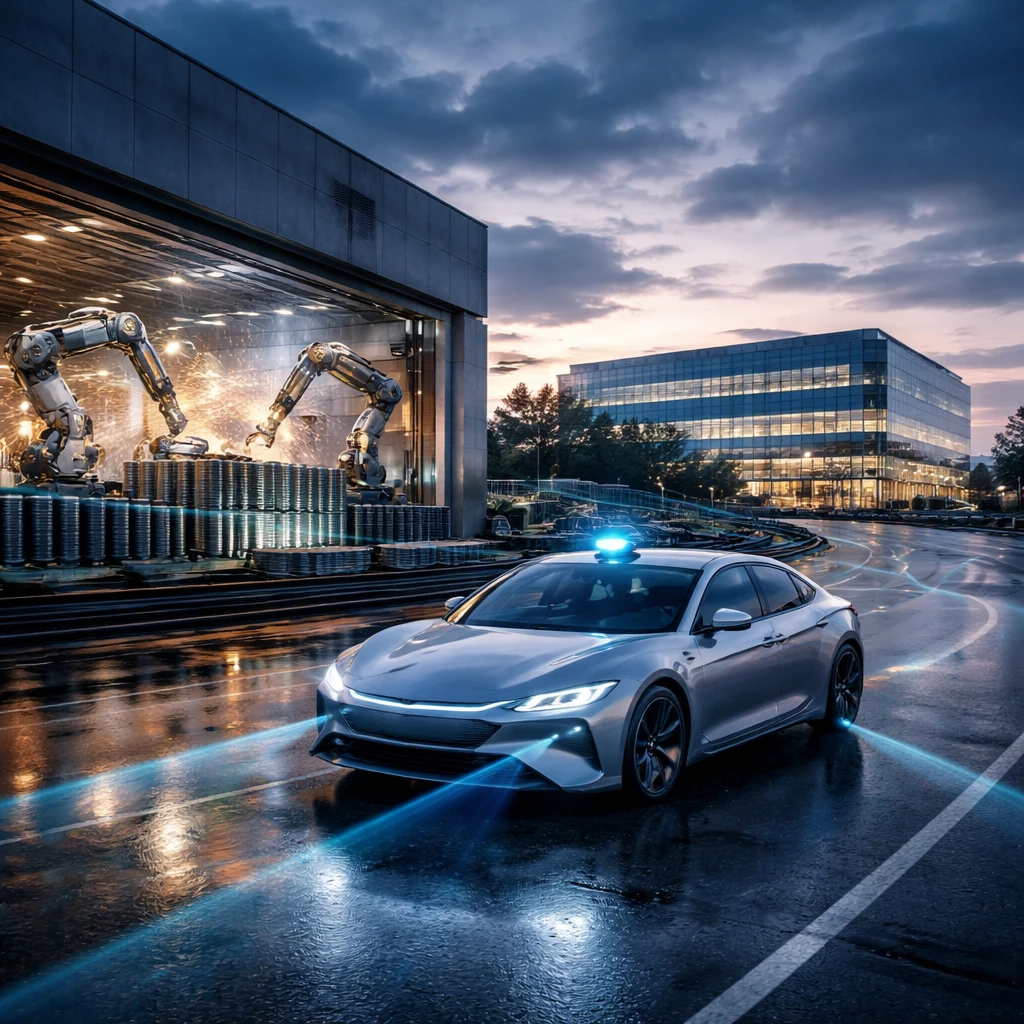
Oppenheimer has published research identifying what it considers leading investment opportunities in the Physical AI sector, citing recent technical progress in vehicle autonomy, lidar sensing platforms and battery energy density. The firm frames vertical integration as a dominant industry trend, with platform companies broadening capabilities and working to secure their supply chains.
Oppenheimer describes perception and battery firms as likely "pick and shovel" beneficiaries that may deliver outsized returns as on-road autonomy expands and supporting hardware improves. The research also tracks legislative measures that could influence market dynamics, noting the Safe LiDAR Act and the Connected Vehicle Security Act as items moving through Congress that may favor domestic technology suppliers.
Company highlights
Tesla
The electric vehicle manufacturer is singled out for its expanding technology footprint and degree of vertical integration. Oppenheimer notes Tesla's chip production efforts in partnership with Terafab and points to the company's continued development of autonomous driving software. The firm highlights Tesla's robotaxi operation in Austin, which it reports comprises roughly 20 unsupervised vehicles.
Oppenheimer revised its estimates for Tesla and views the automaker as a leader in vertically integrating capabilities across the Physical AI value chain. Recent company results included a notable second-quarter automotive volume beat, with 480,100 units delivered, a figure that surpassed consensus expectations. Following those results, Jefferies raised its price target on Tesla to $400 and RBC Capital increased its target to $500.
Aeva Technologies
Aeva is identified as a perception-technology company that Oppenheimer expects to be capable of delivering beat-and-raise results. The firm notes that market participants have already begun pricing in the potential passage of legislation that would limit Chinese technologies in certain civilian applications, a development Oppenheimer says could benefit domestic suppliers such as Aeva. The research also records that Oppenheimer revised its estimates for the company.
Operationally, Aeva announced an agreement with Bendix Commercial Vehicle Systems to develop a lidar-based safety solution for commercial trucks. The company recently completed a public offering that raised gross proceeds of $115 million.
Ouster
Oppenheimer boosted its price target on Ouster to $57 from $42, underscoring the company's sensor fusion and software strengths as central to building competitive advantages. The firm revised estimates and views Ouster as a key perception play due to its integration of differentiated hardware with AI capabilities.
Ouster disclosed a strategic supply agreement with AIM Intelligent Machines for digital lidar sensors and expanded its manufacturing partnership with Benchmark Electronics to enable high-volume production. The company also priced a public offering expected to generate gross proceeds of approximately $200 million.
Amprius Technologies
Oppenheimer lists Amprius as a battery technology company that aligns with the "pick and shovel" characterization, positioned to gain from improvements in battery density and cycle life across Physical AI applications. In its first-quarter 2026 results, Amprius reported revenues of $28.5 million that beat expectations, although earnings per share fell short of forecasts. The company also announced a collaboration to supply batteries for Matternet's M2 delivery drone fleet.
Electrovaya
Electrovaya is another battery-focused name Oppenheimer highlights as likely to benefit from advancing energy storage technologies supporting Physical AI use cases. The company disclosed a commercial agreement with Amazon to deploy its battery technology in material handling operations. Following that announcement, Raymond James increased its price target on Electrovaya to $22.00, and H.C. Wainwright reiterated a Buy rating.
Enovix
Rounding out Oppenheimer's energy storage selections, Enovix was noted for its role in the battery segment that underpins Physical AI deployments. The company appointed Dr. Michael Vyvoda, a former Apple operations executive, as Chief Operating Officer to oversee global manufacturing and supply chain as Enovix scales production.
Aurora Innovation
Oppenheimer characterizes Aurora Innovation as an autonomous vehicle-technology company approaching a critical adoption inflection for commercial vehicles, with the firm anticipating better-than-expected pricing power. Aurora reported first-quarter 2026 earnings that exceeded analyst expectations for earnings per share. The company also received fresh coverage from Craig-Hallum, which initiated coverage with a Buy rating.
Summary and context
Oppenheimer's research frames the Physical AI landscape as one where integrated platforms and specialized component suppliers both have roles to play. The firm emphasizes perception and battery suppliers as foundational vendors likely to benefit regardless of which platforms ultimately dominate commercially. Legislative movements related to domestic sourcing of lidar and vehicle security are highlighted as potential tailwinds for U.S.-based suppliers.
Key points
- Oppenheimer sees vertical integration and supply-chain control as central industry trends affecting Physical AI platform companies and suppliers.
- Perception (lidar and sensor fusion) and battery technology firms are characterized as 'pick and shovel' plays that could outsize returns as autonomous and robotics deployments expand.
- Congressional legislation such as the Safe LiDAR Act and Connected Vehicle Security Act could advantage domestic technology suppliers, according to Oppenheimer.
Risks and uncertainties
- Legislative outcomes are unsettled - the potential benefits to domestic suppliers depend on whether the referenced bills become law and on their final form.
- Company-level execution risk remains - several firms have completed public offerings or are scaling manufacturing and supply chains, and successful scaling is not guaranteed.
- Financial results are mixed across the cohort - for example, Amprius posted a revenue beat but an earnings-per-share miss, indicating variability in near-term profitability.
Oppenheimer's selections and the accompanying operational updates provide a snapshot of how perception, autonomy software and battery innovations are being positioned commercially. The firm’s emphasis on both platform-scale integration and specialist component suppliers reflects the multi-faceted nature of investment opportunities in Physical AI.