
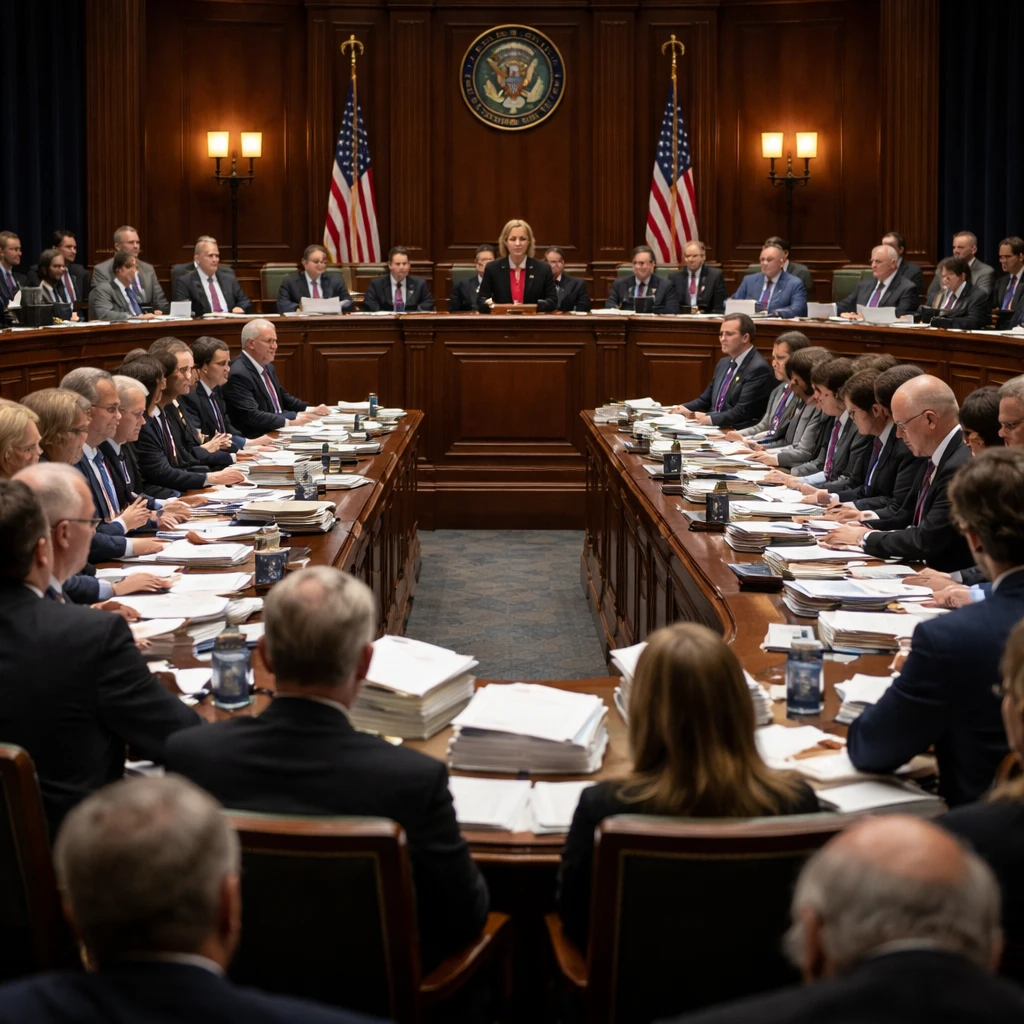
WASHINGTON, July 16 - Republican lawmakers in the U.S. House moved forward on Thursday with a $95 billion budget framework designed to accommodate President Donald Trump’s priorities: augmented defense funding tied to the Iran war, support for farmers coping with higher input costs, and a broad rewrite of voting rules ahead of the midterm elections.
The Republican-led budget committee approved the resolution in a 20-14 party-line vote, sending the plan to the full House for possible consideration as early as next week. If adopted by the House, the blueprint would set the stage for measures to be advanced through the Senate’s budget reconciliation process, which permits certain fiscal legislation to pass with a simple majority rather than the 60 votes typically required in the chamber.
Under the plan laid out by House Republicans, the new spending would be allocated as follows: $60 billion for defense, $13 billion for intelligence, $12 billion for agriculture assistance and $10 billion to implement the SAVE America Act - former President Trump’s signature voter ID proposal - across the next decade. Republicans hold 53 of the Senate’s 100 seats, a margin that could be decisive if reconciliation is used to bypass unified Democratic opposition.
Budget committee chair Jodey Arrington, a Republican from Texas, told fellow panel members: "We’re not going to get any help from our Democrat colleagues to do what I believe are ... critical things," as the committee advanced the resolution for full House consideration.
Procedure and political dynamics
Republican leaders in the House signaled they hope to pass the blueprint rapidly. However, it remains uncertain whether the chamber’s narrow GOP majority can secure the votes necessary to advance the measure, particularly after fractures within the conference were on display earlier Thursday when the House failed to pass a veterans benefits bill because of opposition from Republican hardliners.
Senate Republican leaders have tempered expectations for a swift reconciliation push even if the House approves the resolution. The budget blueprint faces opposition from multiple Republican constituencies: defense hawks who argue the plan does not provide enough Pentagon funding, deficit hawks who insist on cuts to offset new spending, and party members concerned that enshrining a partisan voter ID statute could complicate election prospects ahead of November.
Content of the voter ID proposal and legislative mechanics
The SAVE America Act, described by Trump as his No. 1 legislative priority, does not have the votes to pass the Senate as a standalone bill, according to Republicans. The GOP is planning to rely on reconciliation to pair federal grant incentives with state-level requirements: offering funds to states that implement photo ID checks at polling places, require proof of citizenship for voter registration, and provide state voter rolls to the Department of Homeland Security.
Amendments and dissent
During committee consideration, Republicans defeated 14 Democratic amendments that sought to restore funding for healthcare and food assistance, reverse previous education cuts, curb the Trump administration’s immigration policies, revoke tariffs imposed by Trump, and eliminate spending proposed for the Iran war. Committee Republicans framed the defense allocations as necessary to back U.S. military operations in Iran, to replenish weapons stockpiles depleted during the Middle East conflict and to improve readiness.
Democratic Representative Becca Balint of Vermont criticized the resolution on the House floor, saying: "This budget resolution is a poorly planned, poorly drafted backdoor deal to pay for President Trump’s decision to start a war with Iran. It’s irresponsible ... and we see it played out every single day on the news." The resolution includes no direct offsets for the additional $95 billion in spending.
Fiscal details and projected effects
Committee Republican staff indicated the resolution would restrain broader federal outlays by capping discretionary spending for fiscal year 2027 - which begins October 1 - at $1.67 trillion, a level described as well below the benchmark being sought by House appropriators. The plan would also permit discretionary spending to rise by no more than 1% annually for the remainder of the decade.
Democrats warned that such lower spending caps would force roughly $200 billion in additional cuts to social programs that serve lower-income Americans in the coming years.
Separately, the resolution would authorize legislation aimed at assisting U.S. farmers facing elevated fuel and fertilizer costs related to the ongoing war, according to Republican lawmakers.
Next steps
If the full House approves the budget resolution, Republican leaders plan to use it as a vehicle to advance specific spending and policy measures under reconciliation. Whether the full conference can hold together to pass the blueprint and whether the Senate will take up reconciliation-based measures in short order remain open questions.