
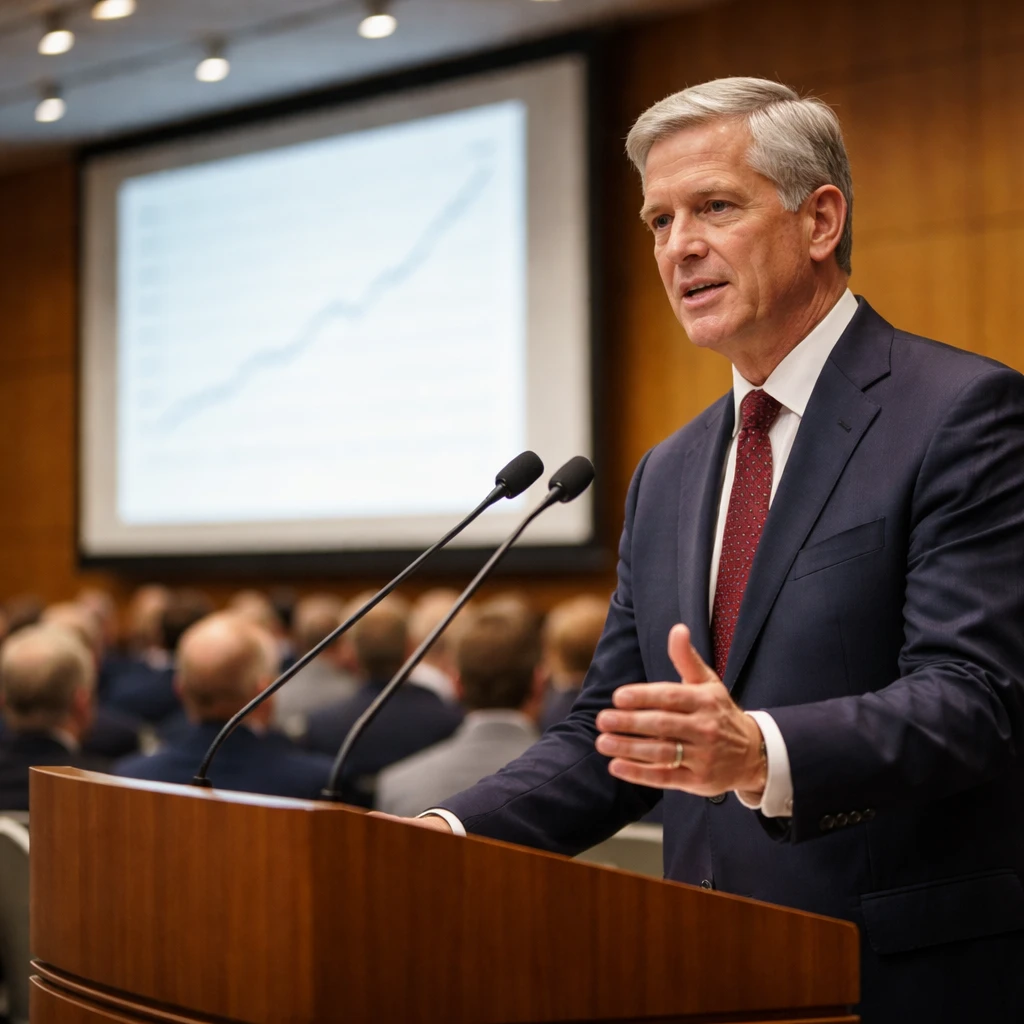
Kansas City Federal Reserve President Jeff Schmid told attendees at an economics forum in Nebraska that inflation remains broadly elevated across both goods and services and continues to be the primary concern guiding monetary policy amid a steady labor market.
Schmid characterized inflation running at roughly double the Fed's 2% goal as "concerning," and he pushed back on the notion that recent price increases are mainly a short-lived phenomenon driven by transitory factors such as high oil costs.
"I am uncomfortable ever assuming that a burst of inflation is likely to be temporary," Schmid said. "Inflation shocks are not intrinsically transitory."
Although he is not a voter on interest rate policy this year, Schmid did not use his prepared remarks to call explicitly for higher interest rates. He did, however, caution against drawing strong conclusions from a single data release, even if that release showed inflation running lower than many had expected.
Schmid noted that the week’s softer inflation readings were influenced by recent declines in oil prices, but he warned that such relief may not persist. "It would be premature to put too much weight on a single data point relative to recent trends," he said. "With the price of oil once again rising, it is uncertain how persistent any relief on energy will be."
The Federal Reserve is scheduled to meet on July 28-29. Schmid's remarks come amid signals from some policymakers that they could support an increase in interest rates if inflation does not continue to ease in the months ahead. Market participants currently expect that any policy tightening would materialize in September.
Schmid also addressed the role of Fed officials speaking publicly about their economic outlooks and policy judgments, defending the practice as essential for accountability given the central bank’s institutional independence. He argued that transparency helps prevent misperceptions about political influence and clarifies how decisions are reached.
"Independence demands accountability. And we can only be accountable if we are transparent on how we arrive at the decisions we make," Schmid said. "Transparency is necessary to avoid the perception that our decisions are politically influenced. If we don't explain our decisions, the public is left to speculate."
The remarks referenced the uncertain path for energy prices and their implications for inflation readings while reiterating that a single soft report should not be treated as definitive. Schmid’s comments also noted that New Fed Chairman Kevin Warsh has not laid out a policy stance, and that Warsh favors a stricter approach to forward guidance on rates.
Schmid’s emphasis on persistent inflation pressures and the need for transparent communication frames the current policy debate as one where officials remain alert to upside risks to prices even as some monthly measures show moderation.
Key takeaways
- Inflation is broadly elevated and running at about twice the Fed's 2% target, a development Schmid called "concerning."
- Recent lower-than-expected inflation readings were partly driven by oil price declines, but Schmid warned that energy-driven relief may not last as oil prices rise again.
- Schmid defended Fed transparency as necessary for accountability and to avoid perceptions of political influence.
Impacted sectors: Energy, consumer goods, services, and fixed-income markets are among those sensitive to the inflation outlook and interest-rate expectations.