
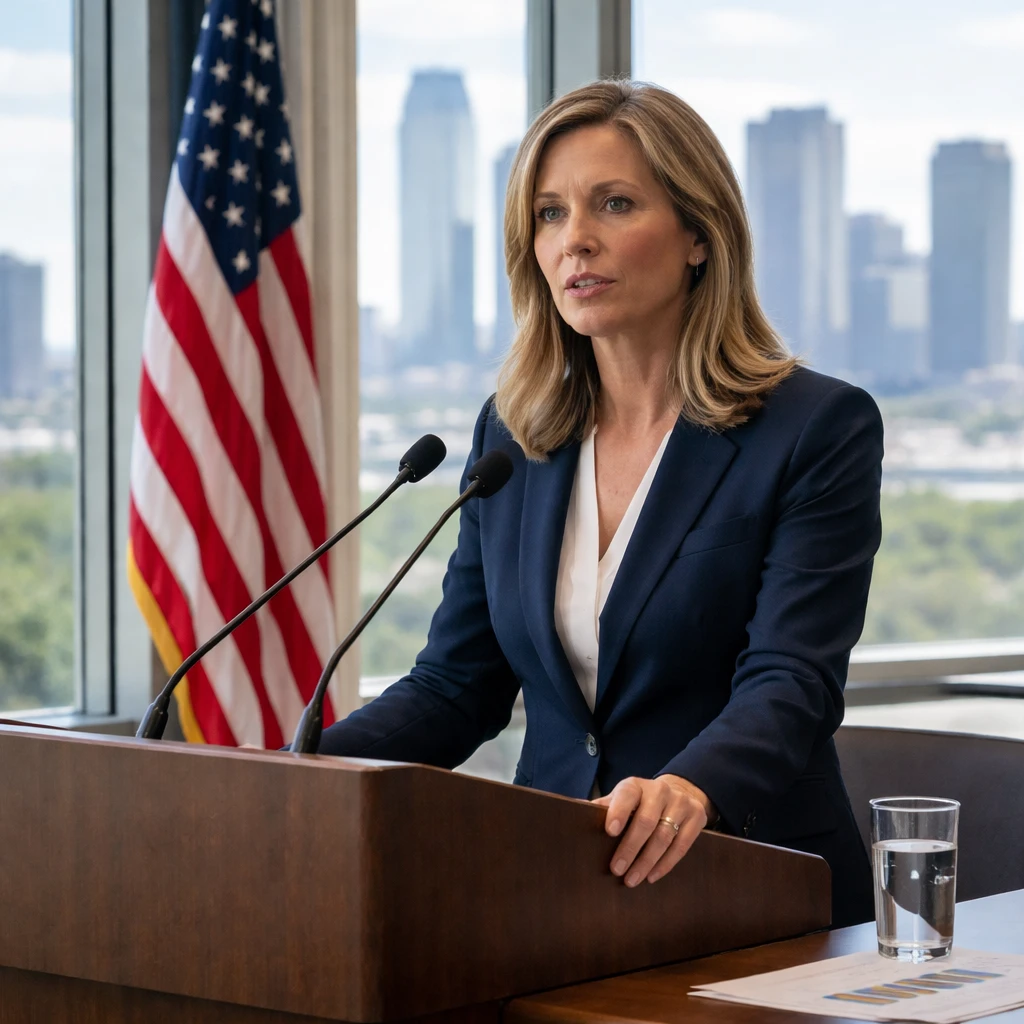
Dallas Federal Reserve President Lorie Logan on Thursday became the first policymaker under Fed Chairman Kevin Warsh to publicly call for an increase in interest rates, a move that could set up a dissent at the Federal Open Market Committee's meeting scheduled for July 28-29. Delivering prepared remarks in Houston, Logan said recent readings do not convince her that inflation will return reliably to the Fed's 2% objective.
"Inflation has been too high, for too long, and does not appear to be on track all the way back to 2%," Logan told attendees. "I currently believe modestly higher interest rates would better balance the outlook and risks for the FOMC's maximum employment and price stability goals."
Logan framed her recommendation as a precaution against upside inflation risks and noted that a growing minority of Fed officials share concerns that holding the policy rate at current levels is no longer appropriate. She said the combination of labor market strength, robust consumption and financial indicators points to a situation where monetary policy is not exerting sufficient restraint.
"The labor, consumption and financial data indicate that monetary policy is not restraining the economy," she said. "If higher inflation becomes entrenched, we'd need sharper rate increases to bring it back to target, with a larger cost for the labor market. Better modest restriction now than severe restriction later."
Logan acknowledged that consumer price inflation softened slightly in June but characterized the trajectory back to 2% as fragile. "It is more a hope than a likelihood," she said, adding that "It is time to finish the job of restoring price stability."
She identified several near-term sources of inflationary pressure. Renewed hostilities in the Middle East could reverse recent relief in fuel prices, she said, and sizable investment in artificial intelligence has the potential to generate broader price pressures. While she conceded that AI and other technologies may "eventually" deliver productivity gains that expand supply and lower prices, Logan stressed that the timing and magnitude of those effects are uncertain. "The demand effects are here already. And when demand outstrips supply, the result is higher prices," she said.
Kevin Warsh became Fed chairman in May. At his first policy meeting in June, officials unanimously supported keeping the policy rate in its current 3.50%-3.75% range, though some participants saw a case for raising rates. Logan's public call for a modest increase distinguishes her within the Fed and could influence deliberations ahead of the late-July meeting.
Summary
Lorie Logan urged a modest rise in short-term interest rates, arguing current policy is not sufficiently restraining demand and that inflation remains on a tenuous path back to 2%. She pointed to risks from geopolitical tensions affecting fuel and from AI-driven demand, while noting productivity gains from technology remain uncertain.
Key points
- Logan is the first Fed policymaker under Chairman Kevin Warsh to publicly advocate a rate increase, potentially creating a dissent at the July 28-29 FOMC meeting.
- She argued that recent labor, consumption and financial data suggest monetary policy is not restraining the economy and that modestly higher rates would better balance risks to employment and price stability.
- Logan highlighted inflation risks from renewed Middle East hostilities and AI-related demand pressures; she acknowledged AI may "eventually" boost supply, but timing and scale are uncertain.
Risks and uncertainties
- Geopolitical risk - Renewed Middle East hostilities could reverse fuel price relief and push inflation higher, affecting energy and transportation sectors.
- Technology-driven demand - Large-scale AI investment may already be producing demand effects that could outpace supply, with implications for technology and broader price dynamics.
- Policy trade-offs - If inflation becomes entrenched, sharper rate hikes later could impose greater costs on the labor market; the path back to 2% was described as "tenuous."