
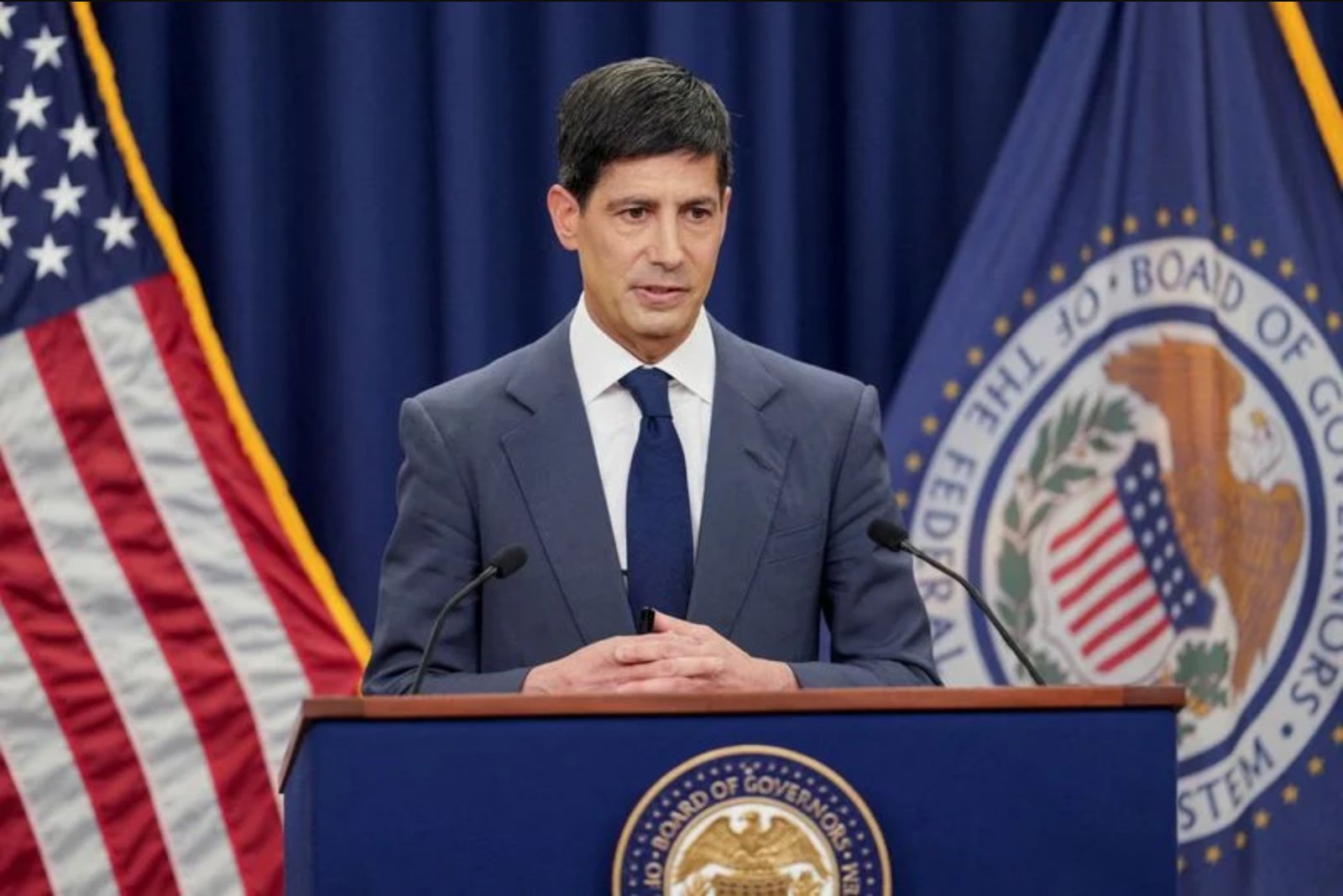
WASHINGTON, June 19 - In his initial policy meeting as Federal Reserve chair, Kevin Warsh set a distinct tone: a compact, inflation-centered approach that harks back to a 1990s-era central bank style. The meeting concluded with rates held steady in the 3.50%-to-3.75% range, where they have been since December, and a concise policy statement that avoided the expansive public coaching that has characterized recent Fed leadership.
The pared-down communications strategy and Warsh's concentrated emphasis on inflation at Wednesday's press conference prompted an immediate market response. Investors interpreted the chair's remarks - particularly the lack of a discussed threshold for future tightening - as a signal that rate hikes were likely, and bond yields moved higher.
That market move was, in the view of some central banking communicators, a direct consequence of the new tone. "The market reaction was massively amplified by the Warsh press conference that combined a hawkish near single-mandate emphasis on the need to deliver price stability with a total absence of any modulating discussion of the Fed’s strategy or reaction function," wrote Krishna Guha, a former communications official at the New York Fed and now vice-chairman and head of economics and central bank strategy at Evercore ISI. He added that "Discussion of the reaction function and strategy...supports more effective central banking."
"The market reaction was massively amplified by the Warsh press conference that combined a hawkish near single-mandate emphasis on the need to deliver price stability with a total absence of any modulating discussion of the Fed’s strategy or reaction function," Krishna Guha wrote.
The Fed's policy statement itself was economical in language and scope, echoing the brevity of statements drafted under then-Chair Alan Greenspan. But unlike the era when central banking leaders kept markets largely outside their deliberative circle, the modern backdrop is one of intense information flow and frequent market attention on policymaker cues. The Fed's "dot plot" released Wednesday - a regular communication tool displaying individual policymakers' rate expectations - laid bare what Warsh did not elaborate upon in public remarks: many policymakers appear to be leaning toward the likelihood of rate increases later this year.
Some observers noted that the new concise wording produced ambiguity in places. For instance, rather than stating plainly that "inflation is elevated," the statement described inflation as elevated "relative to the Committee’s 2% target." That phrasing leaves room for interpretation about whether inflation is viewed as excessive in an absolute sense. Warsh has reaffirmed the 2% target while also suggesting that exact decimal-point precision around that target may not be decisive, hinting at some tolerance for inflation near the goal.
Similarly, the employment passage was framed comparatively: instead of a simple characterization of job gains, the statement said employment had "kept pace with the workforce." The choice of words appears to avoid engaging with the Powell-era framing of a delicate balance, which was complicated in part by changes in labor supply tied to immigration policy. Warsh did not expand on those dynamics during the press session.
On growth, the statement highlighted areas Warsh signaled as central to future strength - productivity and capital investment - while leaving out a fuller enumeration of gross domestic product components such as consumption, net exports and government spending. The Fed also omitted a formal assessment weighing relative risks to its dual mandate, and instead the statement closed with a direct pledge: "The committee will deliver price stability."
"The committee will deliver price stability."
Economists and market participants offered differing readings of the shorter statement and Warsh's public posture. Diane Swonk, chief economist and managing director at KPMG US, said the statement represented a boon to the new chair, characterizing it as "a gift" that aligned the committee's document with Warsh's priorities, including the pronounced focus on inflation. The policy statement was approved by the Federal Open Market Committee in a unanimous vote - the first such unanimity in a year - which reinforced the sense of a cohesive, if minimalist, start to Warsh's tenure.
But questions remain about whether this leaner approach will be viable when markets and economic conditions shift. The Fed has historically adjusted tactics in response to crises when a narrow set of first principles proved insufficient. Warsh announced five task forces intended to recommend reforms for the central bank. Those groups cover communications, the balance sheet, the inflation framework, productivity, and the integration of real-time alternative data into policymaking.
Michael Feroli, chief economist at JPMorgan, cautioned that the task forces might either usher in substantive change or simply reprise earlier debates. He pointed to last year's discussions on communications reform, which despite analysis from former Chair Ben Bernanke and interest from then-Chair Jerome Powell resulted in no decisive shift.
Warsh, who served as a governor under Ben Bernanke and left the Fed in 2011 in part over disagreements with post-crisis bond-buying policies, has signaled an intent to press for reforms. Three of the task forces - on communications, the balance sheet and the inflation framework - directly address areas transformed by the 2007-2009 financial crisis, the subsequent period of weak growth and the expanded role the Fed took on amid political gridlock that left monetary policymakers as the primary active economic authority.
The COVID-19 pandemic further enlarged the Fed's remit, with large-scale interventions and an accompanying public-facing role for then-Chair Jerome Powell. By suggesting that some of that expanded scope could be narrowed, Warsh is challenging established practices and expectations about the Fed's domestic presence.
The two other task forces - on productivity and on the use of high-frequency alternative data sources - address questions many within the Fed already consider pressing. Atlanta Fed research director Paula Tkac observed in mid-May that there is much new data available and substantial processing capability that should yield useful insights. She and other research staff, however, cautioned that novel data series can lose usefulness over time and must be positioned relative to traditional, longer-running measures.
"There’s so much data floating around in the world with so much ability to process it that there’s got to be some things that we can learn," Paula Tkac said.
These debates will shape whether Warsh's pared-back style can coexist with modern markets' expectations for detailed forward guidance. For now, markets have reacted sharply to the combination of Warsh's press remarks and the committee's own projections, underscoring a tension between a slimmer public role for the Fed and the information demands of investors and the broader public.
Implications for markets and policy
- Bond markets have already responded to the chair's emphasis on inflation and the committee dot plot by pricing in a higher probability of future rate increases.
- Communications reform and the use of alternative data could alter how monetary policy is explained and executed, affecting market expectations over time.
- The Fed's prioritization of productivity and capital investment in its statement signals which economic areas the leadership considers central to longer-term growth, but the statement did not address distributional concerns such as potential "K"-shaped outcomes.